
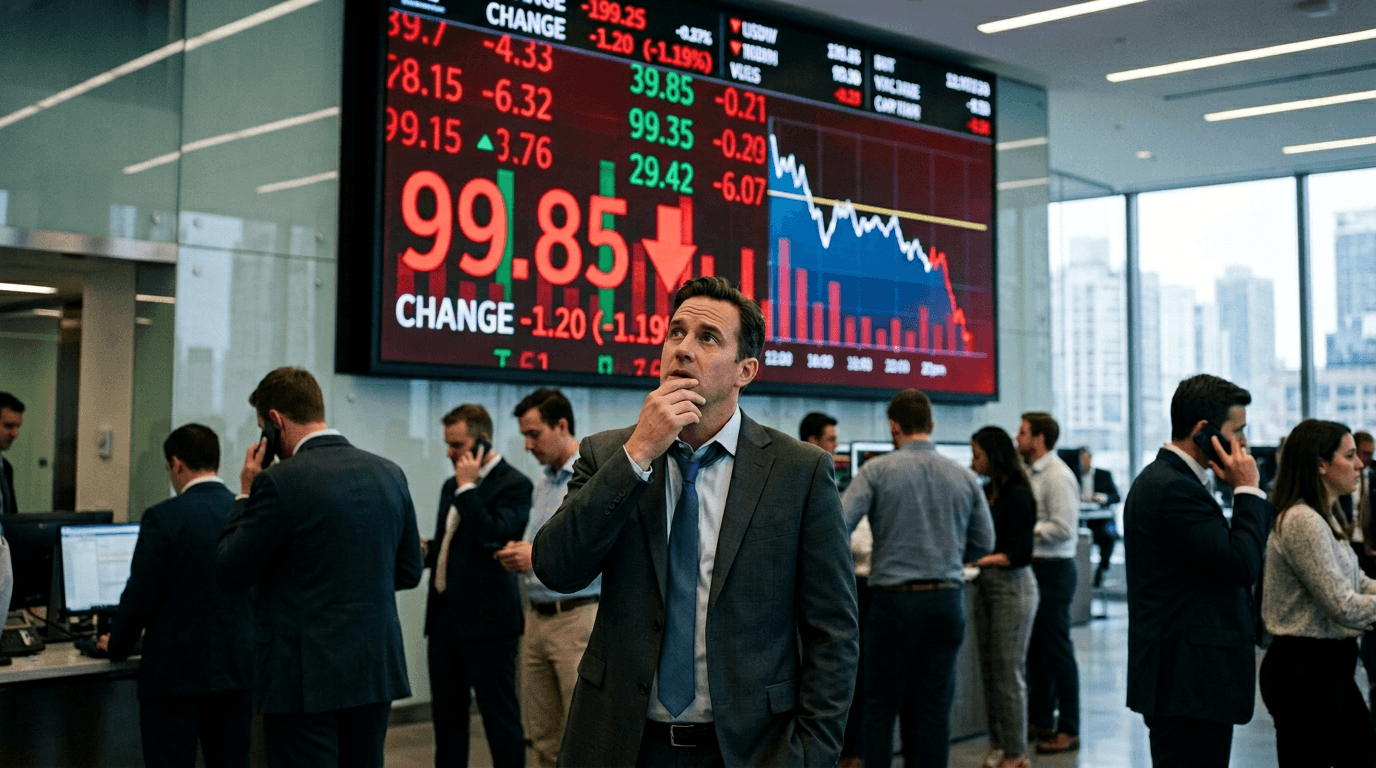
The US Dollar Index Dips Below 100: A Telltale of Economic Turbulence
On March 17, 2026, the US Dollar Index (DXY) fell below the 100 mark, settling at 99.9073. This shift signals a marked change in the currency landscape and amplifies unease about economic stability amid persistent policy ambiguity. President Trump's recent decision to pause certain import tariffs—while maintaining hefty levies on China, Mexico, and Canada—complicates the terrain for traders and policymakers, leaving markets in a state of uncertainty.
A Break Below 100: What It Means
The 100 threshold on the US Dollar Index isn't just a number; it's a critical marker, both technically and psychologically. When breached, it often heralds shifting market sentiment and hints at potential economic fragility. The dollar index, which gauges the US dollar against a basket of six major currencies, had hovered near this level, reflecting market ambivalence. This recent drop underscores vulnerabilities, despite Federal Reserve efforts to stabilize policy, and suggests traders are increasingly wary of underlying weaknesses in dollar strength.
The descent to sub-100 territory, last seen in July 2023, is significant. Back then, the dollar thrived on high interest rates and a safe-haven allure, but those advantages are now waning. The current dip highlights pressures from geopolitical tensions and fiscal policy uncertainties, suggesting the dollar's past gains are under siege.
Trump's Tariff Strategy: A Double-Edged Sword
President Trump's partial tariff pause hints at a possible shift toward moderation, yet the overall scenario remains murky. While the suspension of certain tariffs might temporarily ease global supply chain bottlenecks, substantial tariffs on key partners like China, Mexico, and Canada persist, posing ongoing economic threats. This mixed approach muddles market perceptions, as traders grapple with discerning whether the administration leans toward protectionism or accommodation.
The continuation of these major tariffs stokes recession fears, with economic models predicting significant hits to consumer spending, business investment, and growth. Markets crave clarity and consistency, yet the selective tariff pauses only fuel uncertainty, further weakening the dollar as investors seek more stable or lucrative currency alternatives.
Market Implications and Economic Risks
The dollar index's dip has sweeping implications across asset classes and economic sectors. A softer dollar may boost US exports by enhancing their competitiveness abroad but can also spur inflation by hiking import costs. With inflation a top concern for the Federal Reserve and consumers, a weaker dollar could complicate monetary policy choices. Analysts forecast the DXY to rebound to 100.26 by quarter's end, hinting that this dip might be temporary.
However, broader concerns persist. Middle East geopolitical tensions have spiked oil prices, exacerbating inflation worries. Although recent oil price drops offer some respite, growth uncertainties continue to drag on the dollar. Persistent tariff pressures and fiscal policy questions elevate recession risks, creating a challenging environment for currency valuations.
Key Monitoring Metrics for Traders
In this volatile landscape, traders should closely monitor several key indicators. First, track announcements of further tariff changes, as policy clarity is crucial for currency trajectories. Second, scrutinize economic data releases, especially employment reports and inflation statistics, which influence Federal Reserve actions and dollar strength. Third, keep an eye on Middle East developments and oil prices, as these factors sway risk sentiment and safe-haven demand for the dollar.
The DXY's sub-100 movement also suggests traders should watch support levels around 98-99 and resistance near 101-102. Historical patterns highlight potential volatility, with significant swings possible as policy and economic data interplay. Understanding these technical levels aids traders in positioning themselves strategically as the situation unfolds.
Conclusion and Future Prospects
The US Dollar Index's breach of the 100 mark is a noteworthy development, driven by intertwined policy uncertainties, geopolitical anxieties, and evolving economic expectations. While Trump's selective tariff pause offers a glimmer of hope for moderation, the maintenance of major tariffs on key trading partners keeps risks high. Traders must stay alert, focusing on policy shifts, economic data, and geopolitical events that could steer the dollar's course in the coming months.
---
NEWSIMPACTSCORE: 6