
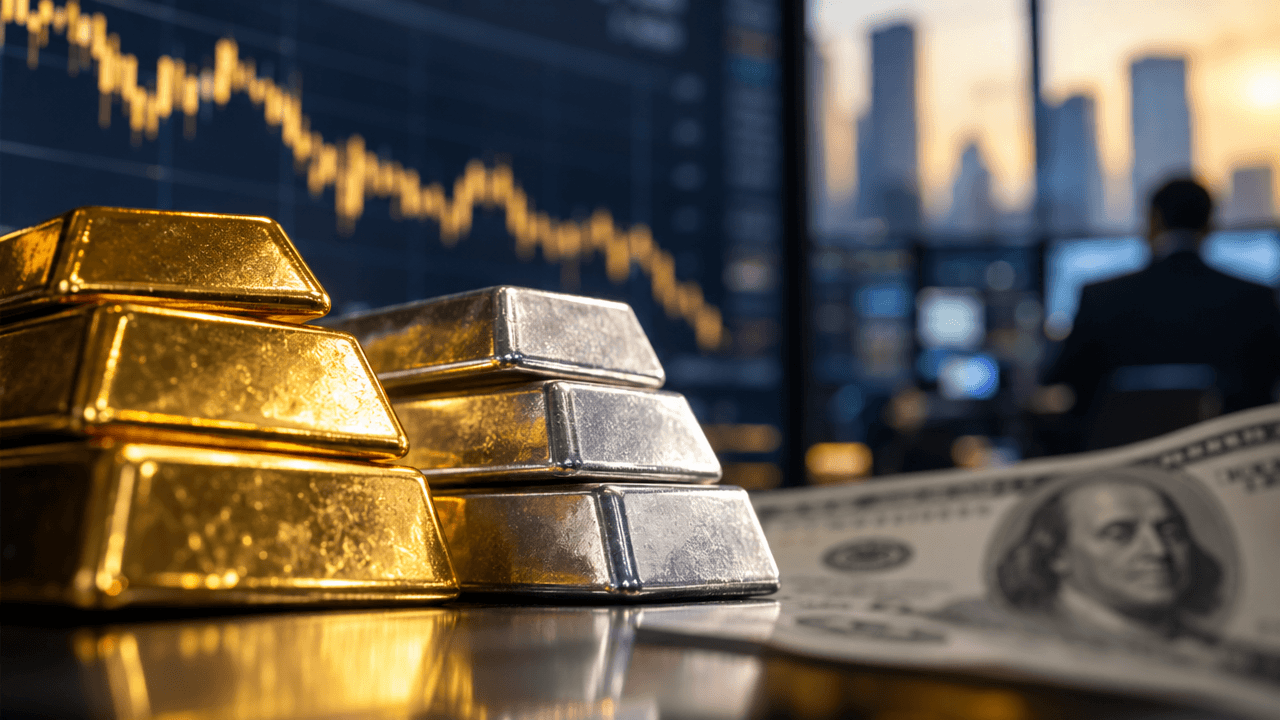
Gold and silver staged a sharp rebound on Thursday as investors reacted to a turbulent mix of geopolitical concerns, falling Treasury yields, a softer U.S. dollar, and a technology-led equity selloff. Spot gold climbed about 1.3% to approximately $4,157.85 per ounce, while U.S. gold futures gained roughly 1.7%. Silver also recovered, rising by more than 2% in early trading as market participants sought protection from uncertainty. [10][2]
The move highlights an important feature of precious metals: they can respond quickly when confidence in risk assets weakens. However, the rebound does not necessarily signal a new long-term trend. Instead, it reflects a market reassessing interest rates, inflation, economic growth, and the durability of the technology-sector rally.
Why Gold And Silver Rebounded
The immediate catalyst was a reversal in Treasury markets. Bond yields had risen sharply after hotter-than-expected inflation data increased speculation that the Federal Reserve could keep interest rates elevated or even consider another increase. Higher yields usually create pressure for gold and silver because these metals do not pay interest.
On Thursday, however, Treasury yields moved lower as investors reduced exposure to stocks and shifted toward government bonds and other defensive assets. The U.S. dollar also weakened, making dollar-priced metals more attractive to international buyers. Falling yields and a softer dollar helped offset the pressure created by persistent inflation concerns. [1][5]
A technology-led equity selloff added another layer of support. Concerns about the sustainability of artificial intelligence valuations encouraged traders to reduce risk across growth stocks. When market participants become less comfortable holding volatile equities, demand often increases for assets viewed as stores of value or portfolio diversifiers.
Gold benefited most clearly from this defensive rotation. Silver also advanced, although its performance can be more uneven because it combines monetary and industrial characteristics.
Gold As A Market Hedge
Gold is often described as a safe-haven asset, but that label requires context. Gold does not rise during every stock-market decline, and it can fall when traders sell profitable positions to raise cash. Its performance is heavily influenced by real interest rates, currency movements, central-bank demand, geopolitical developments, and investor positioning.
Thursday’s rebound shows how quickly these influences can change. A market that had focused on inflation and higher rates shifted toward concerns about equities, economic instability, and capital preservation. The result was renewed demand for bullion.
For traders, the lesson is not that gold always rises during volatility. The more useful takeaway is that gold tends to respond to the type of volatility taking place. A selloff driven by rising real yields may hurt gold, while a selloff driven by recession fears, financial stress, or geopolitical risk may support it.
The recovery also followed a difficult session, making short-term positioning especially important. One market report noted that gold had fallen to its lowest level in several weeks before recovering toward $4,150, while technical analysts continued to describe the outlook as fragile. [4]
SILVER’S DOUBLE ROLE
Silver’s rebound deserves separate attention because the metal is influenced by both investment demand and industrial consumption. Silver is widely used in electronics, electrical equipment, solar technology, and other manufacturing applications. This creates additional upside potential when industrial activity is strong, but it can also increase downside risk when traders fear slower economic growth.
That dual role explains why silver frequently moves more aggressively than gold. During Thursday’s session, silver gained more than 2% after suffering a much sharper decline the previous day. A report from the market attributed part of the recovery to the weaker dollar and renewed demand for precious metals, while also noting that uncertainty over industrial demand remained a limitation. [6]
Traders should therefore avoid treating silver as simply a cheaper version of gold. Gold is generally more closely tied to monetary and defensive demand. Silver is more sensitive to manufacturing expectations, commodity sentiment, and speculative positioning.
What This Means For Simfi Traders
The latest rebound provides a useful scenario for simulated finance traders. Rather than reacting to a single price candle, traders can build a structured process around the factors driving the move.
First, monitor the relationship between metals and Treasury yields. If yields continue falling while the dollar weakens, the environment may remain supportive for gold. If yields and the dollar reverse higher, precious metals could face renewed pressure.
Second, distinguish between a rebound and a trend change. Gold’s advance toward the $4,150 area recovered much of the previous session’s decline, but that does not confirm that buyers have regained complete control. One market outlook identified the $4,200 to $4,219 zone as an important area for confirming a stronger recovery, while renewed strength in yields could send gold back toward $4,100. [12]
Third, manage volatility rather than trying to predict every move. Silver’s sharp decline and subsequent rebound demonstrate how quickly leverage can amplify both gains and losses. SimFi traders can use smaller position sizes, predefined stop levels, and risk limits to test strategies without allowing one trade to dominate an account.
Finally, follow the calendar. Inflation data, retail sales, central-bank communication, employment reports, and major developments in technology stocks can all influence metals through interest-rate expectations and risk sentiment.
The Bigger Picture
Gold and silver’s rebound is a reminder that markets are driven by changing expectations, not isolated headlines. Inflation can push yields higher and pressure metals one day, while a stock-market selloff can reverse that pressure the next. For investors and simulated traders alike, flexibility is more valuable than loyalty to a single market narrative.
The most practical approach is to combine fundamental signals with price action. Watch the dollar, Treasury yields, equity-market breadth, and geopolitical risk, then consider how those forces interact. Precious metals may continue to attract defensive demand, but the path is unlikely to be smooth.
For SimFi traders, the objective is not simply to guess whether gold or silver will rise tomorrow. It is to understand why prices are moving, define the risks before entering, and build a repeatable decision-making process. In a volatile market, disciplined execution can matter more than a perfectly timed prediction.