
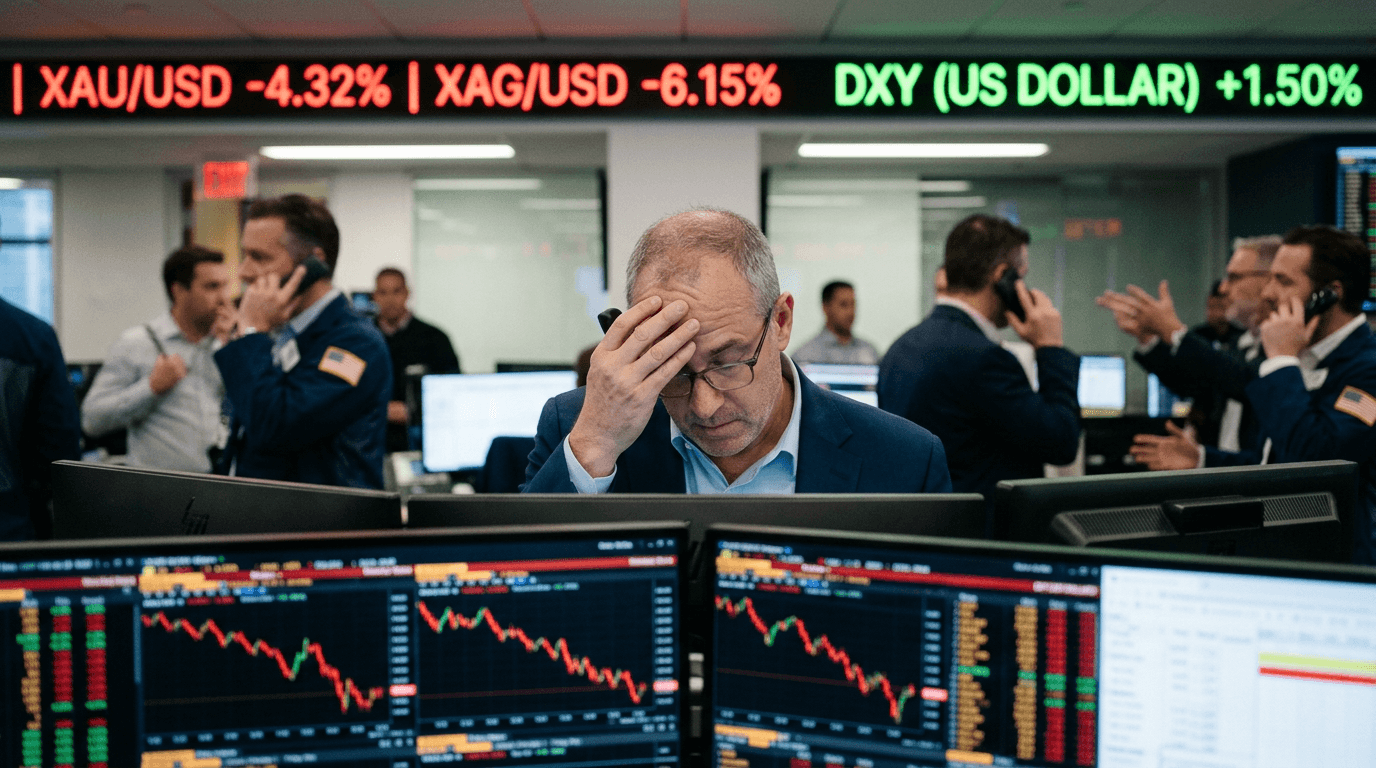
Gold and silver came under heavy pressure in the latest Asia and Europe sessions as a surging US dollar and rising Treasury yields triggered aggressive selling across precious metals. What began as orderly profit-taking quickly accelerated into a broad commodity squeeze, with bullion markets seeing outsized intraday moves, widening bid-ask spreads, and forced liquidation of leveraged positions. The result was a fast, disorderly reset in positioning that caught many short-term traders wrong-footed.
What Happened In Asia And Europe
The selling pressure built steadily through Asian hours as the dollar pushed higher against major and emerging-market currencies, extending gains from the prior US session. Gold futures slipped below recent support zones, drawing in technical sellers and triggering stops layered just underneath. Silver, typically more volatile than gold, followed with exaggerated moves, underperforming on a percentage basis.
By the time European markets opened, the combination of overnight dollar strength and higher US yields had already weakened sentiment in metals. Liquidity improved as more participants came online, but so did selling volume. Market depth thinned on the bid side, amplifying each wave of orders. Intraday charts showed sharp, stair-step declines with only brief, shallow bounces—classic signs of momentum-driven and forced selling rather than orderly rotation.
Why A Stronger Dollar Hits Precious Metals
The core macro driver behind the move was the dollar. Most globally traded commodities, including gold and silver, are priced in US dollars. When the dollar appreciates, those commodities become more expensive for buyers using other currencies, effectively tightening financial conditions for non-US participants.
For gold and silver, this dollar effect is particularly important because a large share of demand comes from outside the US—jewelry and investment demand in Asia, central banks in emerging markets, and industrial users globally. A stronger dollar often leads some of these buyers to step back or hedge, reducing physical and paper demand at the margin.
There is also a portfolio channel. Many macro funds and systematic strategies trade gold as part of a broader “dollar versus hard assets” theme. When the dollar trends higher, models that track momentum, carry, and relative value often rotate out of precious metals and into dollar-denominated assets, adding mechanical selling on top of discretionary flows.
Role Of Yields, Leverage And Margin Calls
Dollar strength rarely comes alone—it is often accompanied by rising US yields, and that pattern held this time. As Treasury yields moved higher, the opportunity cost of holding non-yielding assets like gold increased. In valuation models, higher real yields (yields adjusted for inflation) are especially negative for gold because they raise the “discount rate” applied to future cash flows and store-of-value benefits.
In futures markets, leverage magnified the damage. Many participants use margin to control large gold and silver positions with a relatively small amount of capital. When prices drop quickly, account equity can fall below required maintenance margins, forcing brokers to issue margin calls. If traders cannot or do not top up collateral, the broker closes positions—often at market—regardless of the trader’s original thesis.
This forced selling creates a feedback loop
1) Prices fall as the dollar and yields rise. 2) Margin levels are breached, triggering liquidations. 3) Forced selling pushes prices lower still, tripping additional stops and margin calls.
Silver, with its thinner liquidity and more speculative positioning, is especially vulnerable to this kind of cascade. Even fundamentally sound positions can be closed purely for risk-control reasons, not because the long-term outlook for metals has changed.
Cross-asset Ripple Effects
The moves in gold and silver did not occur in isolation. Commodity-linked currencies such as the Australian dollar, Canadian dollar, and some emerging-market FX pairs faced added pressure as metals sold off. These economies are often partially tied to resource exports, so a synchronized drop in metals prices can weaken their terms of trade and investor sentiment simultaneously.
Equity markets also felt the impact. Gold miners and diversified resource producers typically trade with leverage to underlying metal prices; as bullion fell, these shares suffered outsized declines. Volatility indicators in commodity-related sectors ticked higher, and intraday correlation between metals, miners, and commodity FX rose—a hallmark of stress events where macro forces dominate stock-specific stories.
For global macro traders, this kind of environment can quickly morph into a broader risk episode. A stronger dollar, rising yields, weaker commodities, and pressure on emerging markets often travel together. While the latest move in metals may be mostly positioning-driven, it still sends an important signal about tightening global financial conditions.
Playbook For Traders And Investors
For short-term traders, this episode underscores the importance of monitoring the macro “triad” that drives precious metals: the dollar, real yields, and volatility. A sustained move higher in the dollar and real yields, especially when metals positioning is crowded on the long side, is a clear warning flag that downside risk is growing.
Risk management is critical in these conditions. Keeping position sizes moderate relative to account equity, using hard stops, and avoiding excessive leverage can prevent a sharp intraday move from turning into a portfolio-threatening event. Traders using simulated or evaluation environments can treat this type of session as a live-fire exercise: test how robust your strategy is when markets gap, spreads widen, and correlations spike.
Longer-term investors should distinguish between price action driven by macro shifts versus structural changes in the gold and silver narrative. A stronger dollar and higher yields can pressure metals for weeks or months, but they do not automatically invalidate themes like central-bank gold buying, diversification away from fiat currencies, or industrial demand for silver in technology and green-energy applications. Volatile downdrafts can, for some, present opportunities to scale in with predefined risk parameters.
Conclusion: Volatility Is A Feature, Not A Bug
The latest plunge in gold and silver during the Asia and Europe sessions is a textbook example of how quickly macro forces can reprice crowded trades. Dollar strength and rising US yields acted as the spark, while leverage and margin mechanics turned a normal correction into an outsized intraday move.
For market participants, the key takeaway is not that precious metals are “broken,” but that they are deeply intertwined with global currency and rate dynamics. Understanding those linkages—and planning for how your positions will behave when they shift—is essential. In a world where narrative can change as fast as the dollar index, treating volatility as a constant and risk management as a core edge is no longer optional; it is the foundation of durable trading performance.