
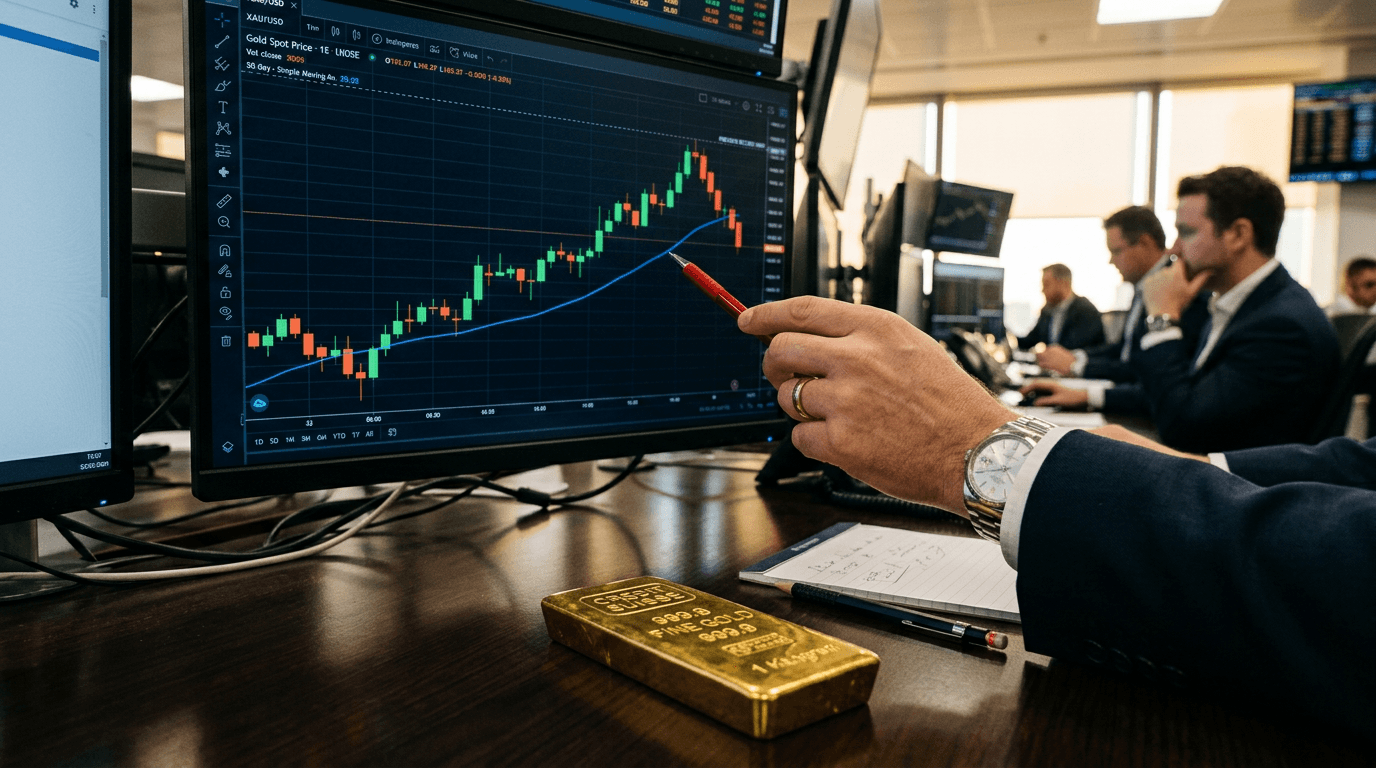
Gold's Dance Above the 50-Day SMA: A Tale of Momentum and Resistance
Gold has maintained its position above the pivotal 50-day simple moving average (SMA) in recent weeks, a testament to enduring investor demand and the allure of safe-haven investments amid geopolitical tensions. However, following its ascent toward record peaks near $5,589 in late January, the precious metal has retreated, now trading within a consolidation pattern that underscores the market's competing forces. As we move into mid-March 2026, gold faces a crucial test of support levels, offering traders and investors key insights into the potential direction of the bull market in the coming months.
The Technical Significance of the 50 SMA Breakthrough
The 50-day SMA has emerged as a crucial technical benchmark for gold traders keeping an eye on XAU/USD performance. With the 50-day SMA hovering between $4,814 and $4,900, depending on the trading date, gold's ability to sustain levels above this threshold signals ongoing bullish momentum. Yet, the recent pullback from highs of about $5,594 illustrates that surpassing a key moving average is merely one part of the equation. The metal encounters significant resistance in the $5,400 to $5,600 range, where profit-taking and investor repositioning have naturally induced selling pressure. Technical analysts highlight that gold remains within a developing uptrend, with its 20-day, 50-day, 100-day, and 200-day moving averages aligned in a bullish formation. This suggests that any pullbacks should be viewed as opportunities rather than indications of a trend reversal.
Unpacking the Drivers of Recent Volatility
Gold's impressive rise from approximately $2,100 in March 2024 to over $5,200 by mid-2026 reflects fundamental shifts in investor sentiment and macroeconomic conditions. Expectations of Federal Reserve rate cuts have reduced the opportunity cost of holding non-yielding assets like gold, increasing its appeal to portfolio managers. Concurrently, tensions in the Middle East have sustained safe-haven demand, with investors shifting capital into defensive positions amid broader market uncertainty. A weakening US dollar has further bolstered gold prices, as a softer greenback renders the metal more affordable for international buyers using other currencies. Central banks, especially in emerging markets, continue to purchase gold robustly, providing structural support beneath the market. These interconnected drivers explain why gold has garnered such broad-based demand despite significant price appreciation over the past 18 months.
Analyst Perspectives and the 2026 Outlook
As 2026 progresses, major financial institutions have significantly revised their gold price forecasts upward. Goldman Sachs has increased its year-end target to $5,400 per ounce, citing robust ETF inflows and structural demand from global investors. JPMorgan's commodities team anticipates even greater upside, predicting that gold could reach approximately $6,300 per ounce by year-end, buoyed by continued central bank demand and expectations of further dollar weakening. UBS has adjusted its outlook to around $6,200 for parts of 2026, while ING Think projects a full-year average near $5,190, with prices potentially climbing to $5,450 by the fourth quarter. Independent market forecasts suggest a trading range between $5,078 and $6,234 during March 2026, although broader scenarios range from below $4,500 to above $6,000. These diverse viewpoints reflect genuine uncertainty about the pace of Federal Reserve policy shifts, the trajectory of real yields, and the durability of geopolitical risk premiums.
Short-Term Corrections as Buying Opportunities
Recent price movements highlight the volatility inherent in rapidly appreciating commodities. Earlier in March, gold experienced a roughly four percent correction as investors liquidated positions to cover losses in other areas—a common dynamic during market turbulence. However, most professional analysts characterize these pullbacks as normal profit-taking within an established bull market, rather than signs of a trend reversal. Support levels near $4,987 and the 100-day moving average around $4,477 serve as technical anchors where buying interest has historically emerged. The fact that gold has consistently rebounded from these zones suggests that long-term investors view dips as accumulation opportunities rather than signals to exit.
Key Levels to Watch Ahead
For traders observing XAU/USD into late March and beyond, several price points warrant close attention. Resistance near $5,145 and $5,405 will determine whether gold can mount a renewed push toward the $5,600 zone, where previous highs are concentrated. A sustained break above $5,572 could bring the $5,866 area into focus as the next logical target. On the downside, failure to hold $5,000 could expose support near $4,845, with an ultimate breach below $4,925 potentially indicating a more pronounced correction. Understanding these technical reference points helps traders develop realistic expectations for entry and exit strategies in the months ahead.
Practical Implications for Investors and Traders
The current environment presents distinct opportunities and risks for market participants. Long-term investors may view pullbacks toward the 50-day moving average as strategic accumulation points, given the backdrop of policy easing and geopolitical risk. Swing traders can capitalize on oscillations between support and resistance levels, using moving averages and pivot points to define risk parameters. Portfolio managers seeking defensive positioning continue to find gold attractive, given its low correlation with equities and its historical role as a wealth preserver during periods of uncertainty. The key takeaway from recent price action is that gold remains in an established uptrend, with temporary retreats offering tactical entry points rather than signals to abandon bullish conviction.
Conclusion: Gold Breaks Above 50 SMA but Retreats from Record Highs
In recent months, XAU/USD has surged past $5,000 to new heights, influenced by Federal Reserve rate cut comments, profit-taking, and safe-haven demand amid Middle East tensions. As the market navigates these dynamics, gold continues to offer valuable insights and opportunities for both traders and investors.