
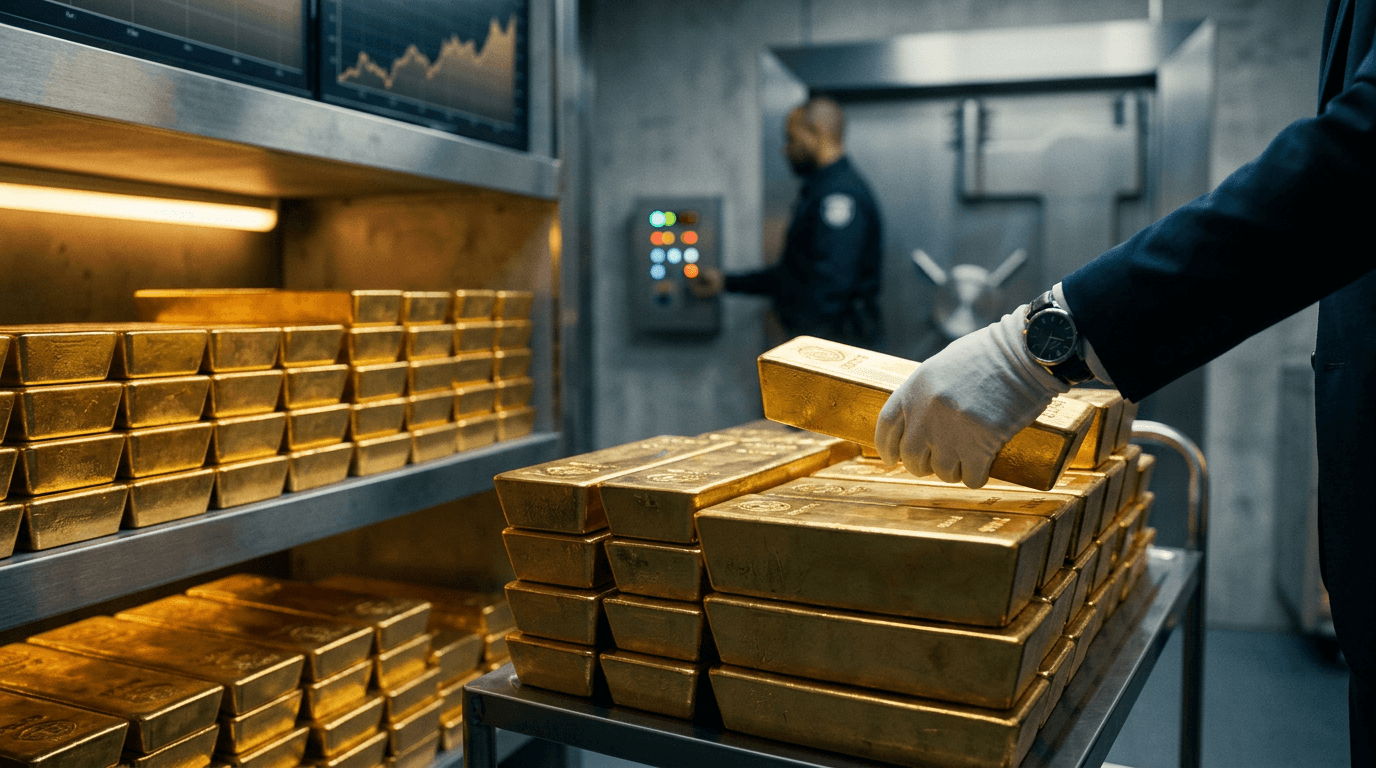
Gold has reclaimed its footing at the psychologically significant $5,000 per ounce level, a milestone that marks both a technical and emotional turning point for precious metals investors. After experiencing early-week volatility, the yellow metal found solid support at this key price floor, coinciding with technical analysis suggesting a 50% Fibonacci retracement. This convergence of technical strength and fundamental demand drivers suggests gold's bull market momentum remains intact, despite occasional pullbacks that test investor conviction.
The journey to $5,000 represents more than just a price milestone. Gold has gained nearly 18% year-to-date in 2026 alone, building on an extraordinary 64% surge throughout 2025 that saw the precious metal breach both the $3,000 and $4,000 thresholds for the first time in history.[1] For traders and investors, the ability of gold to hold support at $5,000 during a period of volatility signals that underlying demand remains robust. When an asset declines sharply but recovers quickly around a round-number support level, it often indicates that institutional buyers are ready to defend that price, preventing further downside and setting up potential for renewed rallies.
WHY THE $5,000 LEVEL MATTERS FOR GOLD
The $5,000 mark carries significance beyond its numerical appeal. Round-number levels like this often attract institutional buying interest, as they serve as reference points for portfolio allocations and risk management strategies. When gold dipped early this week, the $5,000 floor appears to have acted as a magnet for buyers who view any pullback toward these levels as a buying opportunity rather than a sign of weakness.
Technical analysis adds another layer of credibility to gold's current support level. The 50% Fibonacci retracement mentioned in relation to recent price action represents a mathematically-derived level where traders expect reversals to occur. When multiple technical and psychological factors align at the same price point, the probability of that level holding becomes substantially higher. This clustering of support indicators suggests that investors should monitor whether gold can maintain its position above $5,000, as a decisive break below this level could signal a more significant technical breakdown.
The psychological element cannot be ignored. For many investors and traders, the $5,000 per ounce level represents a validation that gold's bull market is genuine and not merely speculative. This psychological confidence, combined with the technical factors, creates a feedback loop where holding above $5,000 attracts more buyers and reinforces the case for higher prices.
Geopolitical Tensions Fuel Safe-haven Demand
The primary catalyst propelling gold higher remains the escalating geopolitical uncertainty gripping global markets. Gold's role as a safe-haven asset has never been more relevant, with investors seeking protection against multiple sources of macro risk. In January 2026, President Trump's threat of a 100% tariff on Canada if it proceeded with trade deals with China rattled markets, sending investors scrambling for assets perceived as immune to policy errors and trade wars.[1] This type of headline-driven geopolitical shock is precisely the environment where gold excels.
Whenever policymakers inject uncertainty into markets through tariff threats, trade tensions, or military posturing, institutional investors and individual portfolios alike rotate toward defensive assets. Gold, with no counterparty risk and no dependency on any government's fiscal health, becomes the ultimate insurance policy. The fact that gold has found support during volatile market conditions demonstrates that this safe-haven premium remains embedded in the price.
Middle East tensions mentioned in the article context provide another layer of geopolitical risk that keeps investors watching gold prices. Historical periods of elevated geopolitical risk have consistently supported higher gold valuations, as investors prefer owning an asset with no correlation to problematic geopolitical outcomes.
Institutional Buying Provides Structural Support
What distinguishes the current gold rally from previous bubbles is the fundamental support provided by institutional investors and central banks. December 2025 marked the seventh consecutive month of positive global gold ETF flows, with North American funds leading the way.[1] This sustained institutional accumulation suggests the rally has structural support rather than being purely driven by retail speculation or short-term momentum traders.
Central banks worldwide have become voracious gold buyers. The World Gold Council reports that central bank buying remained elevated at 220 tonnes in Q3 2025, representing a 28% increase from the prior quarter.[1] China's central bank has extended its buying streak to 14 consecutive months through 2025, accumulating over 2,303 tonnes of gold reserves, while other notable buyers including Kazakhstan, Brazil, Turkey, and Guatemala continue adding to their reserves.[1]
This institutional demand creates a structural floor under gold prices. When major central banks and investment managers are continuously accumulating gold, it reduces the available supply and supports prices during periods of weakness. Morgan Stanley analysts have noted that strong ETF demand is absorbing limited inventories after several years of deficits, highlighting the supply-demand imbalance supporting prices.[1]
Expert Forecasts Point To Further Upside
With gold already commanding $5,000 per ounce, analyst forecasts for 2026 suggest substantial further upside potential. Societe Generale anticipates gold reaching $6,000 per ounce by year-end, with commentary suggesting this may be a conservative estimate.[1] Morgan Stanley has highlighted a bull-case target of $5,700, indicating that even seasoned analysts believe significant gains remain from current levels.[1]
These forecasts should encourage traders to view dips toward the $5,000 support level as accumulation opportunities rather than warning signals.
Key Takeaways For Gold Traders
First, the $5,000 support level appears technically and institutionally sound, offering a reasonable entry point for traders building positions. Second, geopolitical uncertainty will likely continue supporting gold prices, making this an environment where the safe-haven asset should outperform. Third, the structural support from central bank and ETF buying provides a floor that previous bull markets lacked. Finally, with expert forecasts pointing toward $5,400 to $6,000 by year-end, the risk-reward profile favors buyers willing to hold through volatility.