
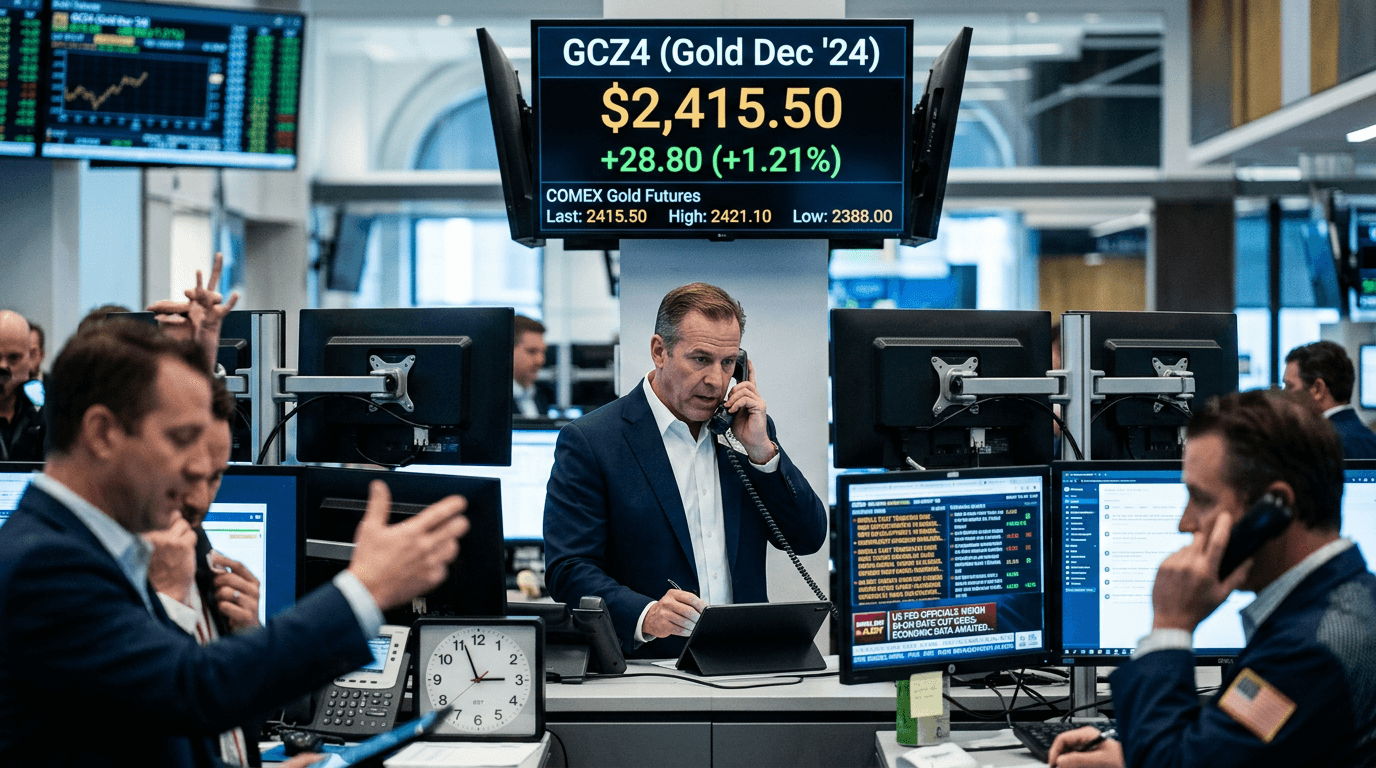
Gold futures are back on the front foot as safe-haven demand returns, with traders using the metal to hedge a fresh mix of geopolitical and policy risks. The rebound has erased a chunk of the recent pullback and stands out all the more because it is occurring alongside a softer US dollar and lingering uncertainty over the Federal Reserve’s next moves. That combination is drawing renewed interest from traders looking to balance portfolios against both sudden geopolitical shocks and downside surprises in upcoming US data.[1][6]
WHAT IS DRIVING THE LATEST GOLD REBOUND?
The immediate catalyst has been a new wave of risk aversion tied to tensions in the Middle East and broader concerns about global stability. Periods of elevated geopolitical stress typically push investors out of risk assets and into liquid havens such as gold, US Treasuries, the Japanese yen, and the Swiss franc.[1][6] When headlines turn more hostile, gold’s lack of default risk and its long history as a store of value become key attractions.
At the same time, markets are grappling with an uneven macro backdrop. Traders are unsure whether the Fed is closer to another rate hike, a pause, or a faster pivot to cuts if growth data softens. That uncertainty increases the appeal of assets that are less directly tied to corporate earnings or a single economic scenario.[6] A softer dollar during this rebound reinforces the idea that some investors are using gold not just as a hedge against war risk, but also as protection against weaker US data or a policy misstep that could hit confidence.
The key nuance is that this is not a classic “everything is collapsing” panic bid. Real yields remain relatively firm, and risk sentiment outside specific stress pockets is not uniformly negative.[1][7] Instead, traders are selectively adding gold exposure as a portfolio insurance layer while still participating in other markets.
Safe-haven Demand In A Changing Risk Landscape
Gold’s safe-haven status is not new, but the drivers behind today’s flows are more complex than a simple fear trade. Rising geopolitical tensions intersect with concerns about energy prices, trade routes, and supply chains, all of which feed into inflation and growth expectations.[1][4] When these variables become harder to forecast, gold’s role as a hedge against macro uncertainty becomes more prominent.
However, safe-haven demand now has to compete with higher yields and alternative defensive assets. Rising or stable real yields typically pressure gold by raising the opportunity cost of holding a non-yielding asset.[6][7] That is why recent pullbacks in gold have often been linked to moves in rates markets, with spikes in yields overshadowing haven flows.[7]
The current rebound suggests that, at least for now, geopolitical and policy risks are strong enough to offset some of those headwinds.[1] But that balance can shift quickly. If real yields push decisively higher again, they can cap upside or trigger another wave of profit taking, especially after a strong multi‑month run.
How Policy Uncertainty Feeds Into Gold Futures
Beyond immediate headlines, gold futures are a barometer of how traders perceive the path of central bank policy. Gold tends to perform best when two forces align: uncertainty rises and real yields fall, often because markets anticipate easier policy or a negative shock to growth.[6] When traders believe the Fed may have to cut rates sooner or deeper than previously expected, gold often catches a bid.
Currently, the policy outlook is blurred by mixed data and conflicting narratives. Strong labor or inflation prints can revive expectations of “higher for longer,” weighing on gold. Softer data, on the other hand, raises the odds of a pivot, especially if accompanied by market stress. That is one reason gold can rally even when the dollar is weak: investors are hedging the risk that the Fed may be forced into a more dovish stance by a growth scare, policy mistake, or financial accident.[6]
For futures traders, this means gold is sitting at the intersection of three critical forces: real yields, the dollar, and global risk sentiment.[1] A move in any one of these can quickly change the tone of the market.
KEY LESSONS FOR TRADERS IN TODAY’S GOLD MARKET
For discretionary traders, the message is clear: you cannot trade gold in isolation. Watching only the gold chart without tracking yields, FX, and broader risk appetite is a recipe for confusion. Monitoring real yields rather than just nominal rates provides a cleaner read on the underlying macro pressure on gold.[6] Sharp drops in real yields tend to support more durable rallies; sudden spikes often precede or accompany pullbacks.
The relationship between gold, the dollar, and risk assets also offers useful clues. When gold rallies while the dollar softens and equities struggle, it usually reinforces a classic safe-haven narrative.[1] When gold rises alongside a firm dollar and strong risk assets, the story might be more about structural demand (such as central bank buying) or an anticipated shift toward easier policy rather than pure fear.
Technical levels still matter. After a strong run to record or near-record highs, gold has shown range-bound behavior, with rallies meeting selling near previous peaks and dips attracting buyers above key support zones.[1][7] That type of price action often favors mean-reversion and range-trading strategies in futures, while longer-term participants may prefer to wait for a clean break beyond established ranges before adding risk.
Risk Management And Simulated Trading Takeaways
Geopolitical and policy-driven moves in gold can be both fast and violent. Headlines around conflict escalation or surprise central bank commentary regularly trigger sharp intraday swings in futures, FX, and rates.[1] Position sizing and risk management therefore become as important as direction.
Practical steps traders can consider include using smaller sizes around key event risks, setting wider but clearly defined stops based on volatility, and planning for multiple scenarios—escalation, de‑escalation, or prolonged stalemate. That type of preparation helps ensure that a single unexpected headline does not derail an entire trading plan.
For traders operating in a simulated finance (SimFi) environment, this is an ideal backdrop to test playbooks. You can experiment with strategies that:
– Link gold entries and exits to changes in real yields or the dollar index – Use spreads between gold and equity indices as a risk-sentiment gauge – Incorporate options structures to express views on volatility around key events
Because no real capital is at risk, you can stress-test how your approach handles sudden spikes, gaps, and whipsaw moves that are characteristic of headline-driven gold markets.
Conclusion
The latest rebound in gold futures underscores that safe-haven demand is alive and well, but also more nuanced than simply “buy gold when things look scary.” In a world of persistent geopolitical tensions and uncertain central bank paths, gold is increasingly being used as a hedge against multiple overlapping risks—from regional conflicts to policy mistakes and unexpected data shocks.
For traders, the opportunity lies in treating gold not as a one-dimensional fear trade, but as a macro asset that responds to a shifting mix of yields, currencies, and risk sentiment. Those who integrate these drivers into a disciplined, well‑risk‑managed framework—whether in live markets or a simulated setting—will be better positioned to navigate the next wave of volatility in the gold complex.