
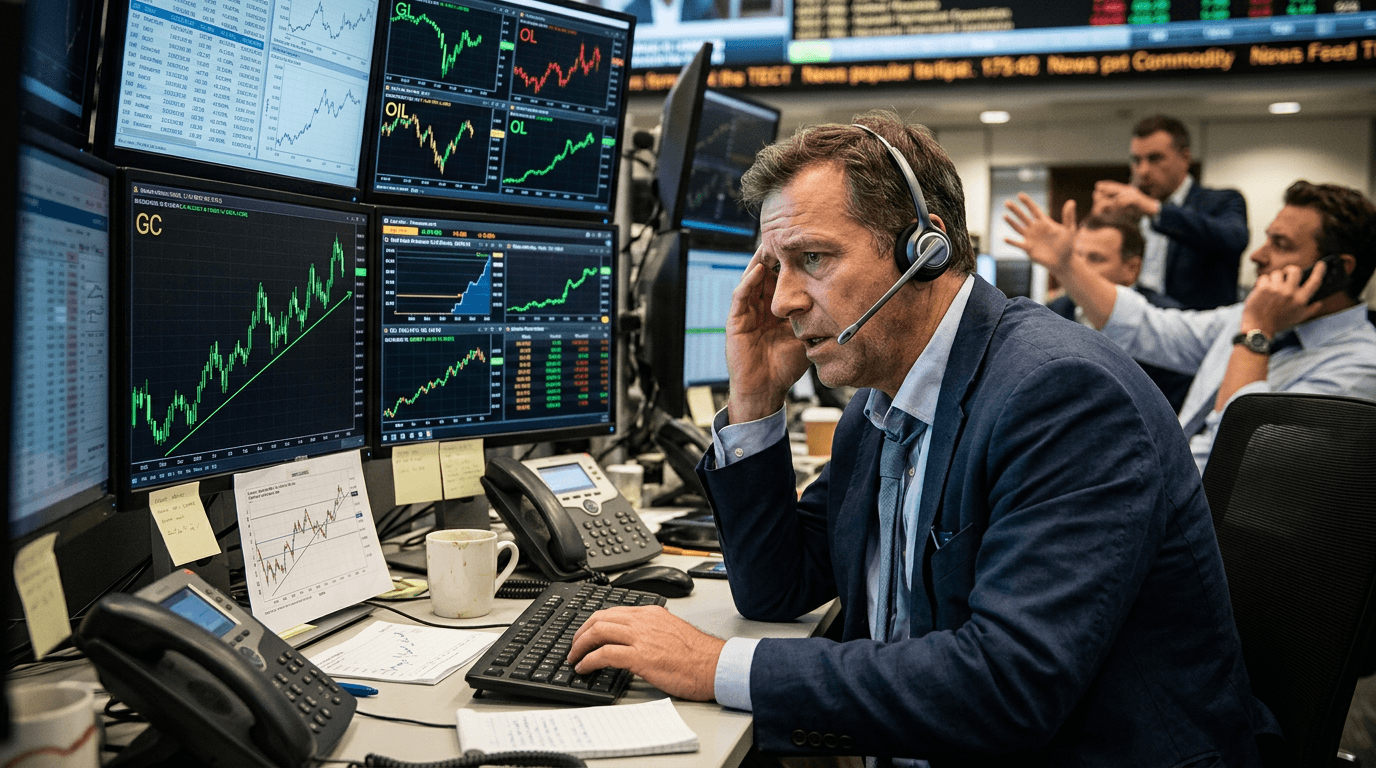
Gold and oil are once again reminding traders that geopolitics can trump almost everything else in markets. As conflict involving the U.S., Israel and Iran intensifies, gold has rebounded from recent dips to trade above $5,350 per ounce, extending a powerful 2026 rally of roughly 22–23% on renewed safe-haven demand.[2][3] At the same time, crude oil has spiked as much as 9% to multi‑month highs, as traders rapidly price in the risk of supply disruptions and inflationary pressure across the global economy.
Safe-haven Flows Into Gold
Gold’s latest move is a textbook example of how capital rotates when geopolitical risk suddenly escalates. Following U.S. and Israeli military strikes against Iran, precious metals rallied sharply as investors sought defensive assets that are insulated from political shocks and currency risk.[2][6][7] Spot gold surged through the $5,350 level during the session, trading about 2% higher near $5,384 per ounce and reinforcing its role as a barometer of market anxiety.[2]
Importantly, this upswing is not happening in isolation. Gold has already posted a year‑to‑date price increase of roughly 22–23%, supported by steady central bank buying, declining interest rate expectations and a weaker dollar.[2][3] Analysts at JPMorgan have highlighted a “risk premium” jump in gold prices, estimating that heightened conflict could add another 5–10% to prices in the near term as investors rush into the metal.[3] That risk premium sits on top of longer‑running structural demand, including diversification by reserve managers and individual investors.[3][5]
Safe‑haven flows are evident not only in gold but also in broader precious metals. Silver has climbed alongside gold, with spot prices advancing over 2% and pushing above $96 per ounce in the latest surge.[2] This broad‑based move suggests investors are seeking hard‑asset exposure rather than making a narrow bet on a single commodity.[2][7] Historically, such flows can persist as long as uncertainty remains elevated and as long as headlines continue to reinforce tail‑risk scenarios.[5][6]
For traders on simulated finance platforms, gold’s behavior offers a clear lesson: in geopolitical stress regimes, price action can decouple from typical macro drivers like yields and the dollar. Earlier episodes showed gold rising even as Treasury yields and the U.S. dollar index moved higher, underscoring how safe‑haven demand can override traditional valuation anchors.[5] In a SimFi environment, this is an opportunity to test strategies that explicitly incorporate geopolitical risk indicators—such as news intensity or volatility indexes—into precious metals positioning.
Oil Spike And Energy Market Shock
While gold reflects the demand side of risk aversion, crude oil shows the supply side shock. A direct conflict involving Iran raises immediate questions about flows through key energy chokepoints, particularly the Strait of Hormuz, which carries a significant share of global seaborne oil exports. Even before any physical disruption occurs, futures markets tend to price in the probability of outages, insurance cost increases for tankers and potential sanctions or blockades.
A single‑day move of around 9% in crude prices to multi‑month highs signals that the market is rapidly repricing the balance of risks, not just the current supply‑demand snapshot. Front‑month contracts typically jump first as hedgers and speculators scramble to secure short‑term barrels, pushing the curve into stronger backwardation—where near‑term prices trade above longer‑dated ones. This structure reflects both fear of near‑term disruption and expectations that, over time, supply might normalize or demand could soften.
Energy futures across the complex—oil, gasoline and distillates—tend to rally together in such episodes. Higher refined product prices feed directly into consumer fuel costs, corporate transportation budgets and input prices for energy‑intensive industries. That transmission channel is why an oil shock is not only a commodities story but a macro event: it can lift measured inflation and inflation expectations, forcing central banks and bond markets to reassess the path of interest rates.
For simulated traders, oil’s reaction provides a live case study in event‑driven volatility. Scenario analysis around geopolitical flashpoints—identifying key regions, infrastructure vulnerabilities and likely policy responses—can be incorporated into trading hypotheses. In SimFi, participants can explore how different futures spreads respond to geopolitical news, or how oil volatility spikes might correlate with moves in currencies of major energy exporters and importers.
Macro Ripple Effects: Inflation And Rates
Gold’s resilience amid rising yields has been a notable feature of recent market behavior, and the latest tension‑driven surge continues that pattern.[5] In earlier episodes, spot gold pushed to record highs above $2,400 per ounce even as the U.S. dollar index and Treasury yields rose, indicating that safe‑haven demand was powerful enough to offset the normally negative impact of higher real rates on gold prices.[5] That same mechanism may reassert itself when an oil shock reignites inflation concerns.
Higher energy prices tend to push headline inflation up, and if the market believes the shock will persist, inflation expectations embedded in instruments like breakeven rates can rise as well. In response, traders may scale back expectations for near‑term rate cuts or even price in a longer period of restrictive policy. Yet gold can still rally under these circumstances if investors see it as protection against both geopolitical chaos and policy uncertainty.[4][5][6]
Major institutions have acknowledged this changing dynamic. Goldman Sachs, for example, previously raised its year‑end gold price forecast substantially, citing the metal’s ability to “soar” despite higher yields and a strong dollar—a signal of robust safe‑haven demand that is less sensitive to traditional macro inputs.[5] Now, with energy prices spiking, the combination of inflation risk and geopolitical stress further supports the narrative of gold as a multi‑faceted hedge.
For simulated traders, this environment highlights the importance of understanding cross‑asset linkages. Gold is not only a hedge against financial market volatility; in an environment of higher oil prices, it can also function as a hedge against stagflation‑type scenarios, where growth slows while inflation remains elevated. Modeling how gold, oil, bond yields and equity volatility move together during crisis windows is a powerful way to refine macro‑aware strategies in a risk‑free SimFi context.
How Simulated Traders Can Navigate This Regime
A complex risk environment like a conflict‑driven gold and oil surge rewards traders who focus on process rather than prediction. In a simulated setting, the goal is not to “call” the next headline, but to build robust frameworks that respond intelligently to new information. One practical approach is to define regimes—normal, stressed, crisis—based on volatility and news flow, and to adapt position sizing and asset selection as the regime shifts.
For gold, simulated traders might experiment with strategies that combine technical levels (such as recent breakout points around $5,350) with qualitative triggers like changes in geopolitical risk indicators or policy statements from major central banks.[2][3][5] For oil, they might test how different hedging structures behave when front‑month prices gap higher—such as spread trades between crude and refined products, or between different regional benchmarks.
Risk management is another critical takeaway. Episodes of war‑driven volatility often feature sharp intraday swings and gap risk around news releases. In SimFi, traders can practice setting predefined loss limits, using conditional orders and stress‑testing portfolios against extreme but plausible scenarios, such as temporary closure of a major shipping lane or unexpected diplomatic de‑escalation. These exercises help build discipline that is essential in live markets.
Finally, diversification remains a key principle. While gold and oil may dominate headlines, other assets—from safe‑haven currencies to defense‑linked equities and inflation‑protected bonds—can offer complementary exposures. Simulated portfolios that spread risk across multiple themes are better positioned to withstand the uncertainty that comes with geopolitical shocks, while still allowing traders to express informed views on the core drivers of the current regime.