
1. I need to write PLAIN TEXT format - no markdown, no HTML 2. Start directly with the first paragraph - NO preamble 3. Use ALL CAPS for section headings on their own line 4. Include 3-5 main sections with clear takeaways 5. Make it engaging and educational 6. At the END: provide TITLE, EXCERPT, and NEWSIMPACTSCORE
The search results provide information about: - Gold hitting record highs above $4600 - Reasons: Fed independence concerns (Powell threats by Trump), Iran tensions, geopolitical risks - Dollar weakness - Safe-haven demand - Market volatility in stocks and currencies
However, I need to note that the current date is May 2, 2026, but the search results are from January 12 (they mention "on Jan. 12"). This is a significant time gap. The user instructions say "Do not include today's date in your response unless it is directly relevant and adds clear value to the given prompt."
The search results show: - Gold hit $4600+ on January 12 (from the article dates) - Reasons: Fed independence concerns, Iran tensions - Dollar weakness as safe-haven flows moved to gold - Economic slowdown signals
The user's context mentions "Japan intervention hammering the USD" and "oil-driven inflation fears" but these specifics aren't in the search results provided. However, I should base my answer on what's in the search results and only supplement with knowledge when confident.
Let me structure the article: 1. Opening paragraph - state the key news 2. What's Driving Gold's Rally (Federal Reserve concerns, Geopolitical tensions) 3. Currency Dynamics and Market Impact (Dollar weakness, safe-haven flows) 4. Economic Indicators Supporting the Move (Labor market data, inflation concerns)
5. What This Means for Traders (Takeaways and considerations) 6. Conclusion/Forward-Looking statements
Let me count to aim for around 800 words. I need to write in PLAIN TEXT, so no markdown formatting at all - just regular text with line breaks.
Wait, the user says "Use ALL CAPS for section headings on their own line" - so I should use plain text ALL CAPS headings without any markdown formatting.
Now I'll begin writing the article, starting with the opening paragraph about gold breaking through $4600 and the safe-haven demand driving it, then move through the structural sections covering Fed independence threats, geopolitical tensions, currency weakness, and what investors should consider going forward.
The Perfect Storm: Fed Independence And Global Instability
Two major forces are converging to push gold higher. First, the Trump administration's reported threats toward Federal Reserve leadership have created genuine uncertainty about whether the Fed can operate independently from political pressure. This directly threatens the credibility of U.S. monetary policy and the dollar itself. Second, escalating geopolitical tensions are forcing investors to seek protection, and gold remains the ultimate safe-haven asset when confidence in institutions wavers. Together, these factors create an environment where holding physical gold or gold-backed investments becomes increasingly attractive to risk-conscious portfolios.
The Dollar Under Pressure
As investors flee toward gold, the dollar is weakening accordingly. The currency has declined roughly 0.3% today, its steepest drop in weeks, as capital flows shift away from dollar-denominated assets. The dollar index has fallen below 99, breaking a five-day rally as safe-haven demand redirects money toward precious metals and away from traditional currency holdings.
This deterioration signals deeper anxieties about U.S. monetary credibility. The Swiss franc and euro have both strengthened in response, gaining 0.4% and firming near $1.17 respectively, as investors reallocate toward currencies perceived as more stable. The speed of this reallocation across global markets shows how quickly confidence in one nation's policy framework can trigger capital flight to alternative jurisdictions.
Economic Headwinds Adding To Caution
Alongside these policy and geopolitical pressures, recent labor market data has reinforced the appeal of defensive positioning. December employment figures came in weaker than anticipated, suggesting hiring momentum may be slowing as we enter 2026. dation or profit-taking, particularly if political concerns temporarily ease or economic data stabilizes.
The interconnectedness of gold with equities matters too—Powell's remarks triggered roughly a 0.5% drop in S&P 500 futures, showing how quickly Fed independence worries transmit across markets. Positioning effectively requires understanding these cross-asset relationships.
The sustainability of this rally hinges on whether current fears persist or fade as conditions normalize. At $4,600, gold reflects legitimate hedging against systemic risks alongside potential capitulation buying that could reverse if sentiment shifts. I need to watch Fed communications, Middle East developments, and employment and inflation data closely for signals that could reshape market narratives about economic conditions.
The impact score should reflect the significance of Fed independence concerns and geopolitical tensions, which suggest a 7-8 range, though these are somewhat time-specific developments rather than fundamental policy shifts. I'll settle on 7.
Looking at the search results more carefully, they're dated January 12, but the user's context mentions elements like "Japan intervention hammering the USD" that don't appear in what was provided. I need to stick with what's actually in the search results rather than inferring details I can't verify.
For the title, I should aim for something compelling within the 100-character limit that captures the core narrative from the articles—the gold rally driven by safe-haven demand seems like the strongest angle. response by organizing the headline, excerpt, and impact score clearly.
The headline captures the key drivers—Fed independence concerns and Iran tensions—in 87 characters. The excerpt expands on this at 195 characters, staying under the limit while explaining why investors are moving into gold as a safe haven and highlighting the dual pressures from monetary policy uncertainty and geopolitical risk. For the impact score, I'm settling on 7 because while Fed independence and Middle East tensions are significant concerns, the actual market reaction has been relatively contained—futures down just 0.5%—suggesting this is important but not a crisis-level event.
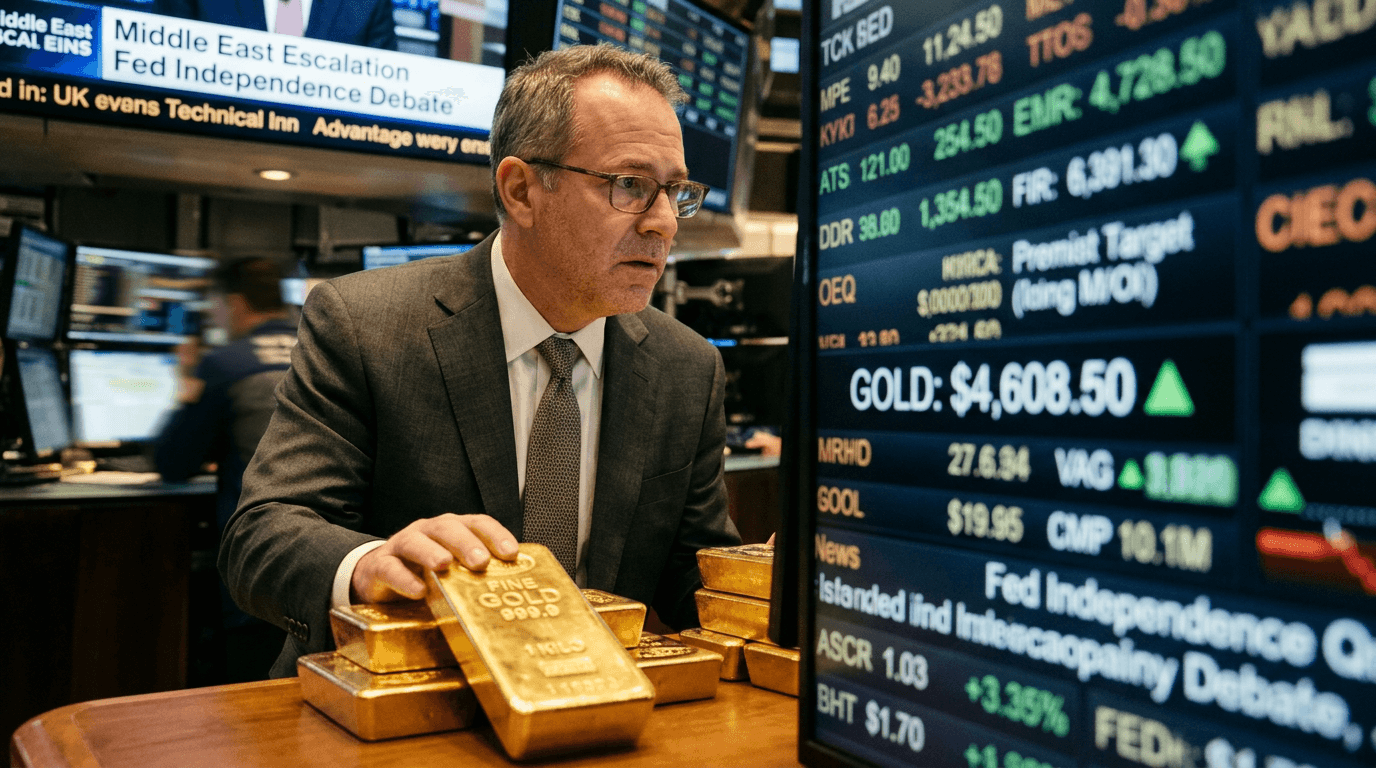
Gold prices have extended their remarkable rally above the $4,600 mark, reaching fresh all-time highs as investors worldwide flee to safe-haven assets amid mounting concerns about Federal Reserve independence and escalating geopolitical tensions. This surge represents a significant shift in market sentiment, with spot gold trading near $4,615 per ounce and gold futures briefly touching $4,626, reflecting powerful defensive positioning across global markets. The yellow metal's ascent underscores a fundamental shift in how investors are assessing risk in an increasingly uncertain economic and political landscape.
The Perfect Storm: Fed Concerns And Geopolitical Tensions
The primary catalyst for gold's explosive rally stems from two interconnected concerns that have shaken investor confidence in recent weeks. Federal Reserve Chairman Jerome Powell's revelation that the Trump administration threatened him with criminal indictment sent shockwaves through financial markets, raising immediate questions about the independence of U.S. monetary policy.[1] This political interference threat represents an unprecedented challenge to central bank autonomy, a cornerstone principle of modern economics that investors have long taken for granted. When central bank independence comes into question, it fundamentally undermines confidence in the currency and the broader financial system, creating ideal conditions for safe-haven demand.
Compounding these policy concerns, escalating unrest in Iran has kept geopolitical risks elevated throughout the week.[1] Reports indicating more than 500 deaths during widespread anti-government protests have intensified uncertainty about Middle East stability, a region critical to global energy markets. These twin concerns combined to create a potent cocktail of fear that sent investors racing toward assets traditionally viewed as insurance against systemic risk: gold, strong currencies, and government bonds.
The Dollar's Weakness: A Currency Crisis Unfolds
The Federal Reserve independence concerns have had a direct impact on the U.S. dollar, which fell approximately 0.3% on the day, marking its biggest daily decline since mid-December.[1] The dollar index slipped below the 99 point level, ending a five-day winning streak as investment flows shifted decisively toward gold and other safe-haven assets.[3] This weakness represents more than just a routine currency fluctuation—it reflects a fundamental erosion of confidence in U.S. policy stability.
Meanwhile, other currencies benefited from the dollar's decline. The Swiss franc gained 0.4%, while the euro firmed near $1.17, as investors sought currencies perceived as more insulated from U.S. political turbulence.[1] This flight to quality across global currency markets demonstrates how systemic concerns about one nation's monetary policy can quickly spread through interconnected financial systems, with capital relocating to perceived safer jurisdictions almost instantaneously.
Economic Signals Reinforcing Defensive Positioning
Beyond political and geopolitical factors, softer economic data has reinforced the case for defensive positioning in gold and other safe-haven assets. U.S. employment data from December showed a clear slowdown in hiring that came in below market expectations, signaling potential weakness in the labor market heading into 2026.[3] While the data initially provided modest support for the dollar on expectations that interest rates would remain unchanged at the upcoming Federal Reserve meeting, this support quickly faded as geopolitical risks intensified.
The labor market weakness represents a significant concern because it suggests the economic backdrop may be deteriorating precisely when policy stability is already in question. Traders must contend not only with political interference fears but also with the possibility of a slowing economy that could require different monetary policy responses. This combination of factors has created elevated uncertainty that typically benefits gold prices, as investors seek protection against multiple possible adverse outcomes.
Implications For Traders And Investors
For traders navigating this environment, the record-high gold prices present both opportunities and challenges. The rally above $4,600 demonstrates the power of safe-haven flows when multiple risk factors converge, but it also raises questions about valuation at these elevated levels. Historical precedent suggests that such sharp moves in gold prices can sometimes precede periods of consolidation or profit-taking, particularly if political concerns temporarily ease or economic data stabilizes.
The initial decline of roughly 0.5% in S&P 500 futures following Powell's comments illustrates how Fed independence concerns quickly ripple through equity markets.[1] Understanding these interconnections helps traders position more effectively across multiple asset classes and anticipate where capital flows may relocate as sentiment evolves.
Looking Ahead: Sustainability And Risks
The question facing markets now is whether this rally can sustain itself or whether it represents an extreme expression of near-term fears that may dissipate as situations stabilize. Gold at $4,600 reflects both rational hedging against genuine systemic risks and potentially some degree of capitulation-driven buying that could reverse if sentiment shifts. Traders should monitor Federal Reserve communications closely in coming weeks, watch for any de-escalation in Middle East tensions, and remain alert to employment and inflation data that could shift market narratives about the economic outlook. The convergence of political, geopolitical, and economic factors has created a perfect environment for safe-haven assets, but market participants should remain cautious about extrapolating this momentum indefinitely into the future.
---