
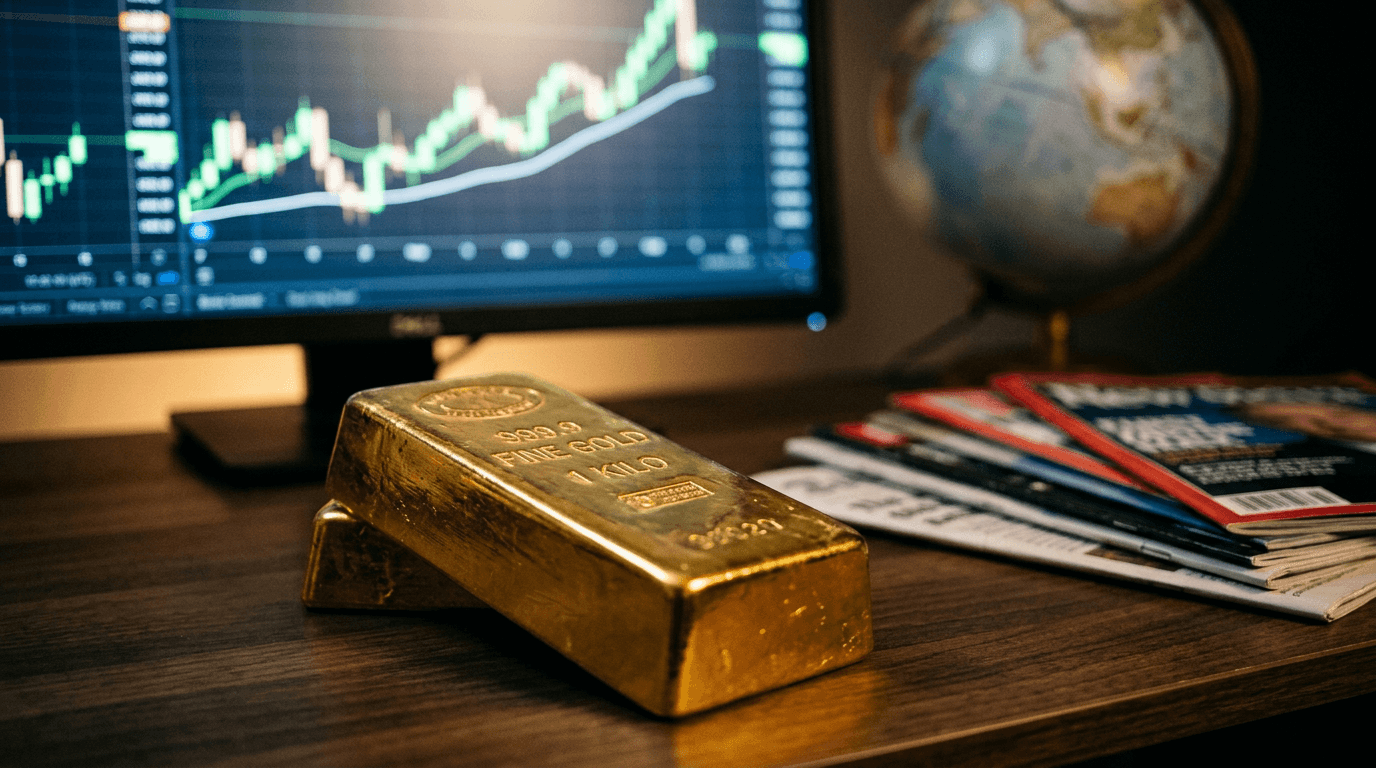
Gold has found critical support at the $5,000 level, marking a significant technical turning point as geopolitical tensions in the Middle East fuel intensifying safe-haven demand. The precious metal's ability to hold this key Fibonacci level amid escalating US-Iran conflict represents more than just a price bounce—it signals renewed investor confidence in gold's role as the ultimate hedging instrument during times of global uncertainty. With analysts increasingly bullish on further upside, the question for traders and investors is no longer whether gold will rally, but how high prices could ultimately climb in a conflict-driven market.
THE $5,000 SUPPORT LEVEL: A TECHNICAL TURNING POINT
The $5,000 support level has proven to be far more than a round number in recent trading sessions. This key Fibonacci level represents the 50% retracement of gold's broader advance, providing psychological and technical support that has prevented further downside during the recent market volatility triggered by the escalating Middle East crisis. On March 4, 2026, spot gold rose 1.6% to $5,166.75 per ounce after a volatile session where it briefly plunged to $5,000 before finding critical support at that exact level.
What makes this support level particularly significant is the buying interest that has emerged in this zone. According to technical analysts, strong buying pressure materialized precisely when prices approached $5,000, suggesting that major institutional investors and central banks viewed this level as an attractive entry point. This technical picture remains bullish as long as gold maintains its position above this critical support, with resistance identified near the $5,200 to $5,400 range representing the next major hurdle for prices to overcome.
Geopolitical Risk And The Safe-haven Rally
The backdrop for gold's current strength is unmistakable: escalating Middle East tensions have triggered a classic flight-to-safety trade. The US and Israeli coordinated strikes on Iranian territory that began on February 28, 2026, followed by widespread Iranian retaliation including missile strikes on US bases and allies across the region, have created precisely the kind of uncertainty that makes gold historically attractive to risk-averse investors.
Central to this geopolitical equation is the closure of the Strait of Hormuz, one of the world's most critical chokepoints for global oil trade. This disruption has caused oil prices to surge, with Brent crude rising 4.7% to $81.40 per barrel on March 3, 2026, after jumping 13% intraday on March 2. Such oil price spikes typically translate into inflationary pressures across global economies, reinforcing gold's appeal as an inflation hedge. Additionally, the stock market reaction to these tensions has been decidedly negative, with major indices including the S&P 500 and European markets declining as investors rotated away from equities into safer assets like precious metals and government bonds.
War Impact On Gold Prices: Inflation And Market Dynamics
The mechanism by which war drives gold prices higher operates through multiple channels simultaneously. First, supply chain disruptions stemming from Middle East tensions typically raise energy costs, which filters through to broader inflation measures. Higher inflation erodes the purchasing power of fiat currencies, making gold—which cannot be printed by central banks—substantially more attractive as a store of value.
Second, wars and geopolitical crises invariably create uncertainty about future economic growth, prompting investors to reduce equity exposure and rotate into defensive assets like precious metals. The recent volatility in global stock markets exemplifies this dynamic, with Asian markets including South Korea's Kospi down 7% amid the regional tensions. Such sharp equity market declines accelerate the flow of capital into gold, as portfolio managers seek to rebalance away from risk assets.
Third, the conflict creates questions about policy responses that could impact monetary conditions. If prolonged disruptions push oil toward $100 per barrel, central banks may face difficult trade-offs between fighting inflation and supporting economic growth, potentially keeping interest rates elevated even as growth slows. This stagflationary scenario would be particularly supportive for gold, which tends to perform well during periods of elevated uncertainty and rising prices.
ANALYST FORECASTS: WHERE COULD GOLD PRICES HEAD?
Professional forecasters have turned decidedly bullish on gold for the remainder of 2026, with war-related upside risks now embedded in most major institutions' projections. JP Morgan projects a base case of $6,300 by year-end, with potential upside to $8,500 in more extreme scenarios where macroeconomic conditions deteriorate significantly due to war-related disruptions. Goldman Sachs forecasts $5,400 by year-end and explicitly cites "significant upside risk" from geopolitical factors. Deutsche Bank sees $6,000, while UBS projects $6,200 by mid-year.
The significance of these forecasts lies in their consistency: virtually every major bank now sees meaningful upside from current levels, with most scenarios targeting moves of $400 to $1,200 from current prices around $5,150-$5,200. If gold successfully breaks above the $5,200 resistance level on a decisive close, many analysts believe it could target the $5,418 to $5,470 zone representing the upper boundary of the recent ascending channel pattern.
Key Takeaways For Traders And Investors
The $5,000 support level has proven robust and meaningful, establishing a floor that has supported gold prices during periods of market stress. As long as geopolitical tensions remain elevated and safe-haven demand persists, gold appears well-positioned to test higher resistance levels throughout 2026. The confluence of technical support, fundamental safe-haven demand, and bullish analyst positioning creates a compelling setup for further appreciation, particularly if any escalation occurs in the Middle East conflict.