
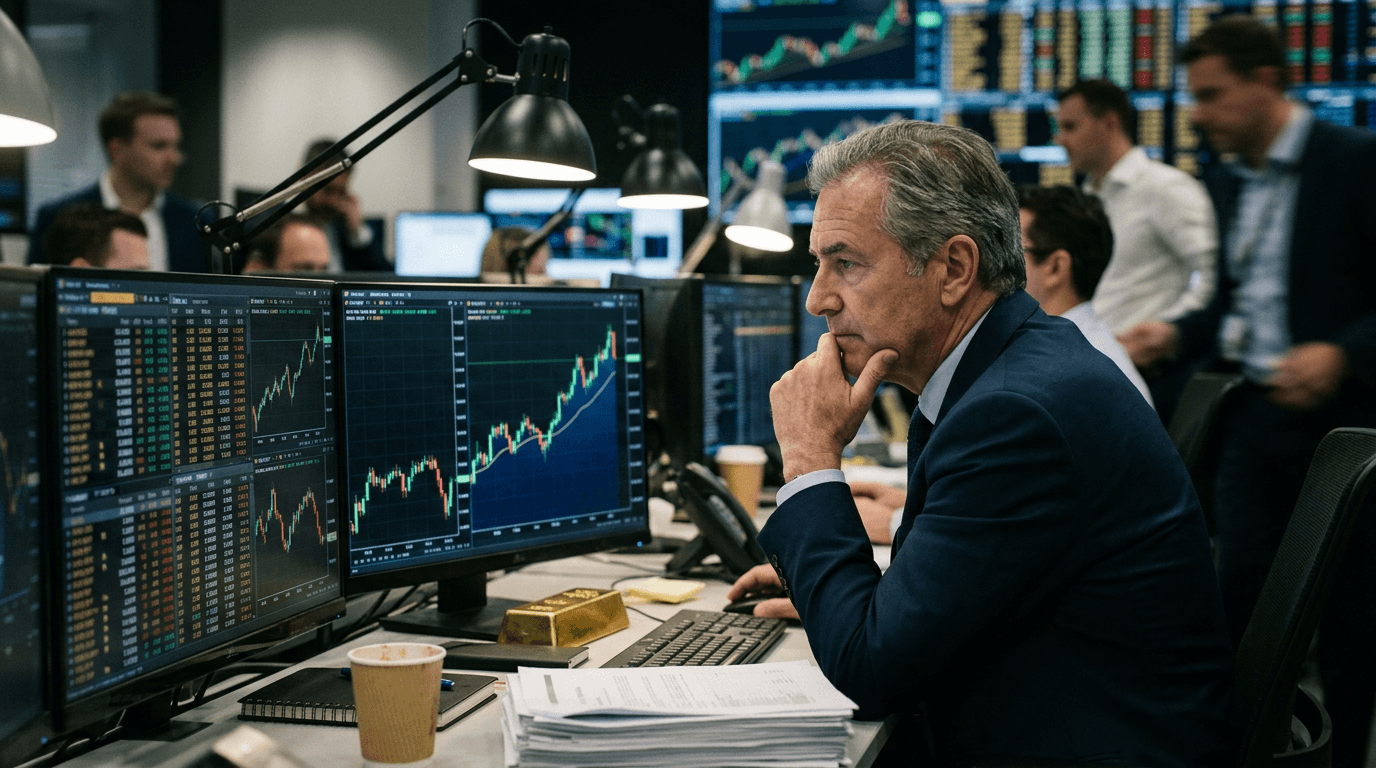
Gold is once again proving why it remains the market’s go-to uncertainty hedge, holding firm even as the U.S. dollar slips on the back of a more cautious tone from Federal Reserve officials. A softer greenback and a central bank signaling patience rather than aggressive tightening is a supportive backdrop for bullion, helping sustain demand across spot and futures markets, gold-linked ETFs, and key FX crosses.
Gold Holds Firm As Dollar Slips
Over the past several years, gold has climbed to and consolidated near record highs as investors navigate inflation, geopolitical tensions, and shifting central bank policies.[20] In some recent episodes, prices have traded above the psychologically important $4,000 per ounce mark, underscoring how strong structural and macro drivers have become for the metal.[3][18] Even when short-term corrections hit, gold has tended to bounce back quickly as buyers step in on dips, reflecting its entrenched role as a long-term store of value.[20]
The current backdrop—where the dollar is giving back recent gains while the Fed strikes a more measured tone—is a textbook environment for gold to stay resilient. Because gold is priced in U.S. dollars globally, any meaningful weakening in the currency effectively makes bullion cheaper for buyers using other currencies, often translating into fresh demand from international investors and central banks.[20] That mechanical effect combines with sentiment: when the market senses the Fed is wary of tightening too far or too fast, traders often reassess the path of real interest rates, which is one of gold’s most important macro inputs.[20]
Why A Cautious Fed Supports Gold
Gold does not pay interest or dividends, so its appeal relative to bonds and cash is heavily influenced by where policy rates and inflation-adjusted yields are headed.[20] When the Fed sounds cautious—emphasizing data dependence, downside risks, or a willingness to pause rather than hike aggressively—it lowers the perceived probability of sharply higher real yields. That, in turn, reduces the opportunity cost of holding gold, making it more attractive as part of a diversified portfolio.
History offers multiple examples of this dynamic. In periods when rates cuts or dovish pivots were anticipated or delivered, gold often responded with strong gains as investors rotated away from cash and shorter-term bonds into alternative stores of value.[12][20] For instance, the FOMC’s rate cut in late 2024 was followed by a surge to new highs as markets priced in a more accommodative bias and lingering inflation risks.[12][20] Similarly, trade tensions and policy uncertainty around 2025 helped push gold to an all-time high near $3,500 per ounce.[20] These episodes illustrate how a shift in the perceived trajectory of Fed policy can be enough to energize gold buyers—even without a crisis.
In the current environment, a cautious Fed tone is feeding the narrative that policymakers want to avoid overtightening into a slowing global economy. That encourages some investors to add or retain gold exposure as insurance against both policy error and future volatility in risk assets.
Dollar Weakness, Safe-haven Flows, And Market Cross-currents
The inverse relationship between gold and the U.S. dollar is one of the most enduring macro correlations in markets.[20] When the dollar index strengthens sharply, gold often faces a headwind; when the dollar retreats, bullion usually finds support as non-U.S. buyers regain purchasing power and speculative flows rotate into commodities and precious metals.[20] A slip in the dollar on the back of cautious Fed language therefore tends to bolster gold’s appeal.
Layered on top of that currency effect is gold’s safe-haven status. Over the last century, major spikes in gold have coincided with periods of elevated uncertainty—from high inflation eras to geopolitical tensions to systemic risk episodes.[20] The COVID-19 pandemic, for example, saw gold rally roughly 27% in the first half of 2020 as investors sought protection from unprecedented economic disruption.[20] More recently, trade frictions, regional conflicts, and shifting alliances have sustained interest in assets perceived as politically neutral and globally liquid—gold being the prime example.[20]
As spot gold and futures remain supported, the ripple effects extend into gold-linked ETFs and FX crosses. Funds that track bullion or gold miners typically see inflows when the narrative centers on safe-haven demand and a softer dollar, which can amplify price moves relative to the underlying metal. In FX markets, pairs like XAUUSD (gold priced in dollars) tend to grind higher when the dollar weakens, while gold against other majors (such as EUR or JPY) may show more nuanced moves as local monetary policies and growth outlooks interact with the global gold story.
What This Means For Traders And Simulated Finance Participants
For traders—whether in live markets or on simulated finance platforms like E8 Markets—this environment offers a rich testing ground for macro and multi-asset strategies. Gold’s firm tone in the face of a softer dollar and cautious central bank rhetoric highlights the importance of linking asset moves to underlying drivers rather than viewing them in isolation.
Trend-following strategies may focus on identifying whether gold is in a sustained uptrend supported by continued dollar weakness and steady ETF inflows, or merely in a sideways consolidation at high levels. Mean-reversion traders might look for short-term overextensions when gold spikes on individual Fed headlines, testing fade-the-move setups with tight risk parameters. Macro traders can experiment with relative-value ideas—such as gold versus real yields, or gold against specific FX crosses—within a simulated environment to refine their understanding of correlations and regime shifts.
Risk management is crucial. Gold can move swiftly when the macro narrative changes—an unexpectedly hawkish Fed speech, a stronger-than-expected inflation print, or a sudden dollar rebound can trigger sharp pullbacks. Using simulated trading allows participants to practice position sizing, stop placement, and scenario planning without capital at risk, building playbooks that can later be applied in live markets.
Key Takeaways For Your Trading Playbook
Several practical lessons emerge from gold holding firm as the dollar slips on a cautious Fed tone. First, always connect gold’s moves to the policy and macro backdrop: monitor Fed speeches, inflation data, and real yield trends alongside price action. Second, remember the currency layer—track the dollar index and key FX pairs to understand how broader flows might be supporting or pressuring bullion.
Third, view gold within a portfolio context. It is both a directional trading instrument and a hedge; understanding when it is acting primarily as a safe haven versus a momentum asset can improve strategy selection. Finally, use simulated environments to stress-test your gold strategies across different scenarios: dovish versus hawkish Fed paths, strong versus weak dollar regimes, and calm versus volatile risk sentiment.
By treating episodes like “Gold holds firm as U.S. dollar slips on cautious Fed tone” as learning opportunities, traders can deepen their grasp of macro mechanics, improve cross-asset intuition, and build more robust frameworks for navigating the ever-changing landscape of precious metals and global currencies.