
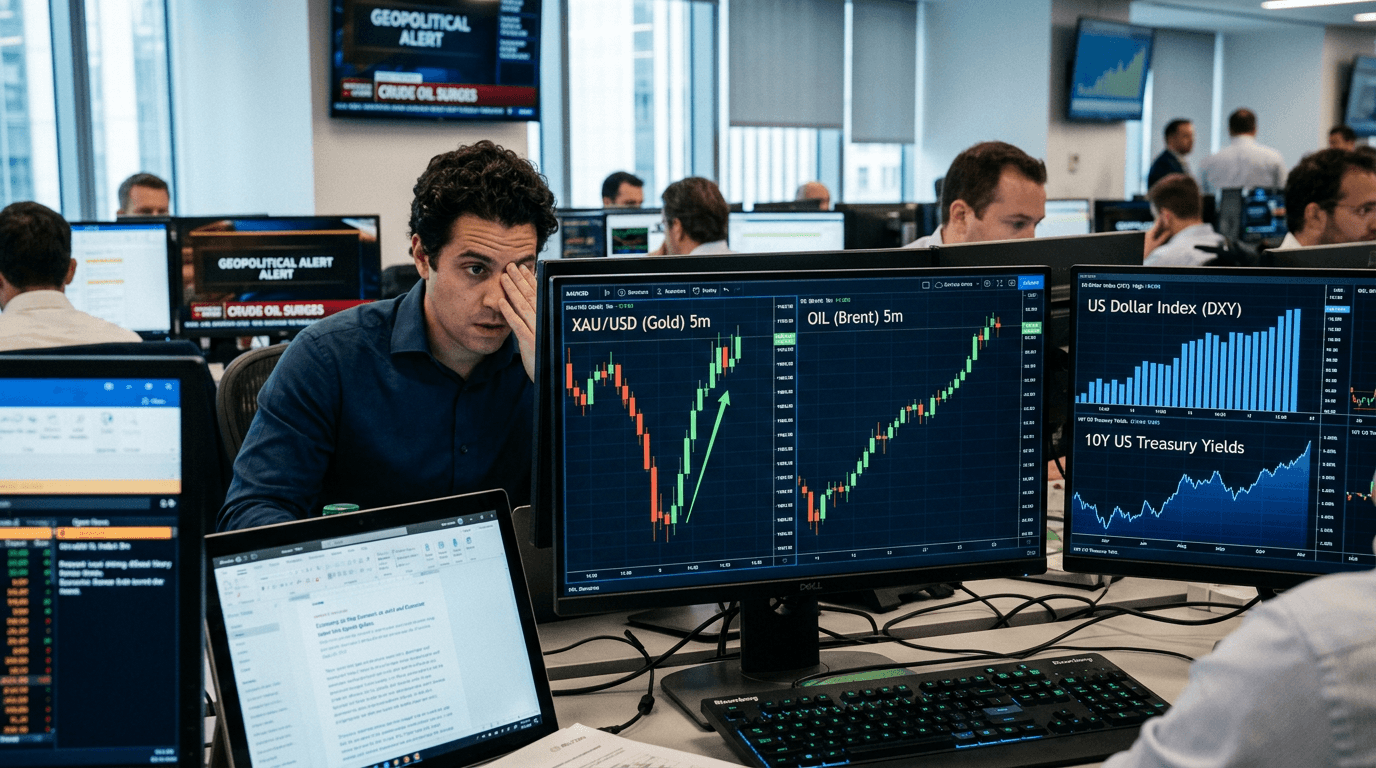
After a sharp washout in the prior session, gold has snapped back as investors rotate back into safe-haven assets. Geopolitical tensions, higher oil prices, and a broader risk-off tone are driving renewed demand for protection, lifting gold futures and spot XAU/USD even as the US dollar remains firm and yields stay elevated. The rebound underscores how quickly sentiment can flip in a market where fear, policy expectations, and FX flows are constantly pulling in different directions.
WHAT’S DRIVING GOLD’S LATEST REBOUND?
The most immediate catalyst behind gold’s move is a classic shift in risk appetite. Rising geopolitical tensions and a jump in crude oil prices have reminded markets of two key risks: potential energy-driven inflation shocks and the possibility of wider instability. In that environment, investors often look to hedge tail risks, and gold remains one of the first ports of call.
At the same time, the rebound is occurring against the backdrop of a firm US dollar and elevated bond yields—conditions that typically pressure non-yielding assets like gold. The fact that gold is rallying despite those headwinds suggests that the safe-haven bid is strong enough, at least in the short term, to outweigh purely macro-driven selling.
Another layer is positioning. The prior session’s selloff likely flushed out short-term longs and triggered stop-losses below recent support. When sentiment shifted back to risk-off, some of that positioning unwound in the opposite direction. Short covering and fresh haven buying often combine to make rebounds feel sharper than the underlying news might suggest.
Finally, intra-asset rotation is in play. As equities wobble and credit spreads widen, institutional and systematic strategies may rebalance toward defensive exposures. That rotation is not just benefiting gold, but also other precious metals and, in some cases, the dollar itself—highlighting that different havens can rally together when anxiety spikes.
SAFE-HAVEN DEMAND VS. MACRO HEADWINDS
To understand this move, it helps to think of gold as sitting in the middle of a macro tug-of-war. On one side are rising real yields and a strong dollar, which tend to cap upside by increasing the opportunity cost of holding gold. On the other side are safe-haven demand, central-bank buying, and long-term diversification flows that provide structural support.
When yields and the dollar are rising for “good” reasons—strong growth, hawkish central banks—gold often struggles. But when yields are high and risk sentiment deteriorates, the story gets more complicated. Investors may accept the drag from yields if they’re worried about liquidity, geopolitical shocks, or equity drawdowns. That’s the type of environment this rebound is signaling.
The key nuance for traders is that the drivers can work on different timeframes. Safe-haven flows can dominate intraday or over a few sessions, pushing prices higher even if the broader medium-term trend is still aligned with rising real yields. That’s why you can see gold post a strong session or two while still being on track for a weaker weekly or monthly performance.
In other words, the current rebound is not necessarily a clean “all-clear” for a new bull trend. It is a reminder that gold’s price is increasingly the result of multiple, sometimes conflicting narratives: fear, policy, FX, and long-term portfolio construction.
XAU/USD TECHNICAL PICTURE: RE-ANCHORING SUPPORT
Technically, the recovery is important because it helps re-anchor support levels for XAU/USD after the prior session’s selloff. When gold pierces a support zone and then quickly snaps back above it, traders pay close attention to whether that move was a genuine breakdown or a “false break” driven by stops and thin liquidity.
On daily charts, this kind of action often shows up as a long lower wick—a sign that sellers pushed prices lower but buyers stepped in aggressively into the dip. If gold can sustain trade above the intraday rebound zone and hold above the prior swing low, that area may evolve into a new reference point for risk management.
Shorter-term traders will be watching whether price consolidates in a new range or quickly attacks recent highs. A slow, overlapping grind higher would suggest ongoing uncertainty; a decisive surge with broad participation would hint that haven flows are intensifying. Volatility measures such as average true range (ATR) are also worth monitoring: a rising ATR coupled with whipsaw price action signals that this is a more treacherous environment for tight stops and oversized positions.
PRACTICAL TAKEAWAYS FOR GOLD AND XAU/USD TRADERS
1) Separate the intraday story from the bigger picture The rebound tells you that safe-haven demand is back in the driver’s seat for now. It doesn’t, by itself, guarantee that the medium-term trend has flipped. Align your trades with your timeframe—don’t let a strong session override a weekly chart that still shows a corrective phase.
2) Watch yields and the dollar as your “first alerts” If real yields and the dollar start to roll over while risk sentiment remains fragile, gold’s rebound has a better chance of evolving into a more durable advance. If yields push higher and the dollar rallies further, haven spikes can remain sharp but short-lived.
3) Use the latest swing levels to define risk The low of the prior session’s selloff and the high of the current rebound are now key markers. For tactical traders, those zones help define invalidation levels and potential breakout points. For longer-term participants, they help frame whether price is stabilizing or simply oscillating inside a broader consolidation.
4) Size positions for volatility, not for conviction Strong opinions can be dangerous in highly headline-driven markets. Volatility around geopolitical headlines and macro surprises can produce violent intraday swings. Position sizing, not prediction, often determines whether you can survive to exploit the next opportunity.
Trading This Environment: From Practice To Execution
For many traders, this is precisely the kind of regime where a simulated or structured environment can add value. Safe-haven spikes tend to punish late entries and poor risk management. Practicing how you respond to sudden gaps, fast reversals, and news-driven volatility—without real capital at risk—can help you refine everything from order placement to stop-loss discipline.
When testing strategies, consider running scenarios across different conditions: - A clean, trend-following environment where gold moves with yields and the dollar - A choppy, range-bound environment with repeated false breaks - A crisis regime where safe-haven flow dominates, overriding usual correlations
You may find that your approach performs well in one regime and poorly in another. Knowing that ahead of time allows you to adjust your trading plan when the macro backdrop shifts.
Conclusion: Gold As A Multi-driver Macro Asset
Gold’s rebound after the prior session’s selloff is a timely reminder that the metal is no longer a simple “fear gauge.” It is a macro asset with multiple, competing drivers: safe-haven demand, real yields, FX dynamics, central-bank activity, and long-term portfolio flows. Today, the pendulum has swung back toward fear and protection, allowing gold to rise even in the face of a firm dollar and elevated yields.
For traders, the edge lies in mapping those drivers onto clear timeframes, honoring newly established technical levels, and sizing positions for the volatility regime you’re actually in—not the one you wish you were trading. Treat this rebound not as a definitive verdict on where gold must go next, but as another datapoint in an evolving macro narrative. The more you can integrate that narrative into a disciplined, tested process, the better positioned you’ll be to navigate the next wave of volatility—whichever direction it takes.