
Key instructions: 1. Output ONLY the article content in PLAIN TEXT format 2. NO preamble, introduction, or meta-commentary 3. Start DIRECTLY with the first paragraph 4. Use ALL CAPS for section headings on their own line 5. Separate paragraphs with blank lines 6. Include 3-5 main sections with clear takeaways 7. At the END, provide: TITLE, EXCERPT, and NEWSIMPACTSCORE
Important note: The search results actually show a more nuanced picture than the user's query suggests. The results indicate: - Gold rebounded toward $4,600, rising about 1% to around $4,588 - BUT gold remains on track for its second consecutive monthly decline - The safe-haven effect is being offset by oil-driven inflation fears and higher rate expectations - There's a paradox: geopolitical stress supports safe-haven demand, but higher rates and stronger dollar cap upside - Gold is trapped in a range between $4,400-$4,800 - The safe-haven role is conditional - it's not providing expected protection
So while the headline says gold is rebounding on safe-haven demand, the reality from the search results is more complex. I should present this accurately while still addressing the prompt. The article should be educational and show both the bullish case (safe-haven demand, geopolitical tensions) and the bearish headwinds (rate expectations, stronger dollar, oil-driven inflation).
I need to: 1. Write in plain text (no markdown, no HTML) 2. Use line breaks between paragraphs 3. Use ALL CAPS for section headings 4. 800 words approximately 5. 3-5 main sections 6. Educational, professional tone 7. Include the TITLE, EXCERPT, and NEWSIMPACTSCORE at the very end
8. Structure with an opening, then sections covering the safe-haven dynamic, the inflation-rate tension, market range constraints, and investor considerations, followed by a conclusion
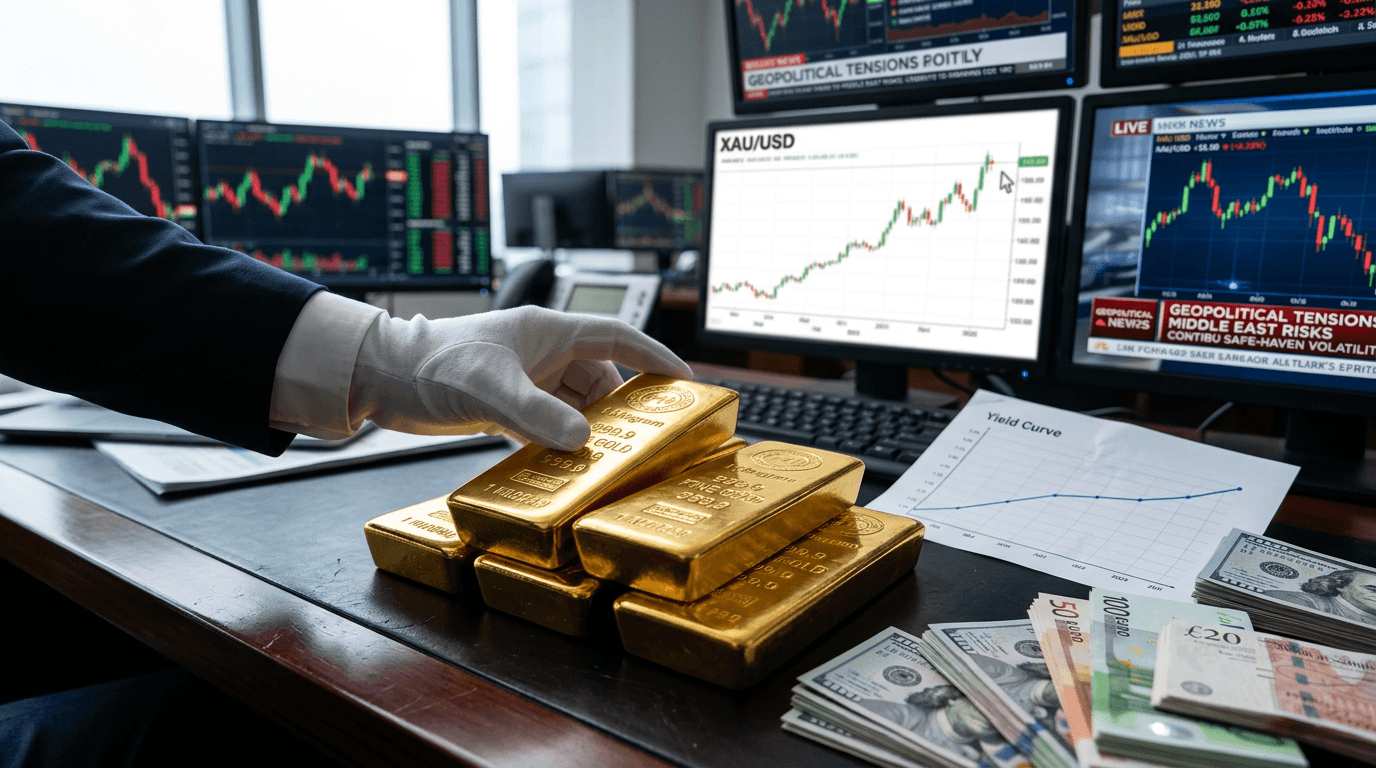
Gold advanced to $4,588 per ounce on Thursday as investors sought safe-haven assets amid escalating U.S.-Iran tensions and Middle East uncertainty, though the rally masks a more complex market dynamic where rising inflation expectations and higher interest rate forecasts continue to pressure the precious metal.[1] The rebound represents a temporary reprieve for bullion after two consecutive months of declines, but analysts caution that gold's path forward remains constrained by competing macroeconomic forces that are reshaping how traditional safe-haven assets behave in the current environment.
The Geopolitical Catalyst For Safe-haven Demand
Reports that the U.S. military plans to brief President Donald Trump on potential military action against Iran, combined with Washington's reaffirmed commitment to maintain a naval blockade until a nuclear agreement is secured, have intensified market anxiety over Middle East stability.[1] This escalation has kept investor focus on the broader implications of prolonged regional instability, particularly concerning the Strait of Hormuz, a critical chokepoint for global energy flows. Historically, gold thrives during periods of geopolitical uncertainty because investors seek to protect their wealth through non-correlated assets that hold value when confidence in traditional markets falters. The current tensions have triggered precisely this type of defensive positioning, with safe-haven flows providing the primary support for gold's recent rebound.
However, the traditional relationship between geopolitical risk and gold prices has weakened considerably in this cycle. Rather than experiencing a clean rally alongside rising tensions, gold has chopped between roughly $4,400 support and $4,800 resistance, showing low volatility and broken correlations with its traditional drivers.[5] This pattern signals that safe-haven demand, while present, is being actively competed against by other market forces that have grown increasingly influential in determining precious metal valuations.
The Inflation-rate Paradox Reshaping Gold Markets
The surge in oil prices driven by Middle East disruption fears has inadvertently created a significant headwind for gold despite geopolitical support. Rising energy costs are driving inflation expectations higher globally, and markets are responding by repricing expectations for Federal Reserve policy.[1] Reuters reported that market participants are no longer expecting rate cuts in 2026 and are increasingly pricing in the possibility of a rate hike by 2027.[1] This shift fundamentally changes the calculus for owning non-yielding assets like gold, which become less attractive when interest rates are higher or expected to rise.
The Federal Reserve's decision on Wednesday to leave rates unchanged came with an unusually visible sign of internal division, with four officials dissenting from the policy decision—an exceptionally high level of disagreement that underscores growing uncertainty over how the central bank should respond to inflation risks linked to energy shocks.[1] These divisions reflect genuine debate within the Fed about whether to maintain hawkish positioning despite geopolitical disruptions. The combination of war-driven inflation fears and tighter monetary expectations has created a genuine paradox for gold: while geopolitical stress supports safe-haven demand, higher rates and a stronger dollar continue to cap upside momentum.[1]
Understanding Gold's Conditional Safe-haven Status
Recent market behavior has raised important questions about whether gold still serves as a reliable safe-haven asset. Current evidence suggests gold's safe-haven role is conditional, performing best during liquidity crises or systemic financial fear, but lagging when inflation is driven by supply shocks like energy price surges and central banks respond with tighter monetary policy.[5] In the current regime, energy and select equities are absorbing the "risk-off" capital flows that might otherwise flow to gold. This does not invalidate gold's long-term role as a portfolio hedge but highlights the need for nuanced expectations about short-term price action.
Gold prices have declined over 15 percent in March alone—the largest monthly drop since the October 2008 global financial crisis—after initially surging to the $5,300 level when Middle East conflict intensified in February.[3] This dramatic reversal reflects the market's reassessment of whether geopolitical turmoil would translate into sustained safe-haven demand or whether other factors would dominate price discovery.
What Comes Next For Gold Investors
Short-term consolidation remains the most likely scenario, with range-bound trading between $4,400 support and $4,800 resistance continuing until a clearer catalyst emerges.[5] A decisive break below $4,400 would signal weakness, while a sustained move above $4,800-$4,900 would suggest renewed bullish momentum. The timing of this potential breakout depends heavily on Federal Reserve guidance, developments in the Hormuz situation, and whether oil-driven inflation concerns moderate or intensify further.
For investors, gold is sitting at the intersection of two competing forces: fear-driven demand and interest-rate restraint.[1] Understanding this tension is essential for positioning portfolios effectively in the current environment.