
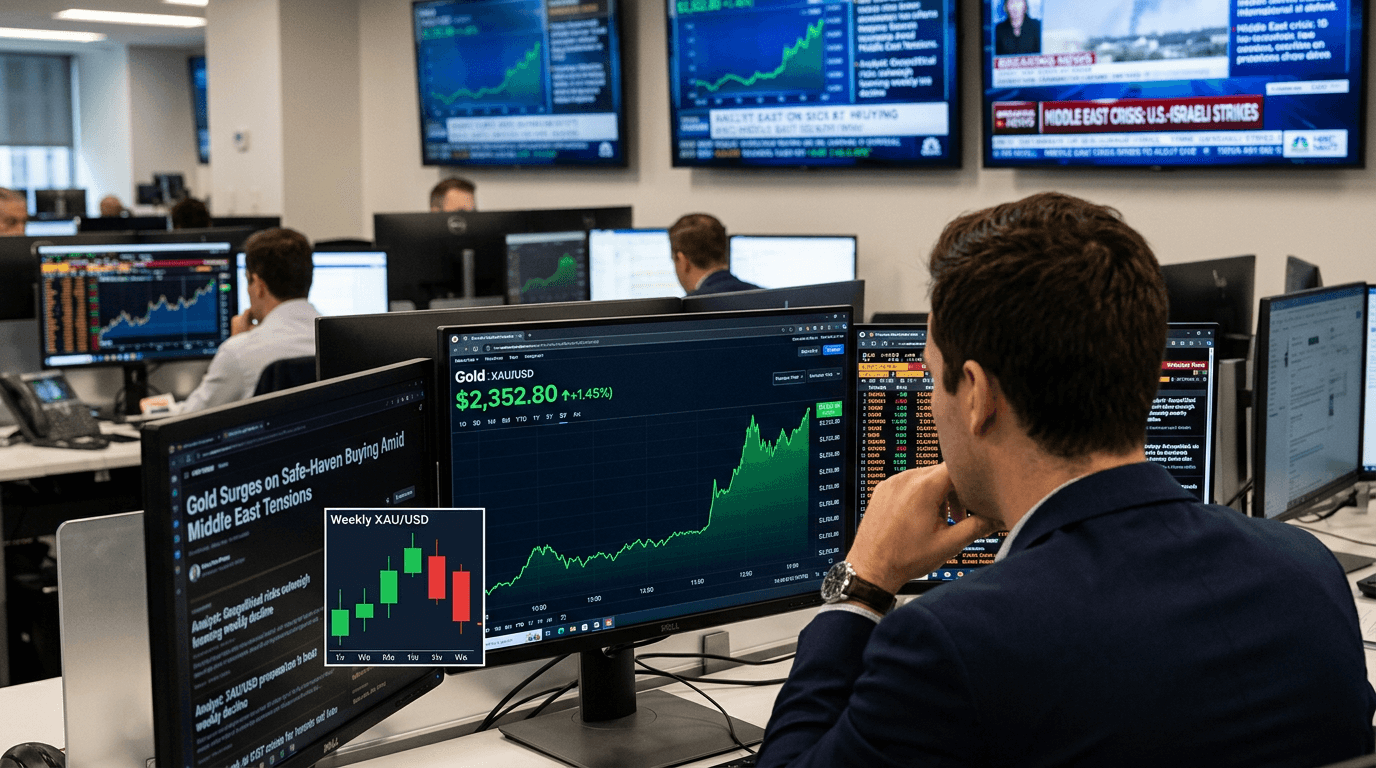
Gold markets are witnessing a resurgence as escalating tensions in the Middle East drive a renewed demand for safe-haven assets. This has pushed the precious metal back to critical support levels, marking a recovery from its trajectory toward its first weekly decline in five weeks. With recent U.S. and Israeli military actions against Iran, there has been a noticeable shift in investor sentiment, causing spot gold to trade near $5,350 per ounce. This movement underscores gold's status as a global uncertainty barometer, as investors navigate concerns over potential oil supply disruptions and broader geopolitical instability affecting financial markets.
The Geopolitical Catalyst For Gold's Rise
The link between Middle East tensions and gold prices is a well-documented relationship in financial markets. Increased geopolitical risks prompt investors to pull back from equities, emerging market currencies, and other risk assets, redirecting funds into gold and similar defensive assets. The current military escalations have heightened this shift, as institutional investors acknowledge the risks posed to crucial energy infrastructure and global supply chains. The joint U.S.-Israeli strikes on Iranian targets exemplify events that increase the likelihood of supply shocks, prompting a swift reassessment of safe-haven assets. Gold's approximately 22 percent year-to-date rise reflects this mounting anxiety, positioning the metal as a hedge against both geopolitical risks and potential inflationary pressures from oil disruptions. Dr. Marcus Chen, a former Federal Reserve economist, recently highlighted that the gold market is a detailed indicator of global fear, with current tensions diminishing the likelihood of imminent supply shock stabilization.
Understanding Gold's Mixed Performance
Gold's recent price action presents an intriguing paradox that has puzzled many market participants. Despite the expectation that rising geopolitical tensions would support precious metal prices, gold has declined by about 8 percent since the formal onset of the Middle East conflict on February 28. This contradiction illustrates the complexity of modern gold markets, where numerous macroeconomic forces are at play. Following the Trump administration's announcement of an extended Iran ceasefire in March 2025, gold prices dropped below $4,750 as geopolitical risk premiums diminished. However, the fragility of this ceasefire was revealed when the U.S. seized an Iranian vessel for breaching a blockade, prompting Tehran's retaliatory warnings and refusal to engage in further talks before the ceasefire's expiration. Such uncertainties around the ceasefire's durability have rekindled safe-haven flows, showing that gold's price responds not just to geopolitical events but also to market perceptions of tension stabilization or escalation. The current uptick reflects a reassessment, with traders and institutions increasingly wagering on continued geopolitical instability.
Technical Support Levels And Trading Strategies
Traders in simulated finance environments should note the technical landscape surrounding current gold prices, which provides critical insights. Gold has established significant technical support near the $5,000 per ounce mark, with market dynamics suggesting that institutional investors are ready to defend this level. Analysts project that gold could trade between $5,078 and $6,234, contingent on the progress of Middle East tensions and Federal Reserve policy actions. In a scenario of severe escalation, involving direct U.S.-Iran military confrontation, gold could surge approximately 15 percent within two weeks, potentially reaching $5,500 to $5,800 as safe-haven demand peaks. Current trading above $5,350 has broken through key multi-week resistance, indicating positive momentum in the near term. Risk management for long positions becomes straightforward, allowing traders to set stop-loss orders below $4,900 to manage downside risk while maintaining potential for upside gains if tensions further escalate.
Structural Demand Sustaining High Prices
In addition to cyclical safe-haven dynamics, structural factors continue to support gold at elevated levels. Central bank purchasing remains robust, with expectations for 900 to 950 metric tons in 2025 as global monetary authorities diversify away from dollar reserves. This official sector demand provides a price floor and illustrates how geopolitical uncertainty is reshaping reserve diversification strategies. Global gold demand is trending toward approximately 4,850 metric tons for the year, the highest since 2011, showing that investment demand extends beyond crisis-driven safe-haven flows. In India, gold ETF inflows have reached around 250 billion rupees, surpassing equity mutual fund inflows for the first time, indicating a fundamental shift away from riskier assets. Concurrently, the U.S. dollar has weakened as real interest rates hit lows not seen since mid-2023, reducing the opportunity cost of holding non-yielding assets like gold and making precious metals more attractive compared to dollar-denominated alternatives.
Key Takeaways For Traders
The current advance in gold prices is driven by a confluence of geopolitical fears, declining real interest rates, and robust central bank demand, providing multiple layers of support at high price levels. The fragility of existing ceasefire agreements suggests ongoing uncertainty, likely sustaining safe-haven flows in the short term. Traders should closely monitor geopolitical developments while recognizing that technical support at $5,000 and structural demand from official sectors offer significant downside protection.