
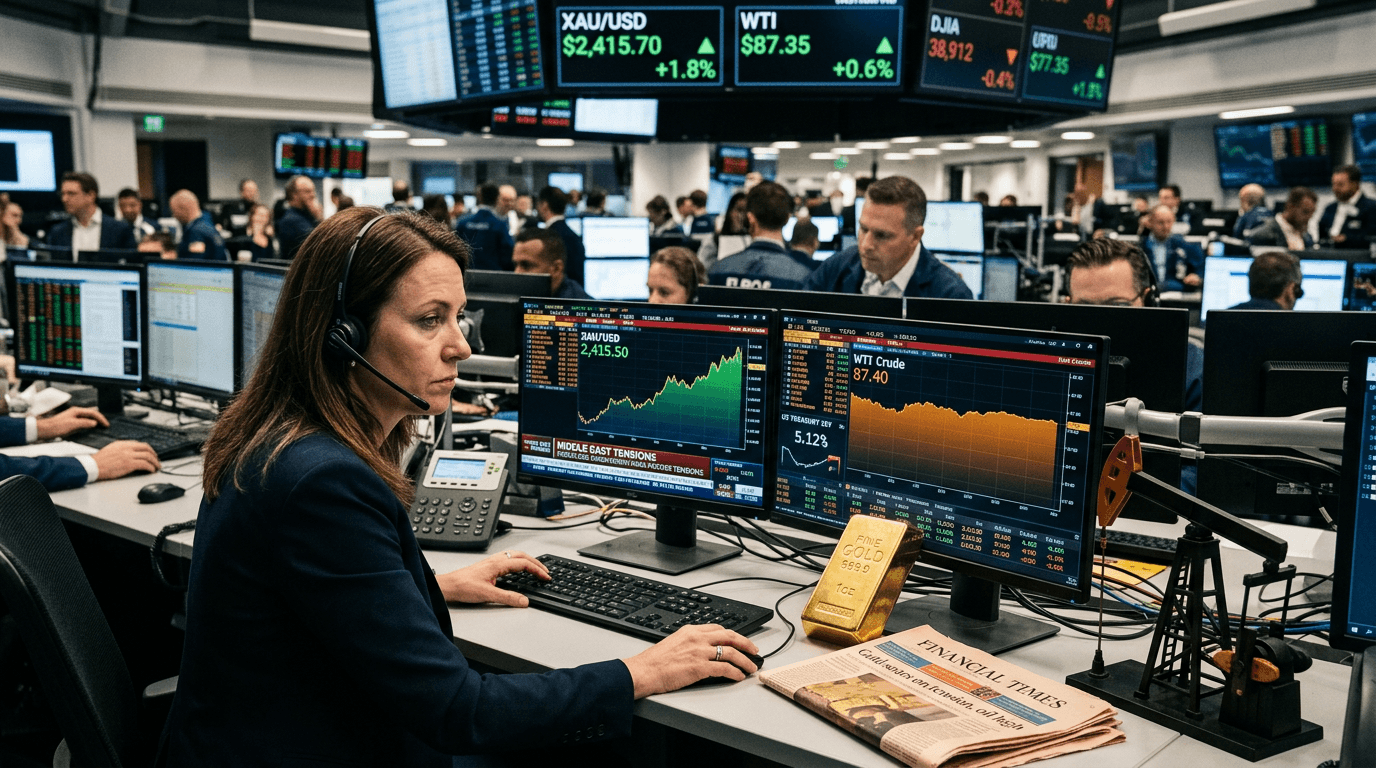
A fresh bout of Middle East tensions and Iran–Israel headlines has pushed investors back into classic hedges, sending gold higher even as crude oil holds near recent highs. Safe-haven demand is helping the metal erase earlier losses, while elevated energy prices keep inflation concerns alive and add a new layer of complexity to the macro narrative.[1][2][5]
Market Backdrop: Gold Rebounds, Oil Holds High Ground
After a brief pullback, gold has regained its footing as traders react to geopolitical risk and reassess the balance between growth, inflation, and interest rates.[1][2] The latest move is less about a sudden shift in fundamentals and more about investors scrambling to insure portfolios against tail risks that are hard to quantify but impossible to ignore.
Recent headlines around Iran and Israel have revived demand for safe-haven assets, with gold rebounding after a prior-session drop.[2][4] That swing captures a familiar pattern: when markets briefly relax, profit-taking hits gold; when tensions flare, buyers reappear quickly and in size.
On the energy side, crude oil remains elevated after a sharp spike driven by fears of supply disruption and broader conflict risk in a key producing region.[1][5] While some analysts argue that global supply is not yet severely constrained, the risk premium embedded in prices has increased, keeping benchmarks well above recent lows and sustaining volatility across the energy complex.[1][5]
The combination of firmer gold and still-high oil is telling a consistent story: markets are repricing geopolitical risk and its potential to spill over into inflation and central bank policy.
Why Geopolitics Drives Safe-haven Flows
Geopolitical shocks affect markets through several channels, and gold sits at the center of that intersection.[1]
First, gold acts as a traditional safe haven. In periods of heightened uncertainty—especially when headlines involve military action or the possibility of escalation—investors often rotate out of equities, high-yield credit, and more speculative assets into instruments perceived as resilient in crises.[1][2] Gold’s long history as a store of value and its independence from any single government’s balance sheet reinforce its appeal when political risk is front and center.
Second, gold functions as an inflation hedge. A sustained rise in oil prices pushes up transportation and production costs, which can filter into broader consumer prices.[1][5] When traders worry that higher energy will keep headline inflation sticky, the logic of holding an asset that has historically preserved purchasing power becomes more compelling.[1]
These two channels—risk aversion and inflation hedging—can operate simultaneously. When a conflict threatens both stability and energy supply, the result is often a double boost to gold demand.[1][5] That is what current price action is signaling: safe-haven inflows are back, and they are being reinforced by concerns that expensive energy could complicate the path back to lower inflation.
Inflation, Rates And Currencies: The Macro Ripple Effect
Higher oil and a stronger gold bid are not just commodity stories; they feed directly into expectations for central banks, bond yields, and currencies.
If elevated crude keeps energy costs high, headline inflation may prove more stubborn than markets or policymakers would like.[1][5] In that scenario, central banks could delay rate cuts or opt for a more gradual easing cycle. Traders who had positioned for aggressive monetary loosening may be forced to adjust, steepening yield curves and lifting real yields relative to prior expectations.
This matters for gold because the metal is sensitive to the opportunity cost of holding a non-yielding asset. Higher real rates generally weigh on gold; lower real rates support it. The current environment is a tug-of-war: safe-haven and inflation-hedging flows are pushing gold higher, while the prospect of fewer or slower rate cuts caps upside.[1][5]
Currency markets are also feeling the effects. Historically, oil shocks can support commodity-linked currencies like the Canadian dollar and Norwegian krone, while safe-haven episodes may bolster the US dollar and Swiss franc.[1][5] That mix can create cross-currents in FX, with some pairs driven more by rate expectations and others by pure risk sentiment.
For traders, the message is clear: the gold and oil moves are not isolated. They feed into inflation swaps, rate futures, FX volatility, and equity sector performance—from energy and defense stocks to travel, airlines, and consumer discretionary names.
Practical Takeaways For Discretionary And Systematic Traders
For discretionary traders, the key is to separate signal from noise. Not every geopolitical headline justifies a major portfolio shift, but sustained tension in a strategic energy region deserves attention. Watching how gold reacts relative to oil can provide clues: if gold rallies strongly while oil only edges higher, markets may be pricing more pure risk aversion than supply shock. If both surge, concerns about inflation and growth may be intensifying.[1][5]
Risk management should come first. In environments like this, volatility can spike quickly and gap risk increases across commodities, FX, and equity indices. Position sizing, wider but defined stops, and an awareness of key event risk—official statements, ceasefire rumors, sanctions—become critical.
Systematic and quantitative traders can view this episode as a stress test for factor models. Regimes characterized by geopolitical risk often see correlations shift: gold may decouple from real yields for stretches, commodity currencies can trade more like risk assets than carry plays, and equity betas change as sector leadership rotates toward energy and defense.[1] Updating correlation matrices and scenario testing can help algorithms adapt to the new regime.
For traders practicing on SimFi platforms, this is an ideal environment to build and test playbooks without real capital at risk. A few practical drills include:
- Designing a rules-based strategy that responds to spikes in gold volatility around geopolitical headlines, with predefined entry and exit criteria.
- Backtesting how different asset classes—gold, oil, major FX pairs, and equity indices—behave during historical Middle East flare-ups, and using those patterns to inform current positioning.
- Stress-testing portfolios under scenarios such as a further escalation (higher oil, stronger safe-haven bid) versus a rapid de-escalation (oil retracement, partial unwind of gold gains).
The objective is not to predict every headline, but to develop a structured framework for reacting when they arrive.
Key Ideas To Watch Next
Going forward, three variables matter most.
First, the trajectory of Middle East tensions. Any signs of de-escalation could ease the safe-haven bid and allow oil’s risk premium to compress, while fresh escalation risks the opposite.[1][5]
Second, incoming inflation data and central bank communication. If policymakers signal they are willing to look through temporary energy spikes, rate expectations may stabilize even with higher oil. If they emphasize upside price risks, markets could further reprice the path of cuts, affecting both gold and risk assets.[1][5]
Third, market positioning and sentiment. After sharp swings, positioning can become crowded in gold or energy, making these markets vulnerable to sudden reversals on any hint of good news. Traders who understand where consensus sits—and where pain points are—will be better equipped to navigate the next phase of this story.
For now, the message from markets is straightforward: geopolitical risk is back on the radar, gold is once again proving its value as portfolio insurance, and elevated oil is keeping the inflation debate alive. How traders respond to this intersection of geopolitics, commodities, and macro policy will define the next chapter of volatility across asset classes.