
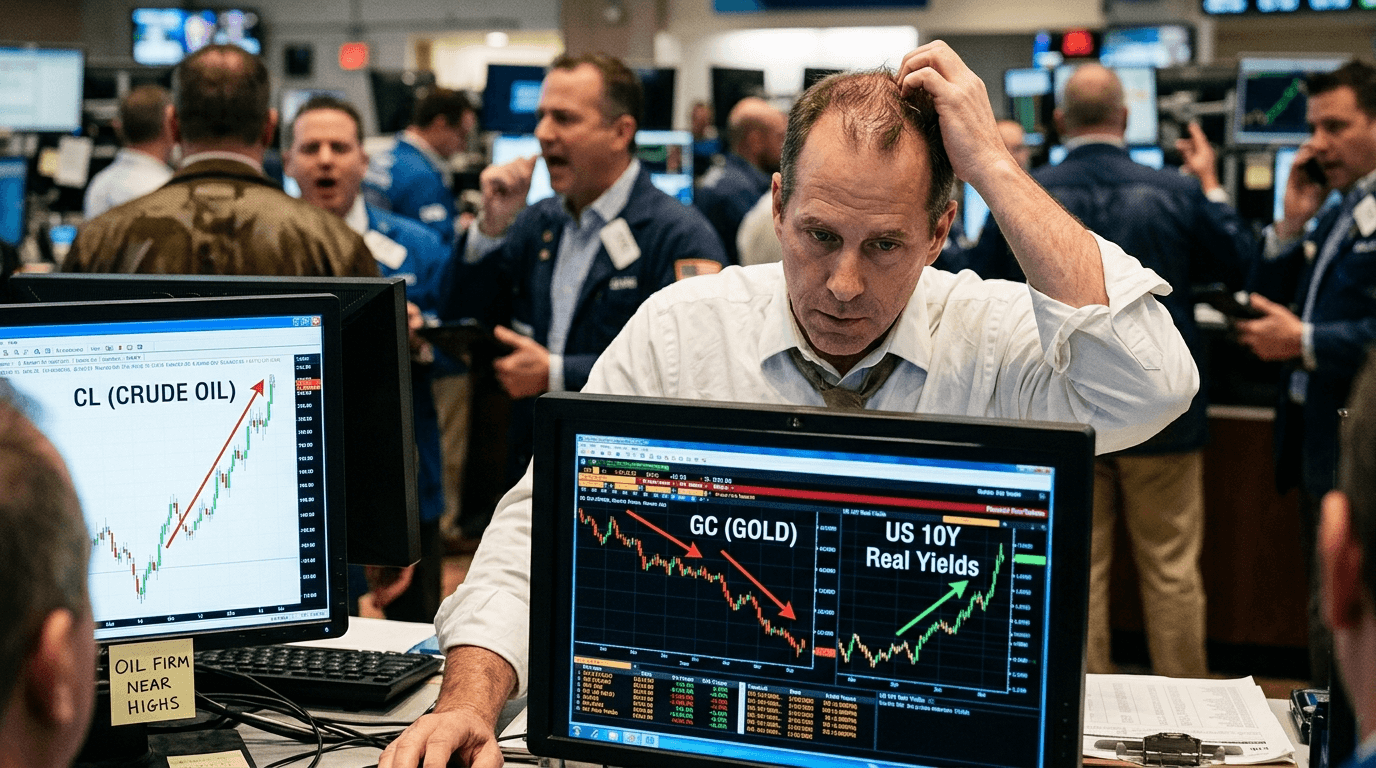
Gold is on the back foot while oil stubbornly holds near recent highs, and that divergence says a lot about how macro forces are rippling through the futures and commodities landscape. With gold futures slipping as real yields grind higher and the dollar stays firm, and crude trading in the low‑90s on renewed geopolitical and supply worries, traders are seeing a textbook example of how different assets respond to the same environment in very different ways.
Current Market Snapshot
Gold has eased by a little over 1% from recent levels, with futures and spot pricing clustered in the 4,440–4,480 range after a series of sessions where daily drops of around 1% followed stronger real yields or hawkish policy tone[1][3][15]. That price zone sits not far below recent highs, but the tone has shifted from relentless strength to a more cautious consolidation, as investors reassess the opportunity cost of holding a non‑yielding asset in an environment where inflation‑adjusted returns on safe bonds are improving[4][9][11]. Recent data shows gold futures around 4,459 with modest day‑to‑day declines, reinforcing the idea that the market is under pressure rather than in free fall[7].
Oil, by contrast, remains elevated in the low‑$90s per barrel after recent gains tied to Middle East tensions and supply concerns. That resilience is feeding through to energy‑linked equities and keeping inflation expectations from falling too quickly, as higher fuel costs filter into corporate margins and consumer prices. The result is a split screen for traders: a defensive metal losing momentum while a key input cost for the global economy refuses to back down.
Why Gold Is Sliding
The primary headwind for gold right now is higher real yields. Real yields measure the inflation‑adjusted return from bonds; when they rise, yield‑bearing assets look more attractive relative to gold, which pays no income[4][9][11]. Decades of data show a strong negative correlation between gold prices and the 10‑year US Treasury inflation‑protected (TIPS) yield, often around −0.7 to −0.9 across major periods[4][12]. Research and trading models suggest that a 1 percentage point increase in real yields can translate into a substantial decline in gold prices, sometimes on the order of 20% or more in historical episodes[4][12][14].
This mechanism is straightforward. When nominal yields rise faster than inflation expectations, the real return on safe bonds increases. Holding gold then carries a higher opportunity cost, because investors forego a richer inflation‑adjusted coupon in exchange for an asset whose payoff is driven mainly by price appreciation and its role as a store of value[9][11][14]. Conversely, when real yields fall or turn negative, that opportunity cost collapses and gold tends to benefit as capital rotates toward assets perceived as hedges against currency debasement and long‑term inflation risks[2][5][12].
On top of real yields, a firm—though slightly softer—dollar is adding pressure. Gold is priced globally in dollars, so a stronger US currency typically weighs on demand from non‑US buyers, making each ounce more expensive in local terms[3][6][13]. The recent combination of rising real yields, a dollar that remains near short‑term highs, and less urgent hedging demand has been enough to push gold futures lower on multiple occasions in recent months[1][3][15]. For traders, the key takeaway is that gold’s bull case now depends less on broad macro anxiety and more on whether real yields can stabilize or move lower again.
Why Oil Is Holding Firm
Oil’s story is very different, rooted in physical supply and geopolitical risk rather than financial opportunity cost. Prices in the low‑$90s per barrel reflect a market where traders see a meaningful probability of supply disruptions, particularly in the Middle East, alongside tighter balances from production restraint and delayed capacity expansions. Even when demand growth softens, concerns about outages or sanctions can keep risk premia embedded in crude benchmarks, supporting futures curves near recent highs.
Higher oil prices also feed back into inflation expectations. Energy is a direct input into transportation, manufacturing, and heating, so persistently expensive crude raises the floor under headline inflation, even if core components are moderating. This can complicate central bank policy: policymakers want to keep inflation expectations anchored, but they must weigh near‑term energy shocks against longer‑term trends. For commodities traders, that uncertainty tends to show up as wider trading ranges, with oil reacting sensitively to news on inventories, OPEC+ decisions, and regional tensions.
From an intermarket perspective, elevated oil and a sliding gold price highlight a key nuance: not all “inflation hedges” move together. Gold responds more to the pricing of real yields and monetary policy, while oil is driven mainly by the balance between physical supply, storage, and demand. Understanding that distinction helps traders avoid assuming that strength in one commodity automatically implies strength in another.
Implications For Traders And Portfolios
For directional traders, gold’s pullback toward the mid‑4,400s is a reminder to track real yields as a core input to any gold strategy[4][9][12]. Before adding long exposure, it is useful to ask whether the inflation‑adjusted return from bonds is likely to fall, stabilize, or rise further. If real yields continue climbing, gold may face ongoing headwinds; if they soften on dovish policy or weaker growth data, gold can quickly regain its footing as a defensive allocation[2][5][14].
Oil’s firmness near recent highs suggests that volatility around supply headlines may present both opportunity and risk. Short‑term traders might focus on calendar spreads, crack spreads, or relative value between benchmarks to express views on refining margins and regional supply constraints. Longer‑term investors need to consider how sustained $90‑plus oil could affect corporate earnings, sector rotations, and inflation trajectories, particularly for energy‑intensive industries.
Portfolio builders should also note the different roles these commodities play. Gold often serves as a macro hedge against financial stress, currency risk, and tail events, with effectiveness influenced heavily by real yield dynamics[4][10][12]. Oil exposure, whether through futures, equities, or sector indices, is more tied to cyclical growth, geopolitics, and inflation. Allocating to both can diversify commodity risk, but each position must be justified on its own drivers rather than a generic “commodity supercycle” thesis.
How Simulated Finance Can Help You Navigate This Divergence
For many traders, the current environment is complex: gold is recalibrating to higher real yields, oil is trading with a geopolitical premium, and cross‑asset correlations are shifting. Practicing in a simulated environment can help refine strategies without the pressure of real capital at risk. A structured SimFi platform allows traders to test how gold futures react when real yields move, or how oil responds to inventory surprises and headline shocks, using realistic pricing, margin, and risk parameters informed by actual market behavior[4][7][9].
By running scenario analyses—such as a sudden drop in real yields, a spike in crude supply disruptions, or synchronized shifts in both—traders can observe how P&L, margin usage, and drawdowns evolve across different portfolios. This kind of experimentation encourages better position sizing, clearer entry and exit rules, and more disciplined risk management. Over time, simulated practice can make live trading decisions more data‑driven and less reactive, especially when markets deliver divergent signals like the current gold‑oil split.
The practical takeaway is straightforward: use periods of cross‑commodity divergence as opportunities to sharpen your process. Track the macro variables that matter most for each asset, stress‑test your ideas in a simulated framework, and treat every move in gold and oil as information about the broader regime rather than noise. That mindset helps turn today’s slide in gold and firmness in oil into a learning cycle that can strengthen your trading edge.