
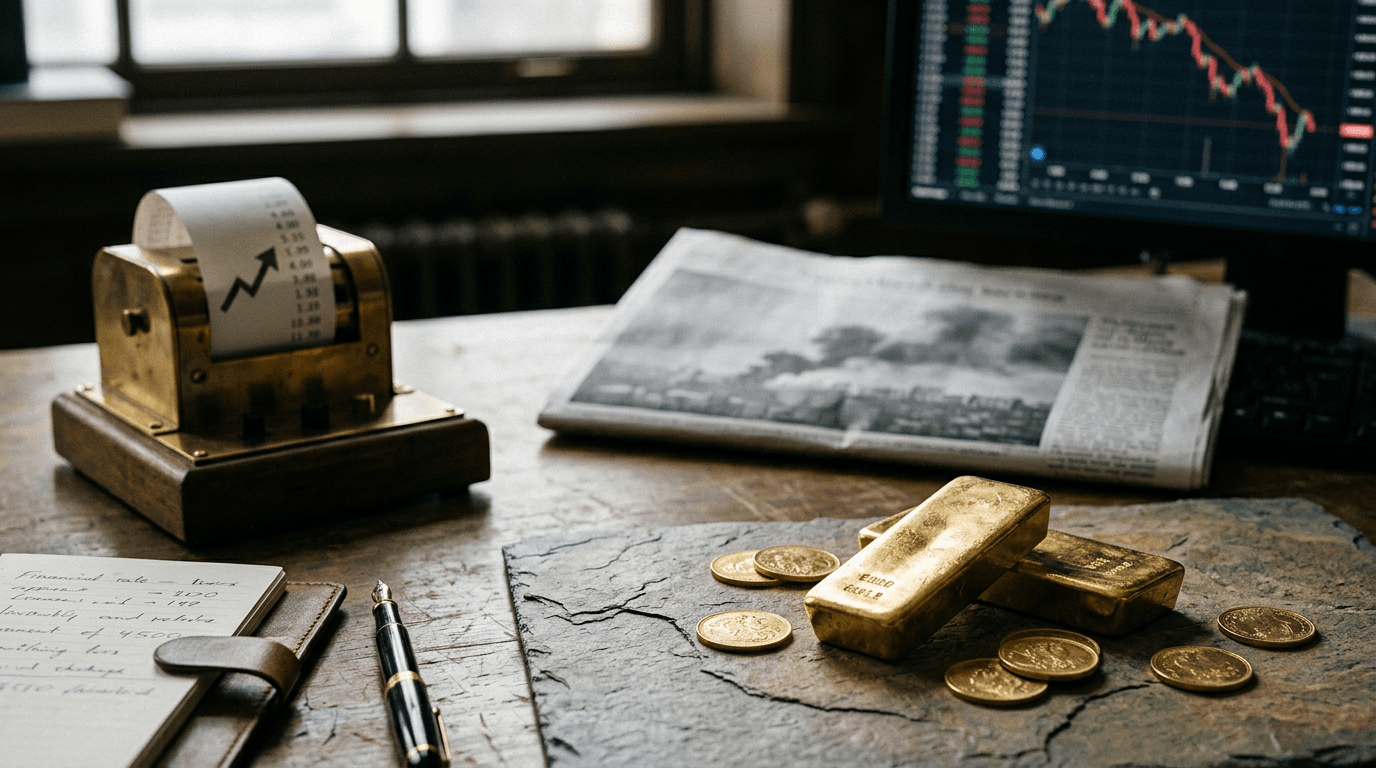
Gold Under Pressure: Testing the $4500 Support Amid Market Shifts
Gold's recent decline has sent ripples across the precious metals market, with the yellow metal struggling to maintain critical support levels that investors had hoped would remain intact. As of late March 2026, gold has fallen from its earlier highs near $5,594, testing crucial support in the $4,400-$4,500 range. This notable retreat reflects broader market dynamics that are reshaping the precious metals landscape. The pullback is driven by a combination of rising US Treasury yields, a strengthening US dollar, and heightened geopolitical tensions, which, paradoxically, have diminished safe-haven demand for gold while boosting the dollar.
Current Price Action Reveals Market Sentiment
Gold traded at $4,551 per ounce on March 19, 2026, sliding to $4,463.57 by March 23, and further descending to $4,384 by March 24. This sharp reversal from the metal's impressive run earlier in the year, breaking the psychological $5,000 barrier, underscores the magnitude of this correction. Just weeks earlier, optimism surrounded gold's performance, leaving market participants questioning whether this support level will hold or if further downside is imminent.
Deciphering the Rate Headwinds
The rise in US Treasury yields is the primary factor behind gold's recent challenges. As a non-yielding asset, gold becomes less attractive when Treasury yields climb, increasing the opportunity cost of holding it. This dynamic has been magnified by shifting inflation expectations and the Federal Reserve's influence on market pricing. The concurrent strengthening of the dollar, which makes gold more expensive for international buyers, further reduces its appeal as a hedge against currency depreciation.
The current scenario is particularly intriguing as geopolitical tensions, typically a driver of safe-haven demand for gold, have played a nuanced role. Escalating Middle East tensions and global energy supply concerns have indeed attracted some investors to precious metals. However, the overriding force has been the dollar's strength. The dollar index rose by 0.35% in late March, buoyed by doubts about ceasefire prospects in Iran and a strong US labor market, suggesting that the Federal Reserve may maintain restrictive monetary policy longer than expected.
Gold vs. Silver: A Diverging Path
A widening gap between gold and silver's performance highlights market stress. Silver has experienced a steeper decline, dropping toward $70 per ounce, suggesting that the weakness in precious metals is driven more by technical selling and broader risk-off sentiment rather than a fundamental loss of faith in gold's safe-haven properties. When investors need to raise cash, they often sell their most liquid holdings first, including silver futures and ETFs, a pattern that typically precedes a capitulation bottom.
Technical Support and Market Psychology
The $4,500 and $4,400 levels are significant technical support points where previous buying interest emerged. However, gold's rapid approach to these levels indicates formidable selling pressure. Some analysts believe that if gold holds above the $4,600 level, the longer-term structure remains intact for recovery, highlighting the psychological importance of round numbers and technical levels in precious metals trading.
Earlier in March 2026, gold was approaching $5,594, with forecasts suggesting the metal could trade between $5,078 and $6,234 during the month. Major investment banks have released bullish year-end targets, with Goldman Sachs projecting $5,400, JPMorgan forecasting $6,300, and UBS suggesting $6,200. While these targets seem distant from current price levels, they underscore analyst confidence in longer-term trends.
Looking Ahead: Implications for Traders
Traders must consider whether the current weakness is a healthy correction within a broader bull market or the start of a more significant reversal. Key factors to monitor include US inflation data releases and Federal Reserve commentary, which will likely drive near-term action. Signs of moderating inflation could ease Treasury yield pressures and support gold. Additionally, developments in geopolitical hotspots and crude oil price trajectories will influence risk sentiment and inflation expectations.
Central bank purchases continue to provide a structural bid under the market as institutions worldwide accumulate gold reserves. This historically provides a floor for extended declines. Despite current weakness, gold's strength in 2026 demonstrates that the longer-term narrative for the metal remains supportive, particularly if interest rate cuts materialize later in the year as some expect.
The battle at $4,500 support is pivotal. A break below this level could lead to $4,400 and potentially cause more technical damage. Conversely, a bounce from current levels could indicate that the worst is over, signaling gold's consolidation before the next upward move.