
Key instructions: 1. Output ONLY the article content in PLAIN TEXT format 2. NO preamble or introductory meta-commentary 3. Start directly with the first paragraph 4. Use ALL CAPS for section headings on their own line 5. Separate paragraphs with blank lines 6. Include 3-5 main sections with clear takeaways 7. Make it engaging and educational 8. 800 words approximately 9. At the very END, provide TITLE, EXCERPT, and NEWSIMPACTSCORE on separate lines
From the search results, I can extract: - Gold prices surged to $5,390/oz (+2.10%) - Silver rallied above $95/oz (+1.5%) - U.S. and Israeli strikes on Iran caused the surge - Safe-haven demand is driving prices - Oil concerns about Strait of Hormuz disruptions - Geopolitical tensions between U.S., Israel, and Iran - Gold rose to $5,004.47 per ounce (another source mentions different price, likely different time) - Christopher Wong from OCBC predicts consolidation: gold $4,800-$5,100, silver $70-$90 - Kyle Rodda from Capital.com notes safe-haven demand - Physical gold demand in Dubai spiking with supply constraints - Fed monetary policy is also a factor
Let me write an 800-word blog article in plain text format:
I need to: 1. Start directly with content 2. Use plain text (no markdown) 3. Use ALL CAPS for headings on their own line 4. Include practical takeaways 5. Make it engaging but professional 6. Keep paragraphs concise 7. After all content, add TITLE, EXCERPT, and NEWSIMPACTSCORE
8. Begin writing the article now without any preamble
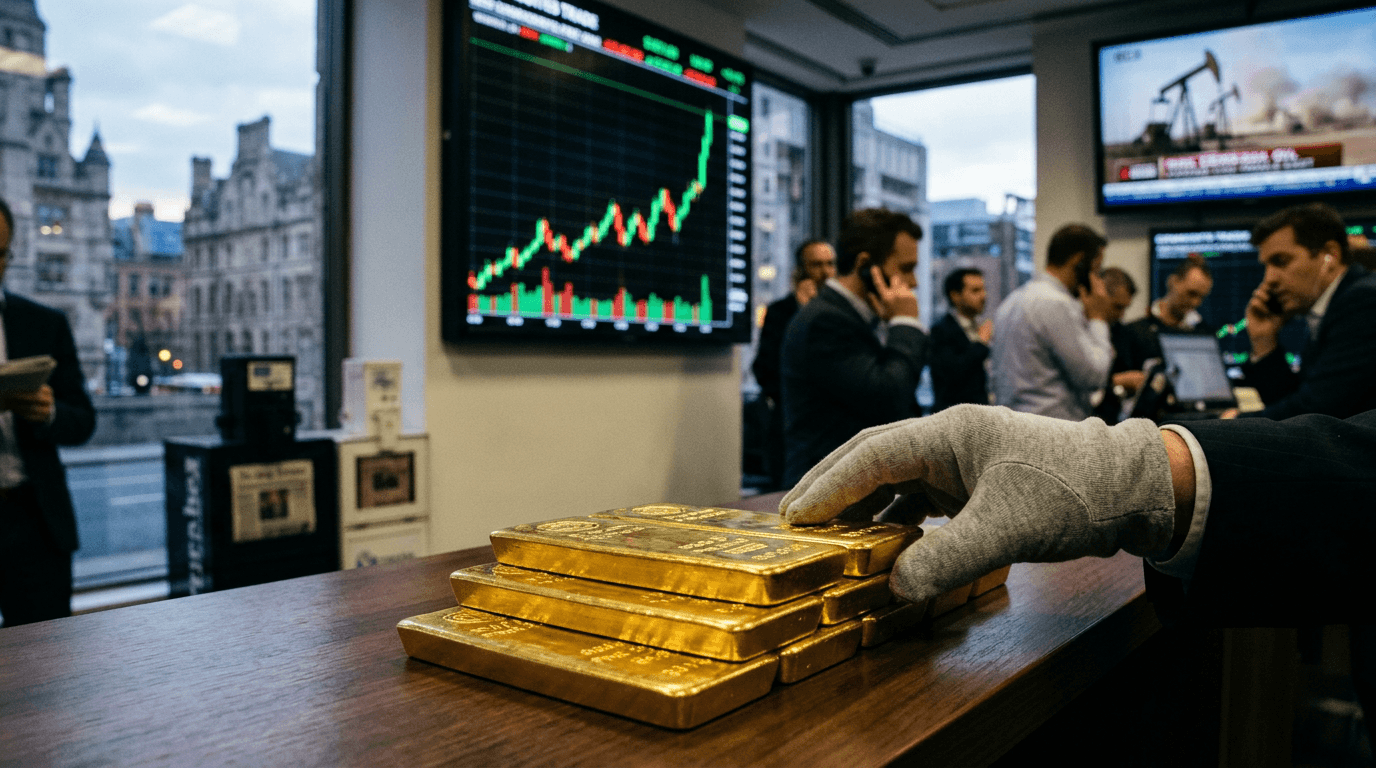
Geopolitical tensions in the Middle East have triggered a classic flight-to-safety rally, sending gold prices surging to multi-week highs as investors seek shelter from mounting uncertainty. After joint U.S. and Israeli military strikes on Iran ignited fresh escalation concerns, precious metals markets responded decisively, with gold climbing to $5,390 per ounce—a gain of 2.10%—while silver rallied above $95 per ounce, marking a robust 1.5% advance. For traders and portfolio managers watching global markets, this development underscores a fundamental truth: when geopolitical risk spikes, gold remains the ultimate safe-haven asset.
The Immediate Catalyst: Middle East Conflict
The catalyst behind this week's precious metals rally is straightforward but significant. Military action between the U.S., Israel, and Iran unsettled global markets, prompting investors to reassess their risk exposure. What began as tensions escalated into active military strikes, followed by Iranian retaliation across the region. This tit-for-tat dynamic creates precisely the kind of uncertainty that drives capital toward defensive positions.
The escalation raised particular concerns about shipping through the Strait of Hormuz, a chokepoint for roughly 20 percent of global oil flows. Any disruption to this critical shipping lane would create substantial supply shocks, explaining why crude oil surged alongside precious metals. For gold investors, this dual concern—both geopolitical risk and potential inflation from oil price spikes—creates a compelling fundamental case for higher valuations.
Safe-haven Demand And Investor Behavior
Kyle Rodda, senior market analyst at Capital.com, captured the core dynamic perfectly: "If there's anything fundamental you could point to that would be supporting gold prices, it's the prospect of conflict in the Middle East and the kind of safe-haven demand that goes along with it." This statement reveals why gold consistently outperforms during crisis periods. Unlike stocks or bonds vulnerable to economic deterioration, gold historically holds value when uncertainty peaks.
Physical gold demand is particularly notable in regions closer to the conflict zone. According to market observers, physical gold demand in Dubai is spiking amid supply constraints, indicating that institutional and retail buyers are actively rotating capital into tangible bullion holdings. This structural buying pressure—demand that existed before the escalation—combined with crisis-driven flows, creates reinforcing momentum in precious metals.
Broader Precious Metals Landscape
The strength across precious metals extends beyond gold. Silver's 1.5 percent advance follows a more dramatic 5 percent jump the previous day, suggesting traders are not merely rotating into traditional safe havens but embracing the entire commodity complex. Platinum edged 0.7 percent higher to $2,084.71 per ounce, while palladium gained 0.4 percent to $1,722.94. This broad-based strength indicates that the safe-haven bid is capturing multiple precious metals classes.
However, strategists are cautious about extrapolating these gains too far into the future. Christopher Wong from OCBC predicts a period of consolidation in the near term, suggesting gold may trade in a $4,800 to $5,100 range while silver holds between $70 and $90. This perspective reflects the reality that while geopolitical events can trigger dramatic short-term moves, longer-term precious metals trends depend on macroeconomic factors including inflation expectations, real interest rates, and Federal Reserve policy direction.
The Fed Factor And Inflation Concerns
The timing of this geopolitical escalation carries additional significance for traders monitoring monetary policy. Rising crude oil prices from Middle East tensions stoke inflation concerns at precisely the moment when markets are evaluating the Federal Reserve's policy direction. Higher energy prices typically translate to broader price pressures throughout the economy, potentially constraining the Fed's ability to cut rates aggressively.
This dynamic creates a complex environment for gold investors. On one hand, geopolitical risk supports higher gold valuations as a safe-haven asset. On the other hand, higher inflation could limit Fed rate cuts, potentially supporting real interest rates and limiting gold's upside. The interplay between these forces will likely determine whether this week's rally proves durable or represents a tactical opportunity within a broader consolidation phase.
Key Takeaways For Traders
For active traders and portfolio managers, this rally offers several important lessons. First, geopolitical tension remains a powerful driver of safe-haven flows, and gold's response validates its role as portfolio insurance during crisis periods. Second, the physical market dynamics—with Dubai demand spiking amid supply constraints—suggest that wholesale bullion markets are genuinely tight, not merely reflecting financial positioning.
Third, traders should monitor not just gold prices but the broader precious metals complex and crude oil dynamics. When oil surges alongside gold, it signals genuine supply-chain concerns rather than purely financial flows. Finally, while current levels represent meaningful gains, strategic positioning should acknowledge that mean-reversion consolidation often follows sharp tactical rallies in precious metals.
The current environment underscores why sophisticated portfolios maintain meaningful precious metals allocations. Whether this specific rally persists depends on how Middle East tensions evolve and whether crude oil stabilizes, but the underlying lesson remains valid: in times of genuine uncertainty, gold continues to earn its place at the portfolio table.