
1. Output ONLY the article content in PLAIN TEXT format 2. Do NOT include any preamble or introductory meta-commentary 3. Start directly with the first paragraph 4. Use ALL CAPS for section headings on their own line 5. Separate paragraphs with blank lines 6. Include 3-5 main sections with clear takeaways 7. Make it engaging and educational 8. At the very END, provide TITLE, EXCERPT, and NEWSIMPACTSCORE on separate lines
The search results show: - Gold is trading around $5,000 with support at that level - Middle East tensions (US-Iran conflict) are driving safe-haven demand - Gold reached record highs near $5,600 - Geopolitical risk premiums support gold prices - Central bank purchases and macroeconomic factors also support gold - Some sources mention investment volumes fell despite record highs, with ETF outflows in March - Oil prices rising due to tensions (Strait of Hormuz concerns) - Fed rate cut expectations being pushed back
I need to write this in PLAIN TEXT, no markdown. Let me structure it with 3-5 sections that are clear and actionable.
The article should be around 800 words, educational, and appeal to both beginners and experienced traders in the SimFi environment.
Let me create the article without any preamble:
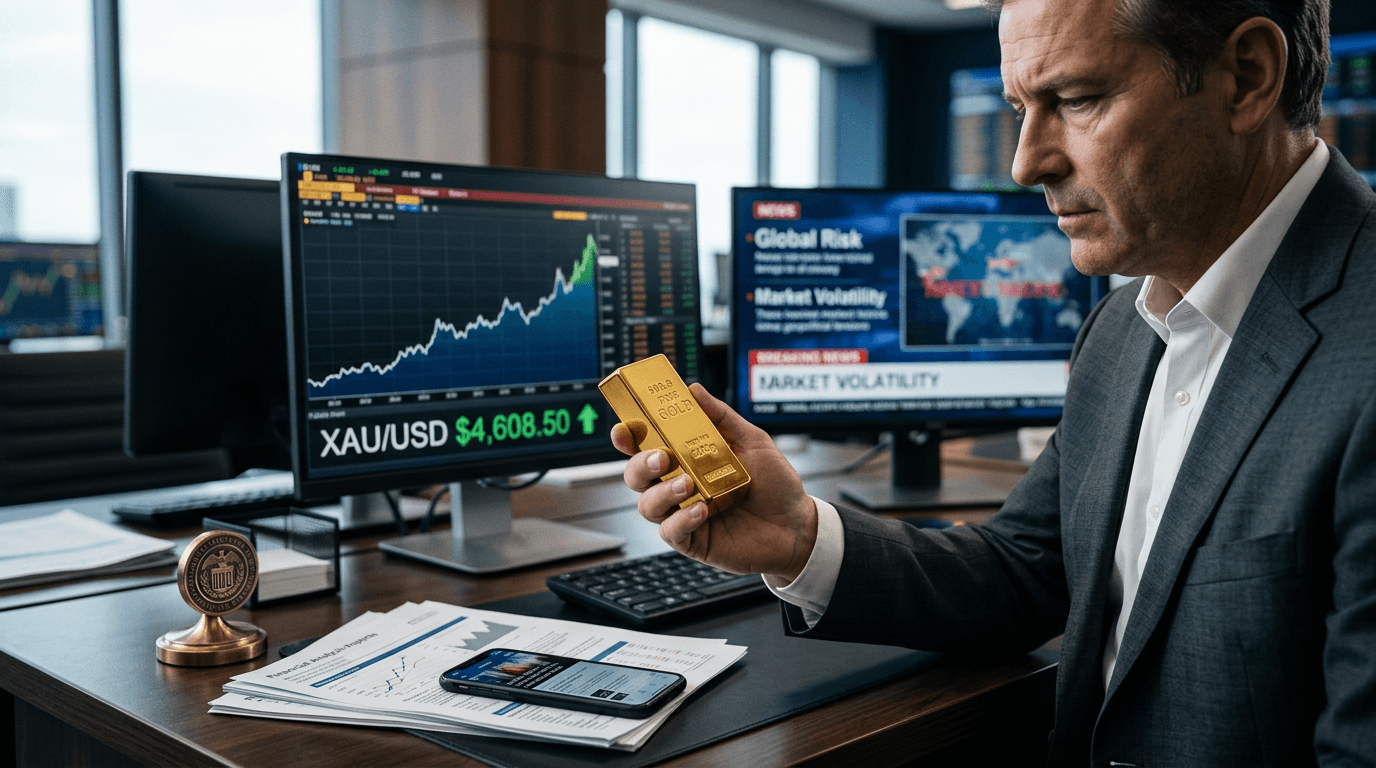
Gold continues to demonstrate its enduring appeal as a safe-haven asset, recovering recent losses and advancing above $4,600 as geopolitical tensions in the Middle East intensify. The precious metal's recent performance underscores a fundamental market truth: when uncertainty rises and traditional markets face headwinds, investors consistently turn to gold to preserve wealth and manage portfolio risk. This dynamic has become increasingly visible in 2026 as escalating US-Iran conflicts reshape global market sentiment and reshape expectations for monetary policy across major economies.
The current rally reflects a confluence of factors that extend far beyond simple technical trading patterns. Gold found crucial support at the $5,000 per ounce level, as the intensifying Middle East conflict enhances its status as the preferred hedge against geopolitical uncertainty. The joint military operations by the US and Israel against Iran have provoked retaliatory responses that raise the prospect of further escalation, creating precisely the kind of environment where safe-haven assets traditionally thrive. For traders evaluating positions in simulated finance environments, this scenario presents a compelling risk-reward setup with well-defined technical parameters.
Understanding The Geopolitical Premium
Geopolitical risk premiums significantly enhance the value of safe-haven assets, with gold's allure during international tensions being well-documented across market cycles. When news from the Middle East deteriorates, capital consistently shifts away from riskier assets like equities and emerging market currencies toward defensive positions, with gold serving as the institutional investor's preferred choice. The mechanics are straightforward: conflict uncertainty raises tail risks across equity markets and increases volatility in currency markets, making non-yielding but stable assets like gold comparatively attractive.
The closure of the Strait of Hormuz and threats to shipping in this strategically vital energy corridor have triggered sharp rises in oil prices. These commodity price pressures introduce inflation concerns that reshape Federal Reserve expectations, ultimately pushing expectations for interest rate cuts further into the future. When real interest rates decline, the opportunity cost of holding non-yielding gold decreases materially, removing a traditional headwind to precious metal prices. This interconnected dynamic between geopolitical risk, energy prices, and monetary policy creates multiple layers of support for gold at elevated levels.
Macroeconomic Foundations Supporting Higher Prices
Beyond immediate geopolitical concerns, robust macroeconomic factors continue establishing structural support for gold prices. The US dollar remains under pressure as real interest rates have declined to levels not seen since mid-2023, materially reducing the opportunity cost of holding non-yielding assets. Central bank gold purchases remain near record levels, with expectations for 900 to 950 metric tons of purchases in 2025 as global institutions actively diversify away from dollar reserves. This demand from official sectors establishes a clear structural floor beneath prices, indicating that monetary authorities themselves recognize gold as increasingly valuable for long-term asset preservation.
Total global gold demand is trending toward approximately 4,850 metric tons for the year, marking the highest level since 2011. This robust investment demand, combined with physical scarcity and official sector purchases, creates multiple support layers at elevated price levels. The ongoing conflict has created a steady bid under gold prices that extends well beyond technical chart levels, as central banks and institutional investors actively accumulate physical gold to hedge macro risks in their portfolios.
Trading Implications For Simulated Finance Environments
For traders in SimFi platforms, gold maintaining support at $5,000 amidst geopolitical tensions offers a compelling risk-reward scenario with clearly defined parameters. The technical outlook suggests that buyers are prepared to defend this level, with analysis indicating that scenarios above $5,100 are more probable than downward movements. Risk management becomes straightforward, with defined stop-loss placements below $4,900 allowing traders to precisely quantify their downside risk exposure.
Analyst forecasts suggest gold could trade between $5,078 and $6,234 depending on developments in Middle East tensions and the Federal Reserve's monetary policy response. In scenarios involving direct US-Iran military conflict escalation, gold could rise approximately 15 percent within two weeks due to acute safe-haven demand, potentially targeting a range of $5,500 to $5,800. These price objectives reflect the market's built-in premium for geopolitical tail risks, though traders should remain aware that technical corrections could occur following such strong upward moves.
Market Dynamics And Practical Takeaways
The disconnect between record gold prices and declining investment volumes during the first quarter reveals important market psychology. While gold touched nearly $5,600 per ounce in January, ETF volumes fell 5 percent during the quarter as some investors liquidated holdings to raise cash amid conflict-driven market stress. This pattern reminds traders that price and volume often diverge during crisis periods, with forced selling occasionally overwhelming fundamental support levels in the short term.
Oil price increases stemming from Middle East tensions have disrupted traditional market relationships and prompted reassessment of inflation expectations. Markets have shifted expectations for the first Federal Reserve rate cut to September, materially later than previously anticipated. This repricing of monetary policy expectations removes a significant headwind that had pressured gold during periods of higher rate expectations.
The current environment highlights why gold remains essential for diversified portfolio construction during periods of elevated geopolitical uncertainty. Whether trading in simulated environments or managing real portfolios, understanding the relationship between geopolitical events, monetary policy expectations, and safe-haven demand provides a valuable framework for navigating volatile periods and identifying compelling risk-reward scenarios.