
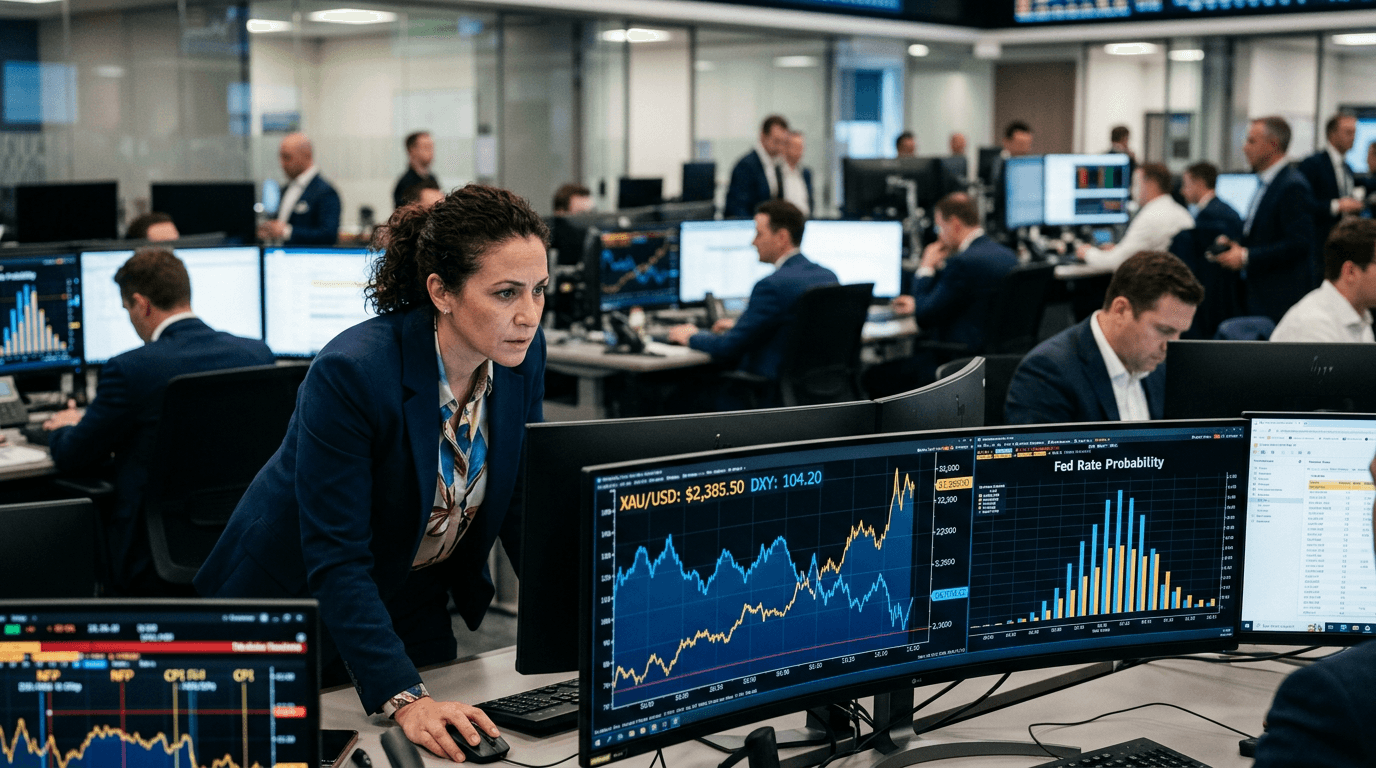
Gold and the dollar have spent August locked in a tug-of-war driven less by headlines and more by how traders interpret every data release and every nuance in Federal Reserve guidance[12][14][15]. With gold recently coming under pressure as the dollar recovers, the message from the market is clear: expectations for the Fed’s next moves, and the sensitivity of those expectations to incoming data, are now the dominant forces shaping currency and precious-metals pricing[12][8][15]. For traders in both live and simulated markets, understanding this dynamic is essential to navigating the next phase of the macro cycle.
Markets Reprice The Fed
Over the past several weeks, futures markets have sharply revised the odds of a September rate hike as softer US inflation, retail sales and jobs data challenged the case for further tightening[2][6][14]. At one point, implied probabilities dropped from above 50% to roughly one in three, reflecting a notable swing in sentiment rather than a formal policy shift[2][14][15]. Each new data print has quickly fed into FedWatch-based pricing, which in turn has rippled through Treasury yields, the dollar index and gold[2][4][6].
This fluid repricing explains why gold and the dollar have moved in relatively fast, alternating bursts instead of a smooth trend[4][8][12]. When weak data dampens hike expectations, yields ease, the dollar softens and gold tends to catch a bid as the opportunity cost of holding a non-yielding asset falls[4][6][12]. Conversely, any sign that growth or inflation may force the Fed’s hand pushes hike odds higher, lifts the dollar and puts gold under renewed pressure[8][10][15]. Traders are not simply reacting to the Fed’s decisions; they are constantly trading the probabilities.
Key takeaway: The current environment is defined by probability trading. Staying on top of how markets price Fed odds week to week is as important as following the eventual policy decision itself.
Why Gold And The Dollar Move In Opposite Directions
The recent pattern reinforces a familiar relationship: gold and the dollar often move in opposing directions because they compete for similar flows in a rate-sensitive world[4][8][12]. A stronger dollar makes dollar-denominated gold more expensive for non-US buyers and typically coincides with higher real yields, both of which weigh on bullion[4][8]. A softer dollar, especially when accompanied by lower yields, tends to support gold as investors look for stores of value and portfolio diversifiers[4][11][12].
In August, gold has oscillated around a soft support area near the low-$4,000s per ounce, with upside bursts whenever rate-hike odds retreat and downside phases when the dollar and long-dated yields push higher[4][9][11]. Policy-related episodes, such as the Fed’s hawkish pause and US Treasury liquidity announcements, have triggered sharp moves as markets reassess both the path of rates and broader risk sentiment[4][7][9]. The net result is a regime where gold trades less on traditional supply-demand factors and more as a macro instrument tied to real yields and the dollar.
Key takeaway: For directional gold trades, dollar trends and real yield expectations are now primary inputs. Traditional factors still matter, but macro pricing is setting the pace.
Data Sensitivity Is Back
One of the defining features of this phase is how quickly markets react to incremental data surprises. Recent softer CPI, flat PPI and weaker consumer sentiment saw September hike odds slide toward the 30–35% area, while stronger regional manufacturing or labor data briefly pushed them higher again[6][13][14]. Gold, silver and the dollar have all responded, often within minutes of releases, as algorithmic and discretionary traders adjust rate-path scenarios[6][7][13].
This heightened data sensitivity reflects a late-cycle environment in which the Fed is close to the peak of its tightening path but has not yet firmly pivoted[11][14][15]. In such periods, marginal changes in inflation or growth have outsized effects on expectations, even if the Fed ultimately holds rates steady at upcoming meetings[4][11]. That is why gold can rally several percent on dovish data one week and give back gains when numbers surprise to the upside the next[4][6][14].
Key takeaway: The calendar matters again. Traders who map out key releases and understand how each one feeds into Fed scenarios are better positioned than those reacting after the move.
Implications For Forex And Commodity-sensitive Fx Pairs
This economy-linked move extends beyond XAU/USD and the broad dollar index into major and commodity-sensitive FX pairs[12][14]. Currencies like AUD, NZD and CAD, as well as emerging-market units tied to metals and energy exports, are reacting to both global risk appetite and the changing cost of dollar funding[12][14]. When weaker US data softens the dollar and lowers hike odds, carry and commodity FX can catch support as capital rotates toward higher-yielding or resource-linked markets[12][14]. When the dollar strengthens on hawkish repricing, those same pairs can underperform as funding pressures and risk aversion rise[8][10][14].
Gold’s moves are also influencing currencies of major gold-exporting countries, where bullion revenue, terms of trade and local growth expectations intersect[11][14]. For multi-asset traders, these cross-asset links create opportunities to express macro views via FX rather than directly in metals or rates, especially in markets where liquidity or leverage constraints make commodity exposure more complex[12][14].
Key takeaway: Thinking in cross-asset terms adds edge. Gold, the dollar, rates and commodity FX are different expressions of the same underlying macro story.
How Simulated Finance Traders Can Respond
For traders on SimFi platforms such as E8 Markets, this environment is ideal for building and testing rule-based strategies around macro catalysts. Simulated portfolios can be structured to track how changes in Fed expectations, as inferred from futures and data releases, affect correlated assets like gold, the dollar index and key FX pairs[2][6][12]. This allows traders to refine entry and exit rules, position sizing, and diversification tactics without capital at risk.
A practical framework might combine three elements: a view on upcoming data, a real-time read of how markets reprice Fed odds, and a cross-asset expression that fits the trader’s risk profile[4][6][14]. For example, a setup could be: “If core inflation prints below consensus and Fed hike odds drop, look for dollar weakness and short-term gold strength; express via XAU/USD and a selected commodity FX pair with tight risk limits.” Back-testing such scenarios in simulated conditions helps traders understand both the reward and the drawdown profile of macro-driven strategies before deploying them in live markets.
Key takeaway: Use the current macro regime as a laboratory. Simulated trading is a powerful way to stress-test macro ideas and build confidence in execution.
Conclusion
Gold’s recent struggle against a recovering dollar, and the broader shifts across FX and commodities, are best understood as a real-time referendum on Fed expectations and data sensitivity rather than a simple trend change[12][14]. Every major US release now acts as a vote on whether the tightening cycle is truly ending, and markets are repricing that vote across yields, currencies and precious metals[4][6][15]. Traders who combine an understanding of this macro backdrop with disciplined strategy design—whether in live markets or simulated environments—will be better equipped to navigate the volatility and uncover opportunity as the data and the Fed continue to shape the path ahead.