
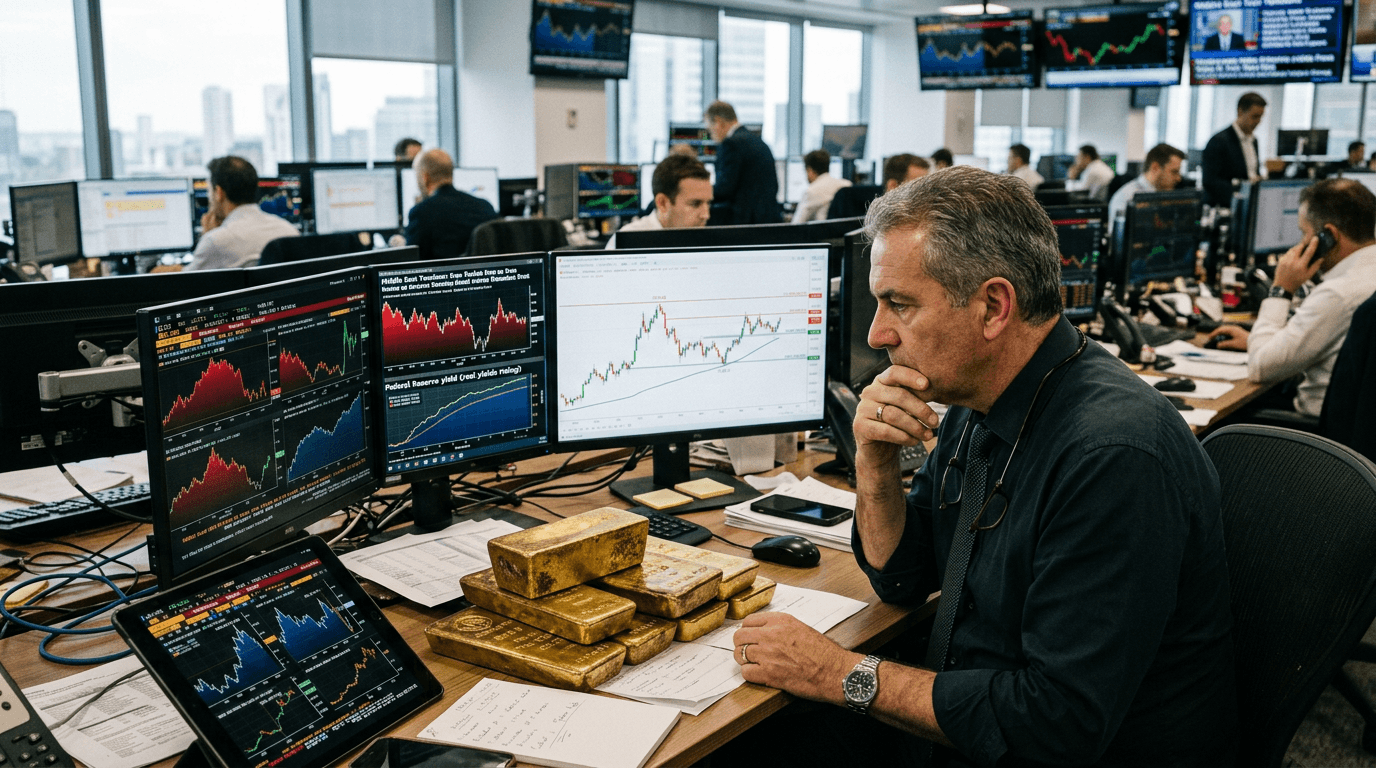
Gold prices have steadied after a sharp pullback driven by rising expectations that the Federal Reserve could keep interest rates higher for longer or even tighten further, while renewed tensions in the Middle East and between the United States and Iran have revived safe-haven demand for bullion.[1][4][8] Investors are now navigating a market where geopolitical risk is providing a floor for gold, but the path higher remains constrained by the outlook for U.S. policy rates and real yields.[7][8]
Safe-haven Demand Returns
Gold’s traditional role as a safe haven is back in focus as conflict risk across the broader Middle East increases and U.S.–Iran tensions resurface.[4][5][12] Episodes such as U.S. and Israeli strikes on Iranian targets and extended nuclear talks have repeatedly driven investors toward gold, spurring price spikes and supporting the metal during periods of equity and credit market stress.[4][5][12] Elevated uncertainty around tariffs, energy prices, and regional security has also reinforced the appeal of gold as a hedge against both geopolitical shocks and potential inflation spillovers.[5][10]
Recent rallies to and near record highs earlier this year underline how quickly safe-haven flows can materialize when political and economic risk rises simultaneously.[2][3][9] In those phases, gold benefited from a combination of central bank buying, institutional inflows, and retail demand seeking an asset perceived as outside the traditional fiat system.[2][4][9] For traders on SimFi platforms, these dynamics highlight why gold often reacts first and fastest to headline risk—even when broader markets are still digesting the implications.
Rate Expectations Cap The Upside
At the same time, the macro backdrop has changed markedly from the ultra-low-rate environment that powered earlier gold bull markets.[7][8] Renewed concerns that the Fed could keep rates “higher for longer,” or even deliver additional hikes if inflation proves sticky, have pushed bond yields and the dollar higher, creating mechanical headwinds for a non-yielding asset like gold.[7][10] When nominal and real yields rise, the opportunity cost of holding bullion versus interest-bearing assets increases, limiting the extent to which safe-haven flows can translate into sustained upside.
Recent price action captures this tug-of-war: gold has tended to stabilize or edge higher on days dominated by Middle East headlines, only to stall or retrace when markets refocus on policy meetings, inflation data, or hawkish Fed commentary.[7][8] Analysts describe the current phase as a “balancing act” in which geopolitical support is offset by the bearish influence of tighter financial conditions and ongoing inflation concerns.[8] In other words, safe-haven demand is strong enough to prevent a deeper selloff, but not yet powerful enough to overcome the drag from rising real yields.
Real Yields And The Dollar: Why They Matter
Understanding the link between real yields, the dollar, and gold is critical for interpreting this environment. A stronger U.S. dollar—often itself a safe-haven asset—makes gold more expensive for non-dollar investors, dampening international demand and occasionally diverting flows away from bullion into cash or short-term Treasuries.[6][7] This has been evident during recent periods when the dollar index climbed to multi-week highs as investors prioritized liquidity, weighing on gold despite ongoing geopolitical stress.[6][7]
Real yields, which adjust nominal yields for inflation, are especially important because they capture the true “carry” investors can earn on safe fixed-income assets relative to zero-yielding gold.[7][8] When inflation expectations fall or policy rates rise, real yields tend to increase, pressuring gold prices and capping rallies that are driven purely by risk aversion.[7][8] For traders and portfolio builders, tracking real yield curves alongside gold futures can offer early clues about whether a safe-haven bid is likely to persist or fade once the macro narrative reasserts itself.
Practical Takeaways For Traders And Simfi Users
For active traders, the current backdrop argues for nuanced rather than one-directional gold strategies. Safe-haven flows tied to U.S.–Iran tensions and broader Middle East risk can create short-term upside spikes and volatility, especially around major headlines or weekend developments.[4][5][12] However, the overhang of potential additional U.S. rate hikes and elevated real yields suggests that chasing momentum without regard to macro data could lead to whipsaw trades as rallies fade when markets refocus on policy.[7][8]
In a SimFi environment, this is an ideal setup to test and refine scenario-based strategies. Traders can simulate:
– Long gold positions triggered by geopolitical risk indicators, paired with tight risk management when major Fed events or inflation releases approach.[4][8] – Relative-value trades that pit gold against rate-sensitive assets, such as long gold versus short bond futures, conditioned on real yield thresholds.[7][8] – Strategies that switch between gold and the dollar, reflecting changing investor preferences for physical safe havens versus liquidity in times of stress.[6][7]
By backtesting these approaches across past episodes—such as recent surges linked to Middle East escalations and tariff uncertainty—traders can better understand how gold behaves when safe-haven and rate narratives collide.[4][5][10][12]
Outlook: What To Watch Next
Looking ahead, the key drivers of gold’s trajectory are likely to remain concentrated in two areas: the evolution of Middle East risk and the Fed’s communication around inflation and growth.[4][7][8] A sustained increase in geopolitical tension, especially involving energy infrastructure or broader regional spillovers, could deepen the flight-to-safety impulse and push gold back toward recent highs despite restrictive policy rates.[4][6][12] Conversely, a clear signal that the Fed is comfortable keeping rates elevated for longer, combined with firmer inflation data, would reinforce higher real yields and potentially cap gold within a consolidation range, even if occasional spikes occur.[7][8]
For traders, the message is straightforward: gold is steady, not complacent. Safe-haven demand is providing support, but the macro ceiling is defined by rate expectations and real yields. Staying agile—monitoring both geopolitical headlines and central bank rhetoric—will be essential for navigating this “steady but capped” phase, whether in live markets or simulated environments.