
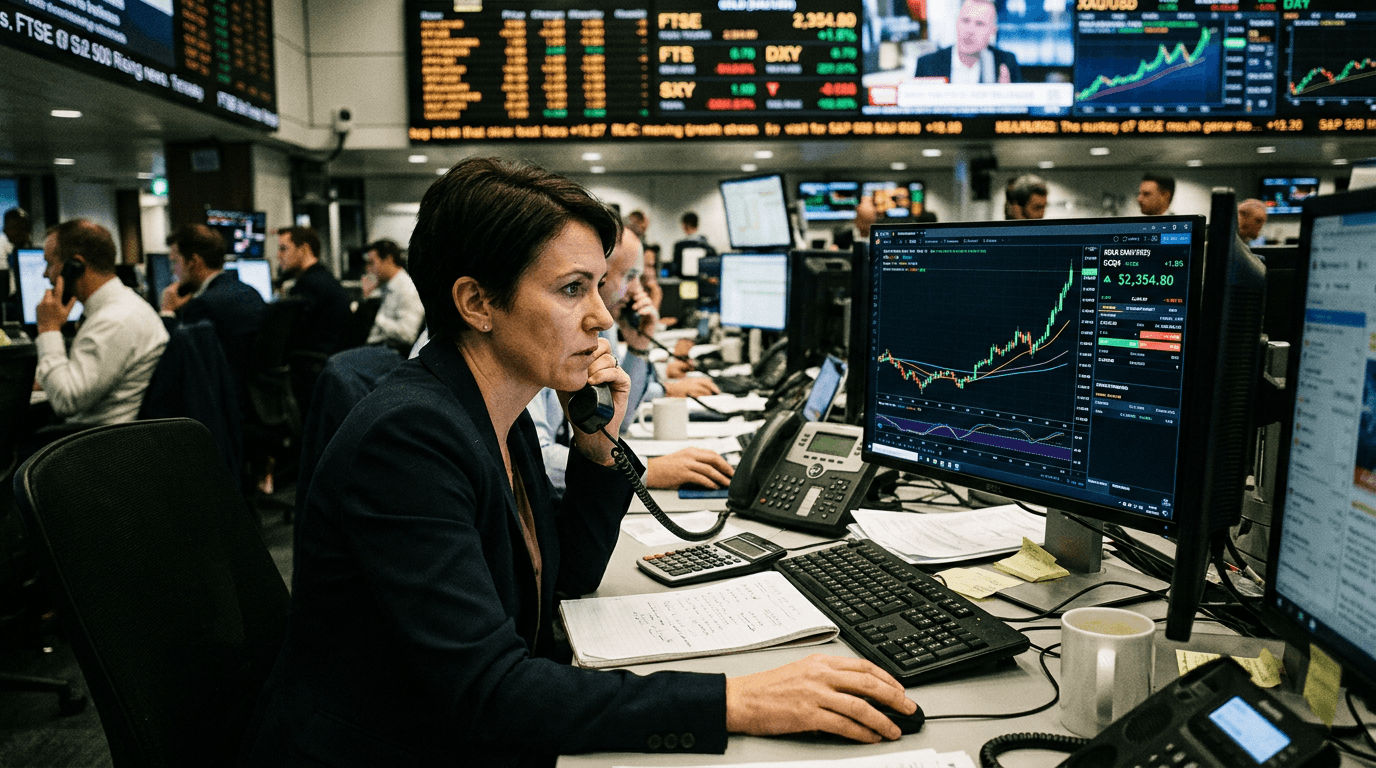
Gold’s latest rebound is a textbook reminder that when markets get nervous, investors still reach for traditional safe havens. After an initial bout of selling, capital has rotated back into bullion as geopolitical tension and macro uncertainty have flared, pressuring risk assets and reviving demand for perceived stores of value.[1][8] For traders in futures and forex, this shift matters because it usually coincides with weaker risk appetite, changes in rate expectations, and subtle but tradable moves in the US dollar.
Market Backdrop: Stress Rises, Gold Responds
The rebound in gold comes after a volatile stretch in which rising yields and shifting expectations for central bank policy temporarily overshadowed safe-haven flows.[1][5] In recent weeks, gold has seen sharp swings—steep pullbacks followed by aggressive recoveries—as traders constantly reprice the balance between higher real rates (a headwind for non-yielding assets) and rising geopolitical and macro risk (a tailwind for safe havens).[1][5] Research on past crises, including the COVID period, confirms that gold tends to behave as a safe haven when uncertainty spikes, offering better protection than equities and even other precious metals like silver or platinum.[4] That historical pattern is once again asserting itself as investors pare back risk exposure and rebuild defensive allocations.
Importantly, the renewed interest in gold is not happening in a vacuum. Equity indices have struggled to hold recent highs, credit spreads have widened at the margin, and volatility indicators have ticked up—classic signs of a market shifting from “greed” back toward “caution.” At the same time, the macro narrative has become more complicated: mixed data on growth and inflation, questions over the timing and pace of rate moves, and persistent geopolitical flashpoints all contribute to a “risk-off” tone. In that environment, gold’s defensive appeal becomes more visible, even when the broader trend has been choppy.[1][8]
Why Safe-haven Demand Is Back In Focus
Gold’s safe-haven role rests on a few structural pillars. It is scarce, durable, and not directly tied to the credit risk of any government or corporation, making it a natural hedge when investors worry about financial stability or policy missteps.[8] Empirical studies show that during periods of extreme uncertainty—like the pandemic shock—gold has historically shielded portfolios more effectively than major stock benchmarks and most other precious metals.[4] That protective behavior is precisely what investors are seeking as headlines turn more negative and correlations between risk assets rise.
However, safe-haven demand is not the only driver of gold, and that is where many newer traders get tripped up. When real interest rates rise rapidly, the opportunity cost of holding gold increases, which can overpower safe-haven flows in the short run.[1][5][6] Recent episodes have illustrated this: gold sold off sharply when markets aggressively repriced higher-for-longer rates, despite ongoing geopolitical risk.[1][5][6] The current rebound suggests that, at least for now, investors see the latest macro and geopolitical risks as significant enough to justify rotating back into defensive assets—even with policy uncertainty still in play.
For traders, the lesson is that safe-haven demand tends to be episodic and sensitive to the intensity of perceived risk. Mild risk-off conditions may not be enough to push gold higher if yields are climbing; it often takes a clear deterioration in sentiment or a narrative shift—such as renewed conflict headlines or unexpected macro disappointments—to get a strong, sustained bid into bullion.
Implications For Forex And Futures Traders
When gold catches a safe-haven bid, forex and futures markets usually don’t stay quiet. Risk-sensitive FX pairs like AUD/USD and NZD/USD often come under pressure as commodity and growth proxies are sold in favor of perceived safer currencies like USD, JPY, and CHF. At the same time, the US dollar’s relationship with gold becomes more nuanced. In classic risk-off episodes, both gold and the dollar can rise together as global capital seeks safety—one via a reserve currency, the other via a real asset—creating interesting relative value opportunities for macro traders.[8]
Gold futures volumes typically pick up during such rotations, with intraday ranges expanding and liquidity clustering around key technical levels. For active traders, this can be a double-edged sword: enhanced opportunity but also heightened whipsaw risk. Position sizing, clear invalidation levels, and disciplined risk management become even more critical when markets are trading headline-to-headline.
On a strategic horizon, asset allocators often use periods of stress to reassess their defensive exposures. The recent rebound fits into a broader multi-year story in which gold has benefited from recurring waves of uncertainty—from shifting monetary regimes to geopolitical fragmentation—reinforcing its role as a strategic asset rather than just a short-term trade.[1][8] For simulated traders, understanding this bigger picture helps contextualize short-term volatility within longer structural themes.
Trading Gold In A Safe-haven Rally
In a safe-haven-driven move, the catalyst is often sentiment rather than pure economic data, so traders should pay close attention to cross-asset signals. Equity volatility indices, credit spreads, and risk-sensitive FX pairs can all confirm (or contradict) what gold is doing on the screen. A gold rally accompanied by falling equities and a stronger USD suggests broad-based risk aversion, while a standalone gold move with muted action elsewhere may be more technical or flow-driven.
From a tactical standpoint, traders might consider:
– Focusing on key technical inflection points on gold futures, aligning entries with clear support/resistance levels and recent swing highs or lows.
– Tracking real yield indicators and central bank pricing; if the market begins to price a slower pace of rate hikes or earlier cuts, that can reinforce safe-haven flows into gold.[5][6]
– Using simulated environments to test how gold behaves under different combinations of risk sentiment and rate expectations, building a playbook for future episodes.
Because safe-haven rallies can be sharp but short-lived, a rules-based plan helps avoid emotional decisions—chasing extended moves or holding on after conditions normalize. Simulated trading allows you to practice scaling in and out, managing gaps around news, and stress-testing your strategy without capital at risk.
Key Takeaways For Simulated Traders
Gold’s rebound on safe-haven demand underscores a few enduring lessons. First, no single driver explains gold’s behavior; it sits at the intersection of risk sentiment, real rates, currency dynamics, and long-term structural demand.[1][4][8] Second, safe-haven flows often arrive in waves, tied to how “urgent” the market perceives current risks to be. Third, the most resilient strategies combine a clear macro framework (what is driving gold) with robust execution rules (how you trade it).
For traders on SimFi platforms, this environment is an ideal live laboratory. You can observe in real time how gold reacts to geopolitical headlines, central bank commentary, and data surprises; watch how those moves interact with major FX pairs; and translate those observations into systematic trading rules. By testing and refining your gold playbook during periods of stress, you prepare yourself for the next risk event—whether that brings another safe-haven surge, a rate-driven pullback, or both in rapid succession.