
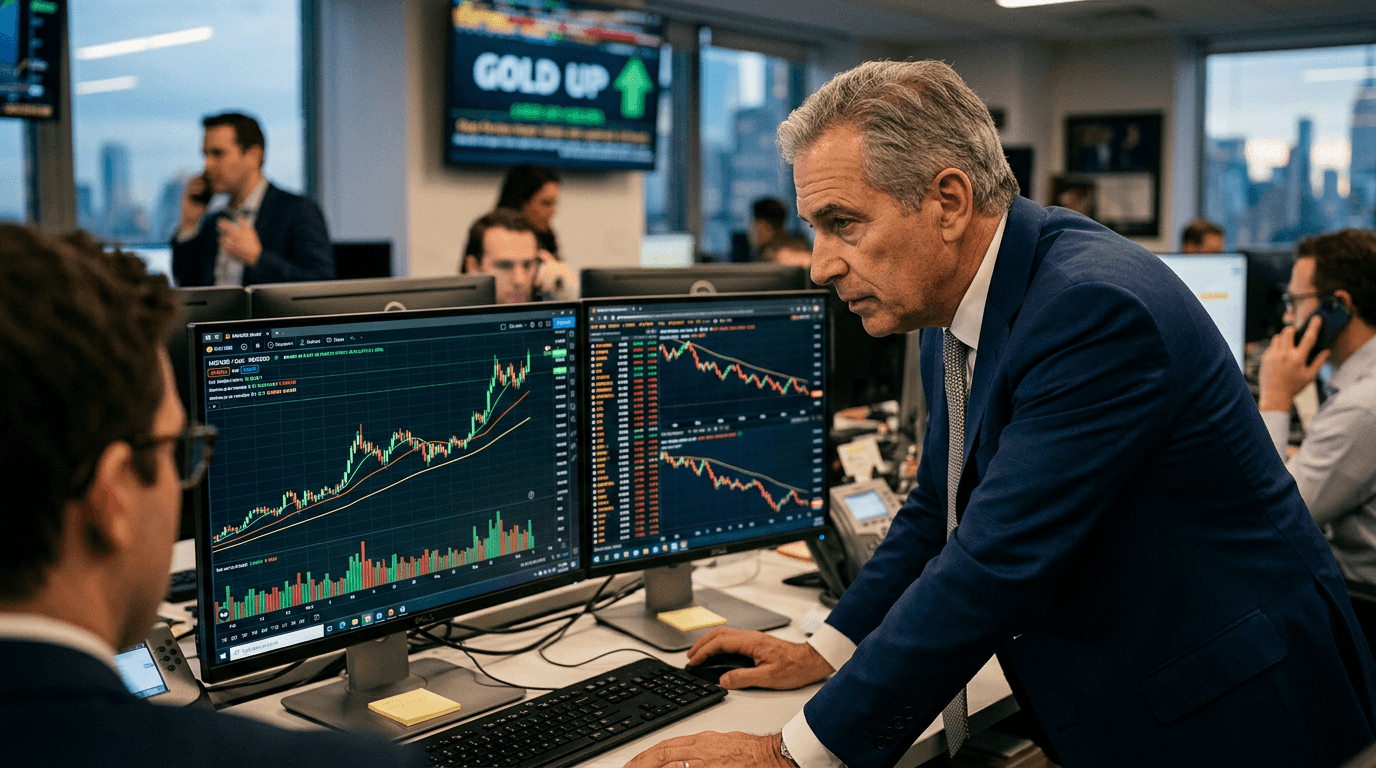
Gold’s latest rebound, highlighted by FXStreet, is a classic reminder that in markets, fear still has a favorite asset. After a bout of profit-taking and rate-driven pressure, investors are once again rotating into gold as geopolitical uncertainty and shifting rate expectations push capital back toward perceived safety.[1][2] For both forex and futures traders, this is more than a commodity story—it is a signal about the broader macro landscape, from dollar strength to real yields and risk sentiment.[1]
Safe-haven Demand Puts Gold Back In The Spotlight
When markets grow uneasy, investors tend to cluster around a familiar set of defensive assets: gold, the U.S. dollar, high-quality government bonds, and occasionally the Japanese yen or Swiss franc.[1][2] Gold sits at the center of this rotation because it is not tied to earnings, credit risk, or a single economy—its value is driven largely by macro expectations and investor psychology.
In the latest move, renewed geopolitical worries and policy uncertainty have pushed investors to reduce exposure to risk assets and add hedges.[1][2] That has translated into fresh buying of bullion, gold futures, and gold-backed ETFs, lifting prices after a recent pullback.[1] At the same time, ongoing expectations for future rate cuts have kept real yields contained, reducing the opportunity cost of holding a non‑yielding asset like gold and reinforcing the safe-haven bid.[1][2]
For traders, the key takeaway is that this rebound is not random. It is a reaction to a cluster of macro drivers—geopolitics, rates, and risk appetite—that often move together in stress episodes.[1]
Why Gold Tracks The Dollar, Yields, And Risk Sentiment
Gold rarely moves in isolation. Over the past several years, its performance has increasingly tracked real yields (nominal yields minus inflation) and expectations for central bank policy.[1][2] When traders anticipate slower tightening, a longer pause, or eventual rate cuts, the relative appeal of gold improves because holding it involves less “missed yield” compared with bonds or cash.[1][2]
The dollar is the other critical piece. Because gold is priced in dollars, a stronger USD tends to weigh on gold by making it more expensive for non‑U.S. buyers, while a softer dollar can support prices even if other conditions stay the same.[1][2] In the current rebound, mixed U.S. data and restrained dollar strength have helped gold recover alongside safe-haven flows.[2]
Risk sentiment acts as the accelerator. When equities wobble or volatility spikes, gold often benefits as a hedge against both downside risk and policy missteps.[1] The rebound FXStreet is highlighting is a textbook example: a modest deterioration in risk appetite, combined with uncertain policy paths, is enough to send fresh money into gold even without a full‑blown crisis.[1][2]
For traders, monitoring this three-way relationship—gold, the dollar, and real yields—can be as important as watching the gold chart itself.
What This Means For Forex Traders
For FX traders, gold’s rebound is a live macro signal, not just a metals story. XAU/USD is effectively a currency pair that reflects not only the price of gold, but also the market’s view on the U.S. dollar, global risk sentiment, and real rates.[1]
When safe-haven demand for gold rises while the dollar also strengthens, it can signal deeper risk aversion, with pressure often spilling into high‑beta currencies such as AUD, NZD, and some emerging‑market FX. When gold rallies while the dollar softens, it can point to a market leaning toward easier policy or lower real yields, often supportive for carry trades and risk currencies—at least until risk sentiment deteriorates further.
In practice, forex traders can:
- Use gold as a real‑time risk barometer. A sharp gold bid intraday, especially alongside weaker equities, is a cue to reassess exposure to pro‑risk FX.
- Track divergences. If gold is rallying but safe‑haven currencies are not, the divergence may signal a short‑term mispricing or a pending catch‑up move.
- Integrate XAU pairs into strategy. Trading XAU/USD, XAU/JPY, or XAU/EUR allows you to directly express a view on how safe‑haven demand will interact with currency moves.
In a simulated environment, this is an ideal moment to test how your FX strategies respond when gold flips from risk‑off laggard to safe‑haven leader.
Opportunities And Risks For Gold Futures Traders
For futures traders, the rebound underscores how quickly sentiment can turn in the precious metals complex.[1] Periods of sustained selling can be followed by sharp short‑covering rallies as macro narratives shift from “higher for longer” to “policy support is coming.”[1]
A few dynamics to watch
- Positioning and short‑covering: When speculative positioning is heavily short, any uptick in safe-haven demand can trigger a fast unwind, amplifying the move higher.
- Term structure: Shifts in the futures curve—such as narrowing contango or a move toward backwardation—can signal tightening physical markets or stronger near‑term demand.
- Event risk: Gold futures often react violently around key macro events like central bank meetings, inflation prints, and geopolitical headlines. The latest rebound shows how quickly prices can reverse after a data or headline shock resets expectations.
Risk management is crucial. Safe-haven rallies can be sharp but also choppy, with intraday reversals as traders reassess the intensity of the threat. Using defined levels, volatility‑adjusted position sizing, and clear invalidation points becomes even more important when the market is trading on headlines.
Practical Takeaways For Simulated Traders
For traders using a SimFi environment, this gold rebound is a timely opportunity to stress‑test your approach to macro‑driven markets. Because simulated trading removes capital pressure, you can focus on process:
- Build a “risk‑off playbook”: Define how you expect gold, major FX pairs, equity indices, and yields to behave when safe-haven demand returns. Then test those assumptions against live or historical data.
- Practice scenario analysis: Run through different paths—escalating geopolitical risk, faster‑than‑expected rate cuts, or a sharp reversal in risk sentiment—and map how your gold and FX positions would behave in each case.
- Refine your indicators: Experiment with tracking combinations of real yields, DXY, equity volatility, and gold in a single dashboard. Look for patterns in how gold tends to react when two or three of those drivers move together.
- Journal your responses: Each time gold spikes on a headline, log what you saw, how you reacted, and what you would change next time. Over several episodes, you will build a personal database of how you navigate safe-haven flows.
Ultimately, the story FXStreet is flagging is bigger than a single bounce in precious metals. It is a reminder that gold still acts as a sensitive gauge of macro anxiety and policy expectations.[1] For active traders—whether in FX, futures, or a simulated environment—the edge often lies not in predicting every headline, but in understanding how assets like gold transmit those shocks through the broader market.