
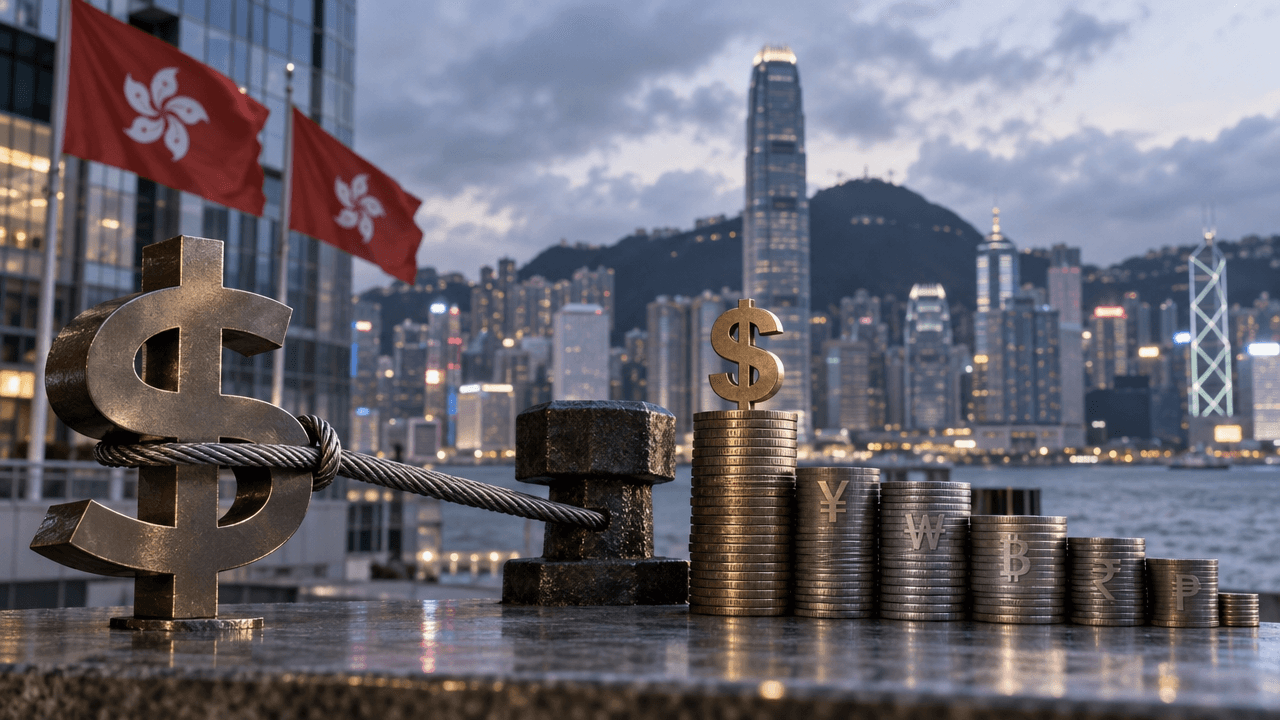
The Hong Kong Monetary Authority’s decision to lift its base rate by 25 basis points to 4.25% marks a notable turning point for regional markets, ending a multi-year period of stability and underscoring how closely Hong Kong’s financial conditions are tied to the U.S. Federal Reserve.[1][2][6][13] For traders focused on the Hong Kong dollar (HKD) and Asian foreign exchange (FX), this move reinforces the dominance of the U.S. dollar and adds another layer of complexity to positioning in regional currencies.[1][8][13]
Why Hong Kong Follows The Fed
Hong Kong operates under a currency board system that pegs the HKD to the U.S. dollar in a tight band, typically around 7.75–7.85 per USD.[8][12][13] Under this framework, the HKMA guarantees convertibility between HKD and USD at a fixed rate, ensuring that the domestic money supply is constrained by foreign exchange reserves.[12] That arrangement stabilizes the currency but effectively imports U.S. monetary policy into Hong Kong, since interest rate differentials between HKD and USD directly influence capital flows.[8][12][13]
The latest 25 bps hike takes the base rate to 4.25%, mirroring the Fed’s increase in its federal funds target range and representing Hong Kong’s first rate rise since 2023.[1][2][6][13][15] Because HKD must remain credible within its band, the HKMA’s priority is not local inflation targeting but maintaining the peg and the confidence of global investors in that system.[12][13] When U.S. rates rise, Hong Kong’s rates typically follow to prevent persistent outflows into higher-yielding U.S. dollar assets.
HKMA officials have already flagged that widening interest rate gaps between HKD and USD can encourage carry trades, where investors borrow in lower-yielding HKD and invest in higher-yielding U.S. dollar assets.[15] The increase in such carry trades can weaken HKD towards the weak side of its trading band, forcing the HKMA to intervene with higher rates or FX operations to defend the peg.[8][13][15] In this context, the latest hike is both a reaction to the Fed and a preemptive step to limit speculative pressure on the currency.
Immediate Impact On Hkd And Local Financial Conditions
In the near term, the rate hike supports the Hong Kong dollar by narrowing the yield gap with the U.S. dollar and reducing the attractiveness of carry trades that sell HKD to buy USD.[13][15] The HKD has been trading toward the weaker end of its band around 7.84–7.85, highlighting the ongoing demand for USD and the importance of credible policy responses.[8][15] By lifting the base rate, the HKMA signals it is prepared to keep funding costs aligned with global benchmarks and defend the currency’s trading range.
Domestically, higher rates translate into more expensive borrowing for households and corporates, from mortgages and consumer loans to corporate credit lines.[1][5][6] For property-heavy Hong Kong, tighter financial conditions may cool leverage-driven activity, but from a macro-stability perspective they reinforce financial discipline and help ensure that capital does not drain too rapidly toward U.S. markets.[1][2][5] Banks will adjust their prime lending rates and deposit rates, reshaping the risk–reward profile for savers and borrowers alike.
For traders, this shift means that HKD is likely to remain relatively stable versus USD, but with short-term volatility around policy announcements and interventions.[8][13] The more interesting opportunities may lie in cross-currency trades—using HKD stability as a funding or reference point while expressing views on more volatile Asian FX pairs.
RIPPLE EFFECTS ACROSS ASIAN FX AND THE U.S. DOLLAR
Because Hong Kong tracks U.S. monetary policy and acts as a major regional financial hub, the HKMA’s move reinforces broader strength in the U.S. dollar against Asian currencies.[1][8][13] As both the Fed and HKMA raise rates, USD-denominated assets become relatively more attractive than local-currency instruments in economies that are not tightening at the same pace. This can put pressure on regional FX such as emerging Asian currencies, which may see capital outflows and depreciation versus the dollar.
The rate move also sends a signal about global liquidity conditions: higher base rates in U.S.-linked systems indicate that the cost of capital is rising, which often weighs on risk assets in Asia, including equities and high-yield credit. While each economy’s central bank sets its own policy path, the combination of Fed and HKMA hikes contributes to a narrative of tighter dollar liquidity and stronger USD over the medium term.[1][2][8][13]
For FX traders, this context generally favours strategies that respect the prevailing USD trend, while being selective about when to fade moves in regional currencies. Short bursts of mean reversion in Asian FX are possible, but they now occur against a backdrop of structurally tighter dollar conditions.
What This Means For Traders And Simulated Investors
For active traders and participants on SimFi platforms like E8 Markets, the HKMA’s decision offers a rich case study in how currency pegs shape interest rate dynamics and FX behaviour. Because the HKD peg anchors expectations, outright directional bets on USD/HKD are constrained by the band, making carry, volatility, and spread trades more relevant than simple trend-following.
Here are practical angles to explore in a simulated environment:
1. Rate-differential scenarios Model how widening or narrowing interest rate spreads between HKD and USD affect capital flows, HKD positioning, and Asian FX performance. Use different Fed paths—continued hikes, pauses, or cuts—and simulate HKMA responses to see how the peg behaves under stress.[12][13][15]
2. Cross-asset impact in Hong Kong Test scenarios where higher rates pressure property prices, bank earnings, and leveraged sectors, while benefiting savers and insurers. Explore how Hong Kong equities react to rising funding costs and a stronger USD backdrop, particularly financials and real estate.
3. Regional FX plays around USD strength Construct simulated portfolios where HKD remains a relatively stable leg, while more flexible currencies—such as those in emerging Asia—absorb the bulk of adjustment to stronger USD and higher global yields.[1][8][13] Evaluate which currencies appear most sensitive to U.S. and HKMA rate changes by tracking drawdowns and volatility under different stress tests.
4. Liquidity and risk management Use this event to refine risk rules: tighter dollar liquidity usually argues for more conservative leverage, stricter stop-losses, and closer monitoring of overnight funding costs. Simulated trading allows experimentation with position sizing and margin strategies without real capital at risk.
How To Position Around Hkma Moves
In practical terms, traders can treat HKMA rate decisions as high-impact macro events, similar in structure to Fed meetings but with distinct local implications. Ahead of such announcements, it can be useful to:
1. Map key levels Identify recent highs and lows in Asian FX pairs, HKD crosses, and relevant equity indices. This helps frame risk around potential volatility spikes when policy news hits.
2. Focus on correlation clusters Monitor how USD strength affects clusters of assets: Asian FX, Hong Kong equities, U.S. tech, and global credit spreads. Stronger USD and higher rates often move these markets together, offering opportunities for relative-value trades and hedging.
3. Stress-test funding strategies In leveraged or margin-based trading, rising base rates translate to higher carrying costs over time. Simulated environments are ideal for testing how strategies perform when funding expenses increase and volatility remains elevated.
Looking Ahead
The HKMA’s 25 bps hike to 4.25% is more than a routine adjustment; it is a reminder that Hong Kong’s currency board ties its fate to the U.S. dollar and amplifies the impact of Fed decisions across Asian markets.[1][2][6][13] For HKD, the move reinforces the peg and supports the currency within its trading band, while signalling that policymakers are alert to carry trade pressures and capital flows.[8][13][15] For Asian FX more broadly, it strengthens the narrative of a firm USD and tighter dollar liquidity, conditions that require disciplined risk management and thoughtful positioning.
For traders and simulated investors, the key takeaway is clear: understanding the mechanics of the HKD peg and its link to U.S. policy is essential to navigating Asian markets. This rate hike provides a timely opportunity to deepen that understanding, refine strategies in a risk-free environment, and prepare for a world where central bank decisions in Washington and Hong Kong continue to shape FX trends across the region.