
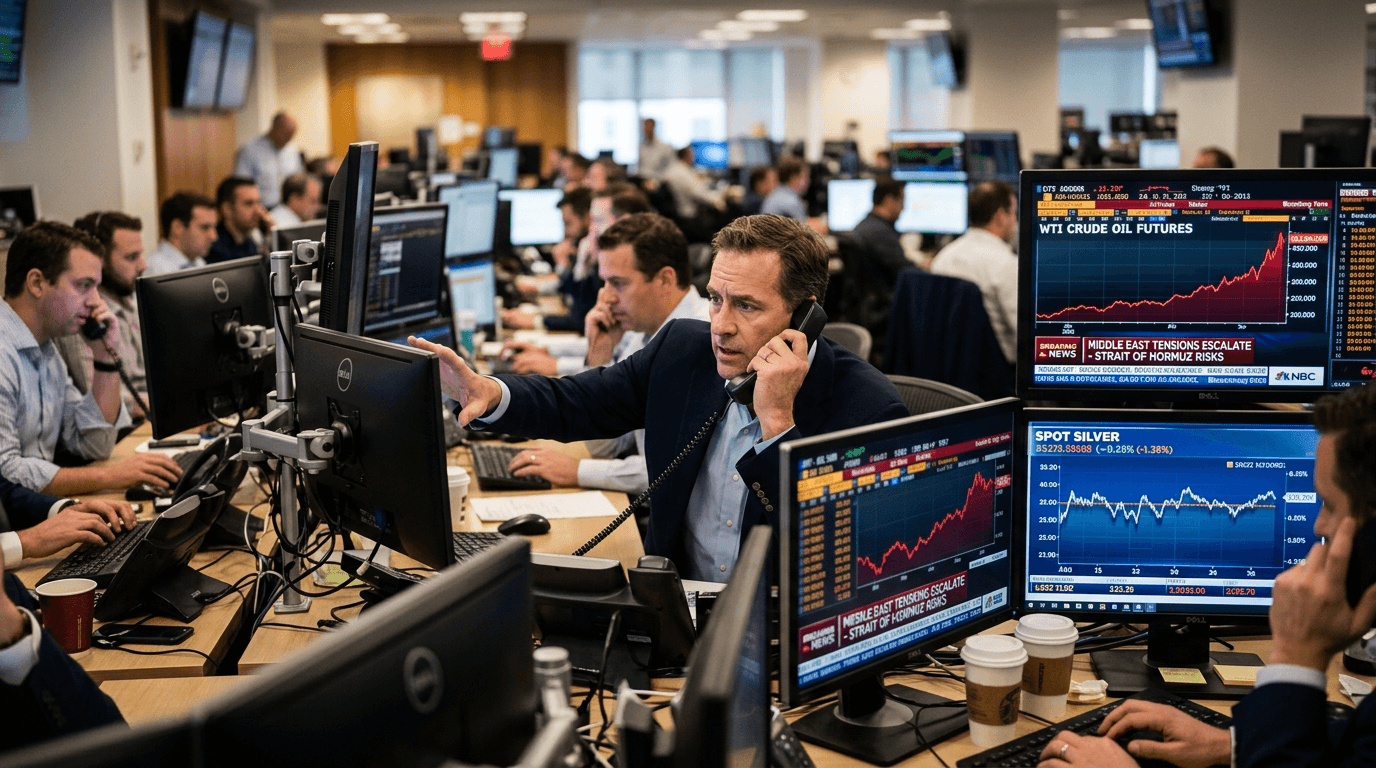
The Middle East conflict and renewed tensions around the Strait of Hormuz are once again reminding markets that geopolitics can re-price entire asset classes in a matter of sessions. Energy benchmarks have pushed higher as traders reassess supply risks, while silver and risk assets across futures and FX are feeling the pressure as positioning rotates toward defense and liquidity.
Geopolitical Flashpoint: Strait Of Hormuz
The Strait of Hormuz sits at the heart of the current market narrative. Roughly 20% of the world’s oil and gas flows through this narrow waterway, which makes it one of the most critical chokepoints in global energy logistics.[1] As US–Iran hostilities escalate and shipping attacks intensify, that chokepoint risk is being priced in almost in real time.
Recent reports highlight assaults on multiple vessels near the Strait, temporary halts to production from key exporters, and warnings to ships to avoid the area altogether.[1][2] In some episodes, international shipping has slowed to a near standstill at the entrance to Hormuz, raising the prospect of more persistent supply disruptions if the conflict broadens or becomes entrenched.[1] For energy markets, every cargo that fails to transit on schedule amplifies concerns around inventories, refining margins and the resilience of global supply chains.
The geopolitical backdrop is not limited to shipping lanes. Military exchanges between the US, Iran and regional actors have targeted bases and infrastructure around the Gulf, creating uncertainty about how much crude and gas can realistically reach end buyers.[2][7][10] The International Energy Agency has noted that conflict-driven cuts from Persian Gulf producers have exceeded 14 million barrels per day at points, roughly 14% of pre-war global supply.[7] That scale of potential disruption explains why even hints of escalation are enough to move prices meaningfully.
For traders, the key takeaway is that “headline risk” around Hormuz is structural for now. Markets are highly sensitive to any news about attacks, cease-fire talks or convoy protection, and the resulting intraday swings can be large. Understanding this geopolitical context is essential to interpreting price action in crude, FX and metals.
Oil Futures: Pricing In Supply Shocks
Oil has been the most direct beneficiary of this renewed stress. On multiple occasions during the conflict, both Brent and WTI have posted single-session gains in the 4–11% range as hostilities escalated.[2][3][7][10][13] US crude futures have jumped from the high $60s into the $70s and beyond within days, while Brent has surged from the low $70s toward the mid-$90s and, in some episodes, crossed the psychologically important $100 threshold.[2][3][6][7][15]
These moves are not just about spot prices. The futures curve has shifted into steeper backwardation during periods of intense risk, with prompt-month contracts trading at a premium to later maturities as buyers scramble for near-term barrels.[6] That pattern signals tight immediate supply and reinforces the inflationary impulse: refiners and end users must pay more today, even if they hope tensions will ease in the medium term.
Producers are trying to respond. OPEC and OPEC+ members have at times announced output increases of around 206,000 barrels per day to calm the market and offset war-related losses.[1][2] Yet analysts remain skeptical that relatively modest production hikes can fully counteract disruptions when shipping routes and on-the-ground infrastructure are themselves under threat.[1] The result is an uneasy balance where supply additions cap some upside, but any negative headline can re-ignite a rally.
Volatility is elevated as a result. Prices have whipsawed—surging on attack news, then retracing as tankers manage to exit Hormuz or as markets refocus on broader supply-demand fundamentals.[8][11] For futures traders, this environment rewards disciplined risk management: tight control of leverage, clear invalidation levels and an appreciation that intraday moves may be driven more by geopolitics than by traditional inventory data or economic releases.
Precious Metals: Why Silver Is Lagging
Geopolitical stress often sends investors toward precious metals, but the current move is nuanced. Gold has benefited from its traditional safe-haven role, while silver futures have remained capped below the $59 mark despite elevated uncertainty. That divergence reflects the dual nature of silver as both a monetary metal and an industrial input.
Unlike gold, silver’s price is highly sensitive to expectations for manufacturing, electronics demand and broader growth. In a war-driven energy shock, higher oil prices tighten financial conditions, threaten growth and complicate the path for central bank rate cuts.[16] This mix can weigh on industrial metals, including silver, even as some investors look to them for protection against potential inflation.
Positioning and FX also matter. A risk-off move typically strengthens the US dollar and other safe havens, which can pressure dollar-denominated commodities. As traders shed risk across equities, high-beta futures and EM FX, they may reduce leveraged long exposure to silver simply to raise cash, reinforcing the cap on prices even in a geopolitically tense environment.
For metals traders, the key lesson is that “geopolitical premium” is not uniform. Oil is directly exposed to Hormuz, and gold is a pure defensive asset. Silver sits in between, making it more vulnerable when investors are simultaneously worrying about growth, liquidity and funding costs. Understanding those role differences can help avoid simplistic assumptions like “war always lifts all commodities.”
Risk-off Flows In Futures And Fx: Trading Implications
The impact of the Middle East war and Hormuz tensions extends far beyond energy and metals. Equity index futures have frequently traded lower as oil spikes, reflecting concerns about profit margins, consumer demand and the risk of secondary financial shocks.[10][16] Higher energy costs feed into inflation expectations, which can delay or even reverse anticipated central bank easing, pressuring valuations for growth-sensitive sectors.
In FX, the pattern is classic risk-off. Safe-haven currencies such as the US dollar, Japanese yen and Swiss franc tend to attract inflows, while high-yield and commodity-linked currencies face selling pressure as carry trades are unwound and volatility rises. Countries seen as vulnerable to higher oil import bills or regional instability may experience sharper FX moves, widening the range of outcomes for traders and portfolio managers.
Volatility across rates and credit markets is also tied to the energy story. Rising oil prices threaten to re-accelerate headline inflation, forcing investors to reassess the path of policy rates and bond yields.[16] This can transmit the Middle East shock into global funding conditions, making leveraged risk positions more expensive to hold and increasing the appeal of cash and short-duration assets.
For futures and FX traders, several practical takeaways stand out. First, correlations can change quickly: assets that usually diversify a portfolio may move in lockstep during a geopolitical shock. Second, liquidity can thin in stressed hours around major headlines, magnifying slippage and execution risk. Third, scenario planning—mapping out how different conflict paths could affect energy, inflation and central bank decisions—becomes as important as technical levels on individual charts.
In a SimFi environment, these dynamics offer a valuable training ground. Traders can practice navigating headline-driven volatility, stress-testing strategies against sudden spikes in oil and shifts in FX risk sentiment without real capital at stake. The current Middle East tensions are a reminder that markets are complex adaptive systems: understanding how geopolitics, energy, metals and currencies interlock is increasingly essential for anyone looking to trade futures and FX with confidence and resilience.