
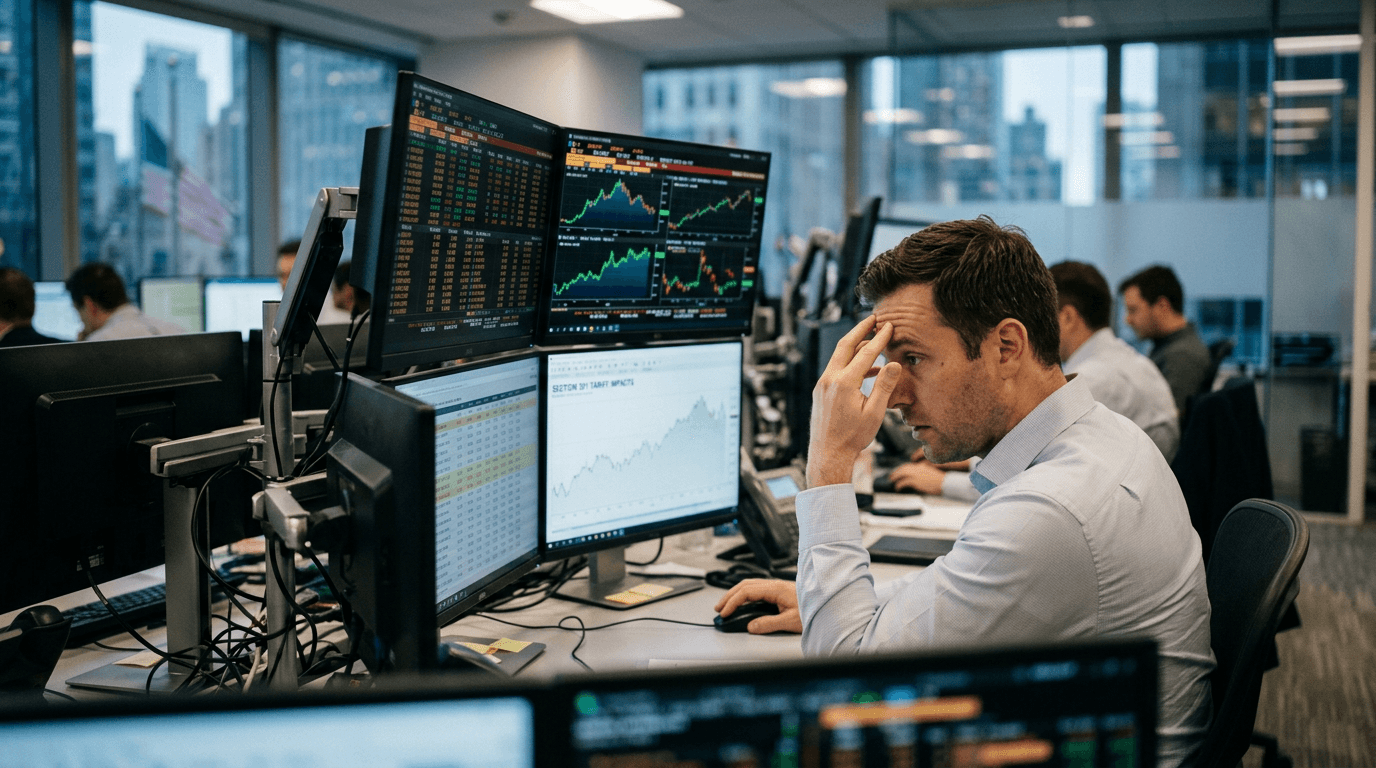
News that the United States is considering broad new tariffs of at least 10% on imports from roughly 60 countries under Section 301 is not just another headline in the trade war narrative. It represents a potential regime shift for global trade, with direct implications for FX markets, equity futures, and growth expectations—especially in emerging markets and Asia’s major economies.
Section 301 In Focus: Why This Tool Matters
Section 301 of the Trade Act of 1974 gives the U.S. Trade Representative (USTR) broad authority to investigate “unfair” foreign trade practices and respond with tariffs or other restrictions when they are deemed to burden or restrict U.S. commerce.[2][3] Once the USTR makes an affirmative determination, tariffs can be imposed without a vote of Congress, across wide product categories, and can remain in place for years before a formal review is required.[2]
Historically, Section 301 was used aggressively against China, with additional tariffs of 25% imposed on selected Chinese imports in response to practices related to intellectual property and forced technology transfer.[1][5] Those measures disrupted global supply chains in sectors like electronics, autos, and agriculture, and many of those tariffs remained in place well into the mid‑2020s.[5]
In 2026, the USTR launched new Section 301 investigations covering 60 economies, focusing on structural excess manufacturing capacity and on imports tied to forced labor.[3][4][7] These investigations now form the legal and political foundation for the newly proposed tariff package. The key point for traders: this is a well-tested legal tool with a track record of being implemented quickly and staying in force for an extended period.
What Makes This Round Different
What is new in the current discussion is the breadth and structure of the proposed measures. Reports indicate the U.S. is considering at least 10% tariffs on imports from around 60 countries, with higher 12.5% levies aimed at major economies such as China, India, and Japan. That would mark a shift from targeted “trade dispute” tariffs toward a more generalized, quasi-across‑the‑board tariff framework, using Section 301 as the main legal vehicle.[3][7]
The current investigations already cover a diverse group of large trading partners, including China, the European Union, Japan, India, Korea, Vietnam, and Mexico, among others.[4] If tariffs were extended broadly across these economies and more, the impact would no longer be isolated to specific sectors—it would reshape pricing and sourcing decisions across much of global trade.
Unlike the earlier use of emergency powers (such as under IEEPA), Section 301 requires a formal process with public comments and hearings, which is currently underway.[3][4] That means there is a pipeline: investigations, comment periods, potential findings of “unreasonable” practices, and then tariff decisions. For markets, this creates a sequence of event risks—each date on the Section 301 calendar becomes a potential volatility catalyst.
How Broad Tariffs Transmit Into Fx And Global Growth
Tariffs function like a tax on imports, raising effective import prices and often disrupting established supply chains.[5][8] Past Section 301 and Section 232 tariffs were found to increase costs for U.S. manufacturers and consumers and to trigger re-routing of trade and investment flows.[1][5][8] When you scale this up to dozens of economies at once, the macro channels multiply.
For FX, the most immediate mechanism is growth and trade balance expectations. Higher U.S. tariffs can reduce export volumes from affected countries, pressuring those economies’ growth prospects and potentially weakening their currencies, particularly in emerging markets with limited policy buffers.[5][8] At the same time, if tariffs are perceived as inflationary in the U.S., they may influence expectations for Federal Reserve policy, affecting dollar funding conditions and risk sentiment.
Asian FX and yuan crosses are especially sensitive. China has already been a primary target of earlier Section 301 actions, and past episodes showed that tariff escalations tended to be associated with depreciation pressure on the yuan and increased volatility in regional currencies linked to China’s trade cycle.[1][5] If new Section 301 tariffs hit China and other Asian exporters simultaneously, traders will reassess fair value for pairs like USD/CNH, CNH/JPY, and regional EM crosses.
Equity futures and global growth expectations also come into play. The U.S. International Trade Commission has documented that earlier tariffs reduced U.S. imports, raised input costs, and had measurable but uneven effects on output and employment.[8] Amplifying such measures across 60 economies risks tightening global financial conditions via weaker earnings expectations, more cautious corporate capex, and a broader shift toward “risk-off” positioning.
What Traders Should Watch: Key Risk Markers
For traders—including those operating in simulated finance environments—the Section 301 story is less about a single headline and more about monitoring a sequence of evolving risk markers.
First, track the policy timeline. Section 301 requires public notice, comment periods, and hearings.[3][4] Hearings and key comment deadlines effectively become scheduled event risks, similar to central bank meetings or major data releases. Market sensitivity will tend to rise as those dates approach and as leaks or trial balloons on tariff rates and product lists emerge.
Second, watch EM FX baskets with high trade exposure to the U.S. and China. Economies deeply integrated into global manufacturing chains—particularly in Asia—are vulnerable to both direct and indirect tariff effects.[5][8] Currency pairs involving China, Korea, Taiwan, Vietnam, Mexico, and others named in the investigations are likely to see higher implied volatility as the policy path clarifies.[4]
Third, use equity index futures as a cross‑check. Indices with heavy weightings in export-oriented sectors (semiconductors, autos, industrials, shipping) can offer an early read on how investors are pricing tariff risk. Weakness in these indices alongside stronger defensive sectors can signal a market shift toward a more entrenched trade conflict scenario.
Practical Takeaways For Risk And Strategy
For discretionary traders
- Build trade scenarios around different tariff outcomes (no action, moderate 10% broad tariffs, more aggressive 12.5%+ on major economies) and map likely moves in EM FX, yuan crosses, and risk-sensitive equity indices under each.
- Consider hedging event risk around key Section 301 milestones with options on FX pairs or equity indices, focusing on structures that benefit from higher volatility if timelines or tariff magnitudes surprise.
For systematic and SimFi traders
- Incorporate trade-policy proxies—such as tariff announcement indices or Section 301 event calendars—into risk filters or regime-detection models, especially if strategies are sensitive to volatility spikes or correlation breakdowns.
- Stress-test portfolios using historical episodes of tariff escalations (e.g., 2018–2019 U.S.–China tariff rounds) to understand how your strategies might behave if correlations between EM FX, commodities, and risk assets shift abruptly.[1][5][8]
For longer-horizon investors and macro thinkers:
- Recognize that Section 301 has become a central instrument of U.S. trade policy and can be used repeatedly across multiple administrations.[3][6][7] Structural de‑globalization, supply‑chain re‑shoring, and more fragmented trade blocs are not just narratives—they are policy-supported trends.
- Factor in that tariffs imposed under Section 301 can last for years, shaping corporate investment, supply chains, and relative growth trajectories well beyond the initial announcement window.[2][5]
In short, the prospect of broad U.S. tariffs under Section 301 is not only a legal or diplomatic story; it is a multi‑asset trading regime story. For active traders, the edge lies in treating the Section 301 process as a structured sequence of catalysts rather than a one‑off shock, and in translating trade headlines into concrete FX, equity, and volatility positioning with clear risk parameters.