
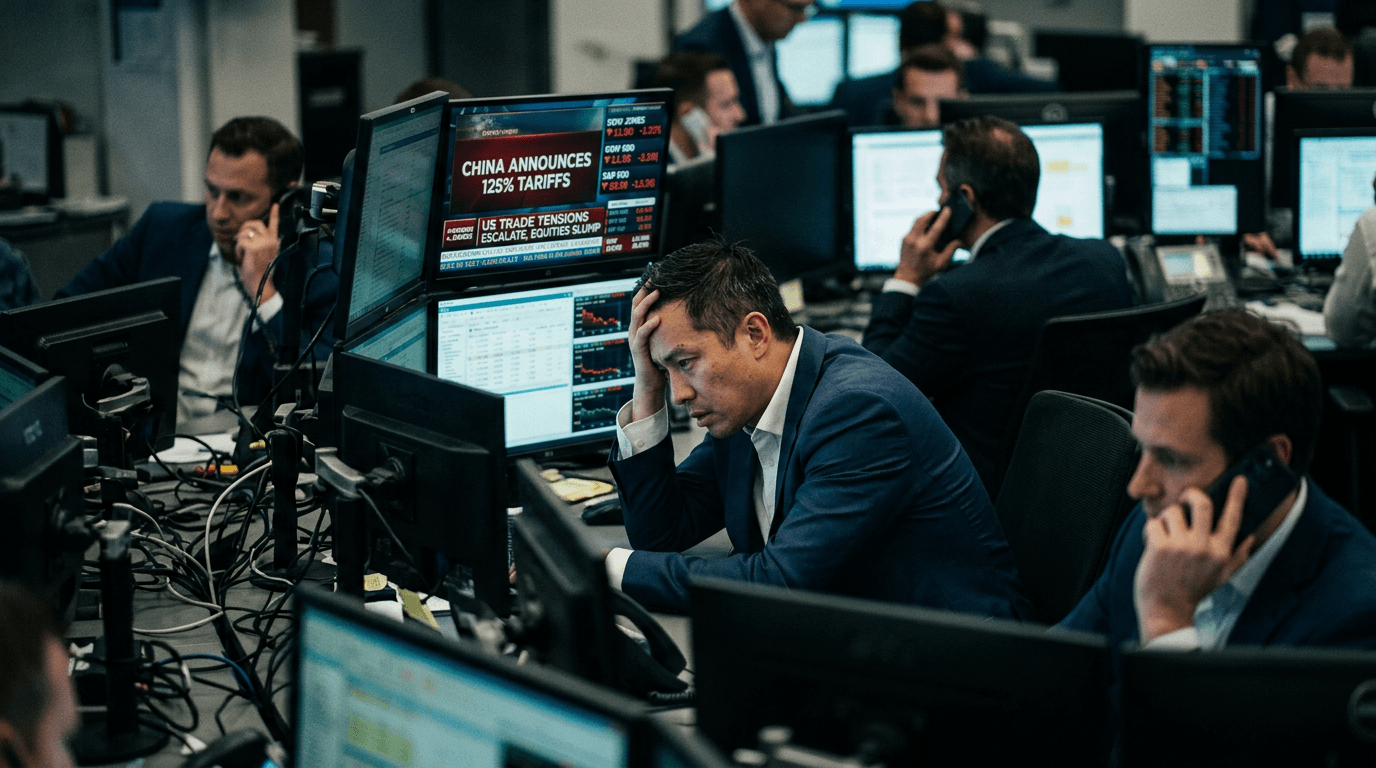
The escalating US-China trade dispute reached a critical juncture in April 2025 when Beijing announced a stunning 125% tariff rate on US goods, marking a significant shift in retaliation strategy. Rather than continuing to match American tariff increases dollar-for-dollar, China's government signaled it would no longer participate in an escalating tariff spiral, choosing instead to implement punitive rates designed to severely restrict American imports. This move represented more than a simple numerical increase—it reflected a fundamental change in Beijing's approach to the trade conflict and sent shockwaves through global markets already grappling with rising protectionist pressures.
Understanding The Escalation Timeline
To grasp the significance of China's 125% tariff announcement, it's essential to understand the sequence of events that led to this point. President Trump had implemented reciprocal tariffs of approximately 145% on Chinese goods as part of his broader tariff strategy. China initially matched this with its own 34% retaliatory tariff on US imports in early April. However, when the US continued to increase tariffs further in early April, China responded on April 9 with an 84% tariff rate. The United States responded that same day by raising its rate to 125%, and China followed suit by announcing matching 125% tariffs effective April 12.
What made this different from previous tit-for-tat exchanges was China's explicit statement that it would no longer simply mirror American tariff increases. Government officials emphasized that at these levels, continued escalation would render American goods essentially uncompetitive in Chinese markets, making further increases largely symbolic rather than economically rational. This represented a psychological shift in how Beijing viewed the trade conflict—moving from reactive matching to strategic positioning.
Market Implications And Investor Concerns
The announcement of 125% tariffs created immediate turbulence across multiple asset classes. Global equities faced significant pressure as investors reassessed earnings forecasts for multinational corporations heavily dependent on US-China trade. Technology companies, industrial manufacturers, and consumer goods producers saw their valuations compressed as analysts downgraded guidance. The semiconductor industry faced particular scrutiny, given its critical role in supply chains and the tension around advanced chip exports to China.
Commodity futures markets reflected heightened uncertainty, with oil prices falling on recession concerns while safe-haven assets like Treasury bonds rallied. The yield curve showed signs of inversion anxiety as traders priced in potential economic slowdown from widespread tariff impacts. Currency markets witnessed volatility in the Chinese yuan and US dollar pairs as investors repositioned around trade war risks.
For traders in simulated finance environments, this period presented a challenging backdrop for traditional momentum strategies that relied on stable macroeconomic conditions. The tariff uncertainty introduced a new regime of elevated volatility that punished unhedged positions and rewarded defensive allocation shifts.
Broader Implications For The Global Economy
Trade wars of this magnitude don't simply affect bilateral commerce—they ripple throughout interconnected global supply chains. Companies that source components from China to assemble products for export faced impossible margin equations. A manufacturer buying Chinese inputs at 125% tariff premiums could not easily pass these costs to consumers without destroying demand. Agricultural exporters, technology suppliers, and automotive manufacturers all faced similar pressures.
Emerging markets with exposure to Chinese demand watched their currencies weaken as growth concerns intensified. Developing economies dependent on commodity exports faced falling prices as Chinese demand prospects dimmed. Financial institutions with significant China exposure faced valuation pressure as credit risk premiums widened.
Key Takeaways For Traders And Investors
The April 2025 escalation offered several important lessons. First, political statements matter as much as economic fundamentals during trade disputes. China's explicit rejection of matching further increases suggested both sides recognized the escalation had reached an unsustainable point. Second, volatility environments created opportunities for options traders and dynamic hedgers, even as directional traders faced headwinds. Third, correlations between seemingly unrelated assets—equities, bonds, and commodities—compressed during this period, requiring sophisticated portfolio construction.
For those following the situation in real-time, tracking government statements alongside tariff announcements proved as important as analyzing trade flow data. The Chinese government's willingness to implement non-tariff countermeasures, including new antidumping investigations and export control restrictions, demonstrated that the trade conflict extended beyond simple tariff rates.
The Path Forward
Within weeks of the 125% announcement, negotiations resumed between US and Chinese officials. By mid-May 2025, the two countries reached a preliminary de-escalation agreement, reducing tariffs to 10% for a 90-day period and suspending the retaliatory increases. This rapid reversal highlighted how markets react not just to current policy but to policy trajectory expectations.
For traders in simulated environments, understanding these dynamics—the escalation, the shock to asset prices, and the subsequent reversal—provides valuable lessons about how geopolitical risks materialize and resolve. The April-May 2025 trade dispute serves as a case study in volatility management, positioning during uncertainty, and the importance of monitoring policy developments alongside traditional financial metrics.