
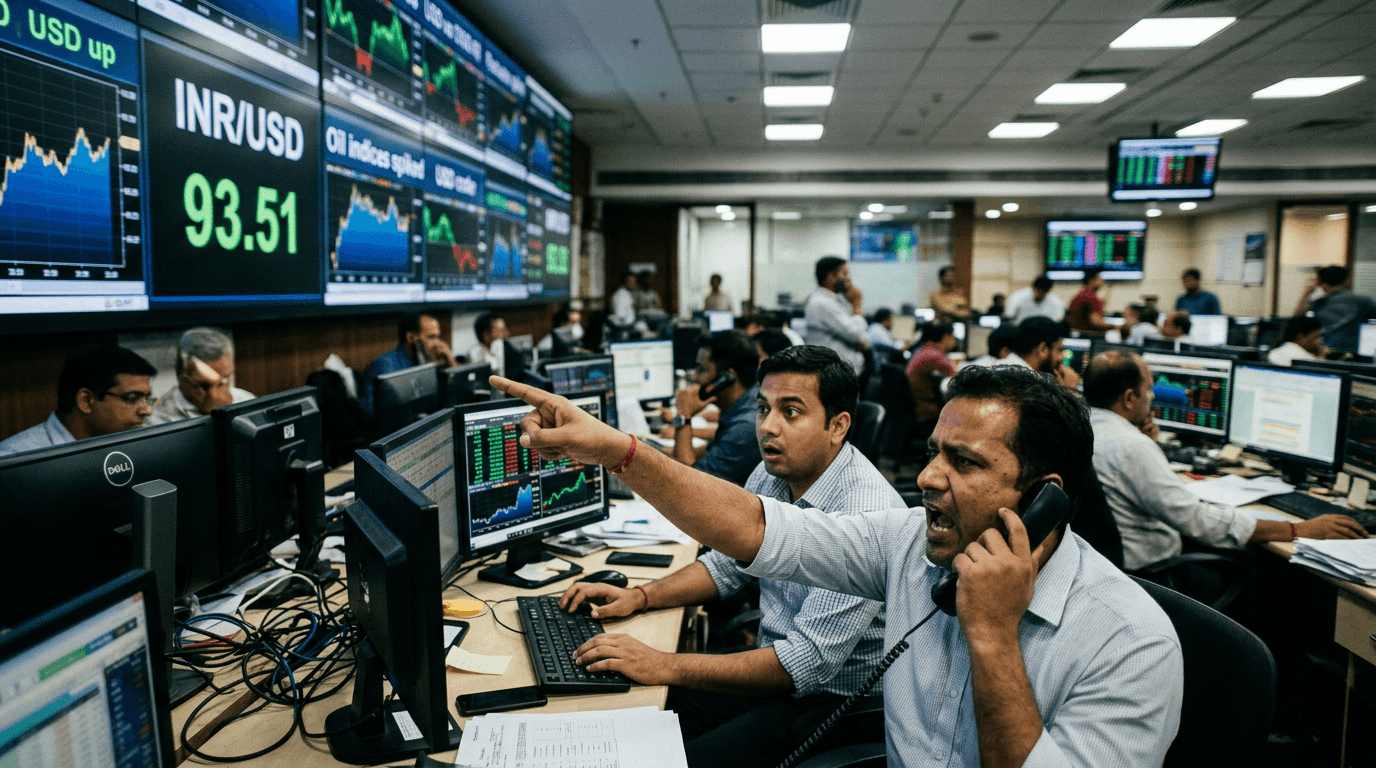
The global forex market is navigating treacherous waters as geopolitical tensions between the United States and Iran create significant volatility across emerging market currencies. Against this backdrop of international conflict and economic uncertainty, the Indian rupee demonstrated resilience by rebounding sharply to close at 93.51 against the US dollar, gaining 71 paise in a single trading session. This movement reflects the complex interplay between geopolitical risk, commodity prices, and capital flows that continue to define trading dynamics in emerging markets during periods of global instability.
Geopolitical Pressures Reshape Forex Dynamics
The recent escalation in West Asia tensions has injected considerable uncertainty into currency markets worldwide. When the US and Iran engaged in renewed military activity near the Strait of Hormuz and in civilian areas, forex traders immediately reassessed their positions. These geopolitical flashpoints create what analysts call "risk-off" sentiment, where investors typically move capital away from riskier emerging market assets and toward safe-haven currencies like the US dollar and Japanese yen.
However, the reported ceasefire announcement, even as it faced challenges with accusations of violations, provided enough optimism to trigger short-covering and bargain-buying in depressed currencies. The rupee, which had fallen to 94.68 against the dollar earlier in the trading session, benefited significantly from this sentiment shift. This dynamic illustrates an essential principle for forex traders: geopolitical events create both the initial shock and subsequent recovery opportunities, as markets attempt to price in conflicting information.
The Reserve Bank of India maintained its key policy rate at 5.25%, citing ongoing West Asia tensions as a reason for caution. The central bank's focus on supply chain disruptions and their impact on inflation and growth demonstrates how geopolitical events extend beyond forex markets to influence broader monetary policy decisions across emerging economies.
Understanding The Rupee's 71 Paise Rebound
The rupee's impressive gain of 71 paise in a single day requires careful examination. The currency opened at 94.58 and initially weakened further to 94.68 before reversing course dramatically. This V-shaped recovery pattern is typical when risk events create initial panic selling followed by rational reassessment. Several factors contributed to the rupee's rebound:
First, the ceasefire announcement, despite its fragile nature, reduced immediate concerns about escalation. Second, Brent crude oil prices, which had spiked concerns about inflation, stabilized around 100 dollars per barrel after falling from earlier highs near 98 dollars. A more stable oil price environment reduces inflation concerns in an oil-importing economy like India, supporting currency strength. Third, technical factors likely played a role, as many traders may have set stop-losses around key levels, triggering algorithmic buying as prices reversed.
The dollar index, which measures the greenback's strength against a basket of six major currencies, declined 0.15% to 97.91. This weakening of the dollar generally supports emerging market currencies, providing tailwind for the rupee's recovery.
Broader Market Impacts And Interconnections
The ripple effects of forex volatility extended well beyond currency markets. India's domestic equity benchmarks fell sharply, with the Sensex declining 516.33 points to 77,328.19 and the Nifty dropping 150.50 points to 24,176.15. The Nifty's break below its 50-day exponential moving average signals weakening momentum, though analysts note that if the index can stabilize above 24,200, recovery potential remains.
Commodity markets reflected the geopolitical premium embedded in prices. Gold futures gained approximately 1% for the week, settling at 152,000 rupees per 10 grams, while silver surged 4.4% to close at 2.61 lakh rupees per kilogram. These precious metal gains reflect classic safe-haven buying during periods of geopolitical uncertainty.
India's forex reserves also came under pressure, declining by 7.794 billion dollars during the week ended May 1 to reach 690.693 billion dollars. This represents a significant drawdown, likely reflecting both the RBI's intervention to support the rupee and capital outflows triggered by geopolitical concerns.
What Traders Should Monitor Going Forward
Looking ahead, several key indicators deserve close attention from forex traders and investors. US non-farm payrolls data traditionally move currency markets significantly, and traders are advised to monitor this release carefully. Research analysts at major brokerages expect the USD-INR pair to trade in a range of 94.10 to 94.90, suggesting limited directional conviction in the near term.
The trajectory of Brent crude prices remains critical, as oil represents a significant inflation input for emerging markets. Any further escalation in West Asia tensions could push crude well above 100 dollars per barrel, pressuring the rupee and broader emerging market currencies. Conversely, sustained de-escalation could allow the rupee to strengthen further.
Takeaways For Market Participants
The rupee's rebound to 93.51 demonstrates that emerging market currencies can find support even during periods of significant stress when geopolitical resolution appears possible. However, the underlying volatility and the 46 paise initial decline serve as reminders that emerging market currencies remain vulnerable to global risk sentiment shifts.
For traders and investors, this environment reinforces the importance of maintaining flexible positioning and staying attuned to both technical levels and geopolitical developments. The interconnection between oil prices, forex movements, and equity performance creates complex trading environments where diversification and risk management are essential. As long as West Asia tensions remain elevated, expect continued currency volatility across emerging markets.
---