
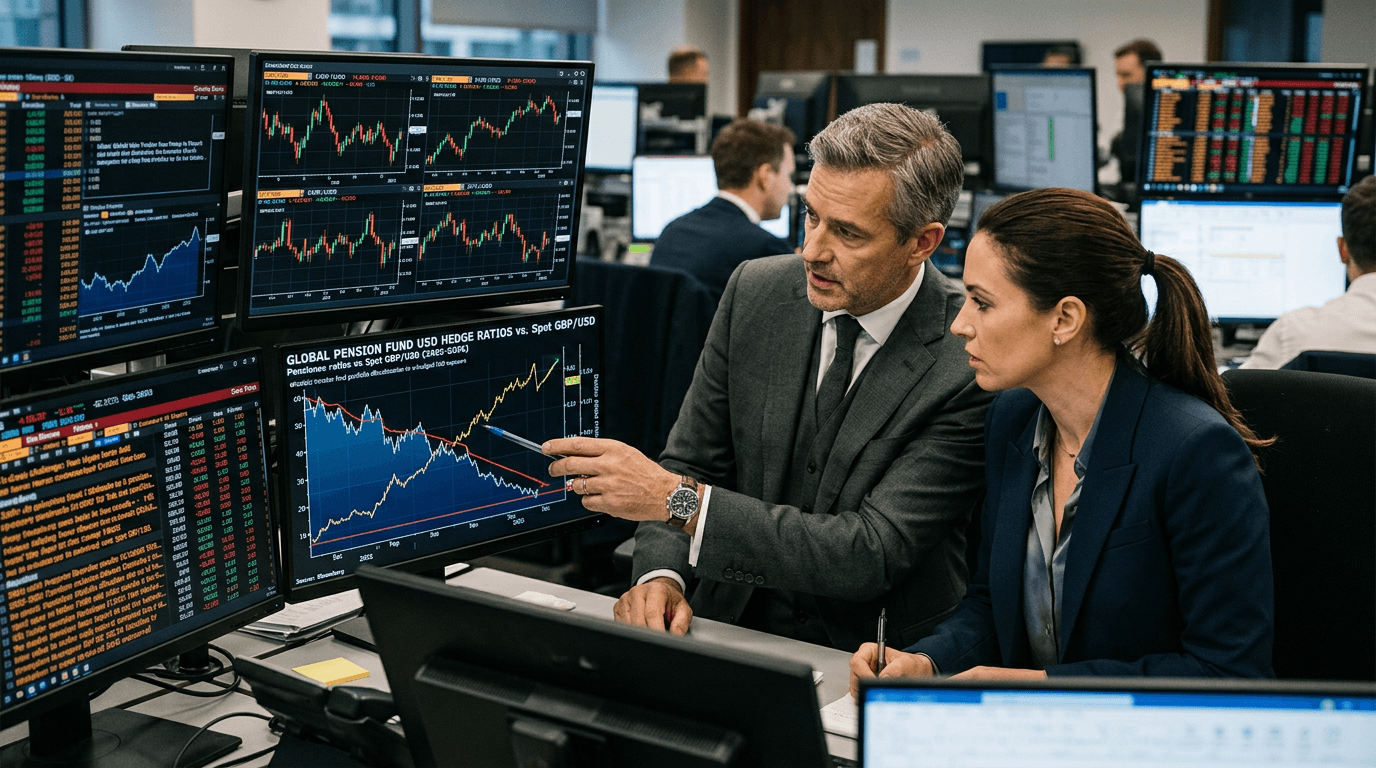
The U.S. dollar’s 2026 rally is not just about macro data and Federal Reserve speeches; it is also being quietly powered by some of the biggest, slowest-moving players in global markets: pension funds.[1][4] As these long-term investors reverse the currency hedges they rushed to put on after last year’s market turmoil, they are adding unhedged dollar exposure in size – a structural flow that can help keep the dollar supported against major currencies and in FX futures.[1][4][9]
WHAT’S DRIVING THE 2026 DOLLAR RALLY
The macro backdrop is the first pillar of this story. A hawkish Federal Reserve, still prioritizing inflation control over rapid easing, has kept U.S. interest rates relatively high versus other developed markets.[1][4] Higher short-term and real yields tend to attract global capital into dollar assets, from Treasuries to U.S. credit and equities.
The second pillar is positioning. The dollar sold off in 2025 during bouts of risk aversion and following April’s slide, when hedging flows by non-U.S. investors amplified downside pressure.[9] As sentiment stabilized and growth in the U.S. outperformed, many of those earlier bearish dollar positions have been squeezed out, giving room for a fresh uptrend.
The third – and underappreciated – pillar is the behavior of institutional investors. Large pension funds in Europe, Canada, Japan and elsewhere had boosted FX hedges on their U.S. holdings during the previous year’s “Liberation Day” market unrest to protect against currency volatility.[1][5] With dollar “woes” easing and policy differentials favoring the U.S., those same institutions are now pulling back on hedges and allowing more FX risk back into their portfolios, effectively re-leveraging to the dollar.[1][5]
How Pension Fund Currency Hedging Really Works
To see why this matters for traders, you need to understand the mechanics of a hedge.
When a euro- or yen-based pension fund buys U.S. assets, it faces dollar exposure on top of the underlying market risk. To reduce currency risk, it can enter into forward contracts or swaps that effectively sell USD and buy its home currency, offsetting FX moves.[6][8] Many consultants historically recommended partial hedges – often in the 50–75% range of foreign currency exposure – to reduce volatility without fully sacrificing potential FX gains.[8]
These hedges are not just book entries; they are real flows. A portfolio-wide program can involve tens of billions of notional in USD forwards, rolled regularly. Industry guidance has increasingly emphasized flexible hedge ratios rather than fixed ones, encouraging schemes to adjust hedging as valuations, policy, and risk budgets evolve.[6] That has opened the door for more dynamic shifts, like the current reduction in dollar hedges.
Crucially, when a pension fund unwinds a hedge, it has to close out those FX contracts. If the original hedge was “sell USD / buy domestic currency,” reversing it means buying back USD and selling the domestic currency in the forward or spot market.[9] Aggregated across many funds, this can produce persistent net demand for dollars, reinforcing an existing uptrend.
Why Pension Funds Are Unwinding Fx Hedges Now
Several structural forces are pushing funds toward less hedging and more unhedged dollar exposure.
First, return expectations from traditional assets are subdued. With projected long-run returns on global stocks and bonds lower than in past decades, more schemes are looking at currencies as an additional source of diversification and alpha.[3] Currency managers report growing interest from government and corporate pension funds seeking strategies that can perform when both equities and bonds struggle, as they did in 2022.[3]
Second, the relative yield picture has changed. In the late 2010s and early 2020s, European and Japanese investors often chose to buy U.S. dollar assets without hedging because negative or ultra-low domestic yields made the carry from unhedged USD exposure attractive.[2] After the volatility and dollar swings of 2025, many funds temporarily increased hedges to contain risk.[5][9] As volatility has moderated and the Fed’s stance keeps U.S. yields appealing, the cost-benefit calculation is tilting back toward accepting currency risk.
Third, the strategic mindset has evolved. Asset owners are increasingly comfortable treating currency as an intentional return source, not just a risk to be minimized.[6] That means they are more willing to run lower hedge ratios when they see macro trends favoring a particular currency – in this case, the dollar. A number of Canadian and Danish institutions that boosted USD hedging in early 2025 have since scaled those hedges back, aligning with the broader trend highlighted by Reuters in 2026.[1][5]
Impact On Major Fx Crosses And Fx Futures
Because pension funds are among the largest holders of foreign assets, their hedging decisions can move major currency pairs, especially over multi-month horizons.[1][9] When they systematically reduce hedges on U.S. exposure, three key impacts tend to show up:
1) Support for the dollar versus funding and reserve currencies Lower hedges mean net buying of USD against EUR, JPY, GBP and others, lending ongoing support to pairs like EUR/USD and USD/JPY beyond what short-term macro headlines might imply.[1][9] This can help sustain a rally even when speculative positioning is already long.
2) Pressure and opportunity in FX futures and forwards Many pension programs implement hedges via forwards and exchange-listed FX futures. As they unwind, open interest and flows shift, affecting curve dynamics, basis, and roll costs in key contracts. Traders active in CME FX futures or OTC forwards may see persistent flows that create mean-reversion or trend-following opportunities around roll dates.
3) Volatility regimes Large hedging adjustments can either dampen or amplify volatility depending on the direction of travel. The BIS documented how increased hedging in early 2025 amplified dollar weakness when investors rushed to protect portfolios after a slide.[9] The current phase – reducing hedges into a rising dollar – may instead help smooth drawdowns for dollar bulls while adding pressure on currencies where domestic investors are net FX sellers.
What This Means For Traders And Simulated Strategies
For discretionary and systematic traders alike, the takeaway is that not all dollar strength is purely “macro.” A portion is structural and flow-driven, arising from how long-horizon investors manage FX risk. In practice, that means:
- Trend signals in USD pairs may be more persistent than short-term data surprises alone would justify, as slow-moving institutional flows continue in the background.
- Pullbacks in the dollar amid still-hawkish Fed messaging and ongoing hedge reductions may present buying opportunities rather than clear reversals.
- Crosses tied to countries with large overseas savings pools (such as EUR, JPY, some Nordic currencies, and CAD) may be especially sensitive to these pension flows.
On a SimFi platform, this environment is ideal for testing medium-horizon FX strategies that explicitly incorporate positioning and flow narratives: for example, models that blend rate differentials with proxies for institutional demand, or discretionary playbooks that focus on “buy-the-dip” behavior in structurally supported USD pairs.
Traders can also experiment with hedge-ratio simulation: designing model portfolios that shift between fully hedged, partially hedged, and unhedged foreign exposures depending on macro and valuation signals, then observing how those choices affect performance and drawdowns. That exercise not only builds intuition about how pension funds think, but also highlights why their collective decisions can be so market-moving.
Ultimately, understanding the current dollar rally means looking beyond the Fed and data releases to the slow, heavy gears of global asset allocation. As pension funds keep easing off their FX protection and embracing unhedged U.S. exposure, those gears are turning in the dollar’s favor – and FX traders who track them carefully can be better positioned for the moves that follow.