
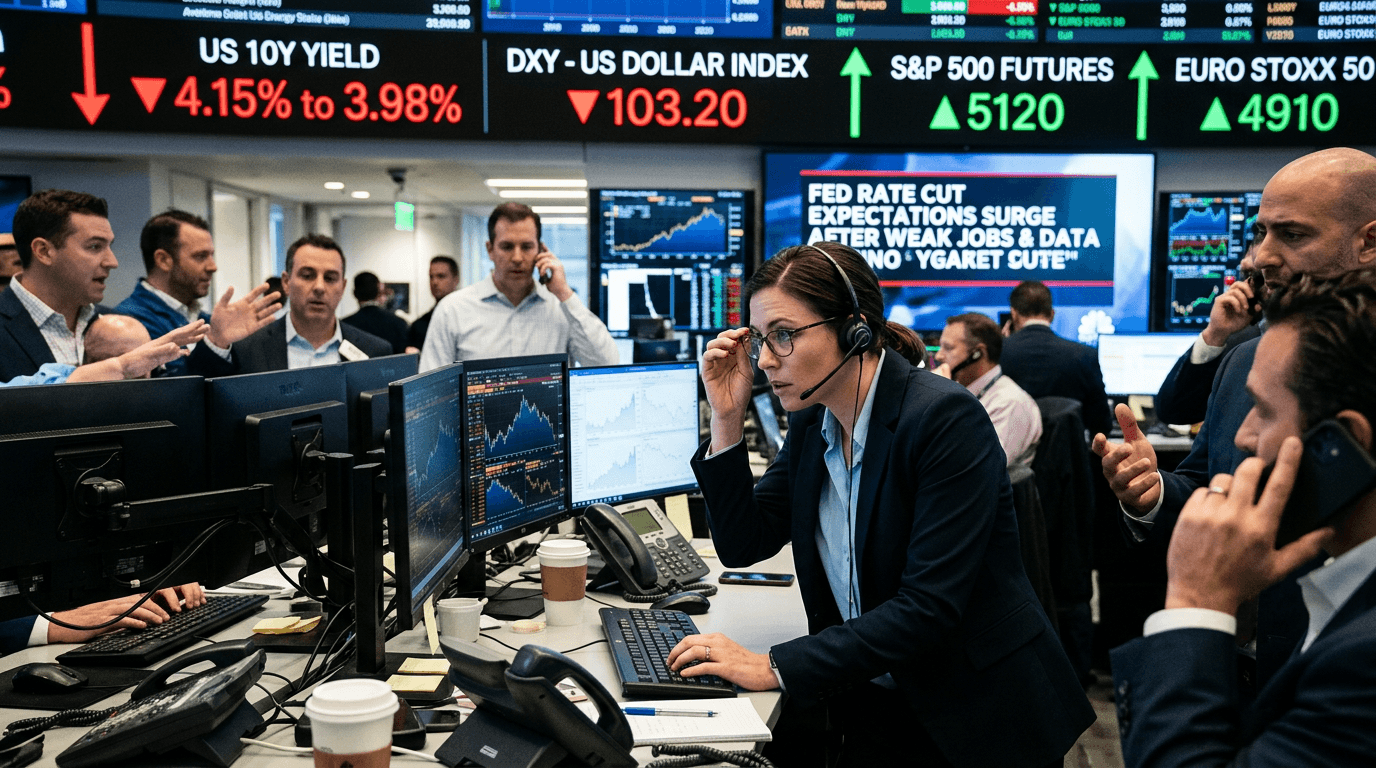
A softening U.S. economic pulse is starting to reshape the interest-rate landscape, and with it, the outlook for Treasury yields and the dollar. Recent labor market figures have shown slower job creation, while inflation readings have eased from prior highs, leading traders to reconsider how quickly and how far the Federal Reserve might cut rates.[8] As expectations for easier policy grow, both bond and currency markets are adjusting, with potential spillovers across global assets.
Driver: Weaker Labor And Softer Inflation Data
The labor market remains resilient by historical standards, but recent data points to a cooler pace of hiring. According to the Bureau of Labor Statistics, payroll employment rose by around 57,000 in June, a noticeably slower gain than the robust monthly increases seen earlier in the cycle.[8] The unemployment rate has ticked higher to 4.2%, signaling that labor conditions are no longer tightening the way they were when the Fed began raising rates.[8]
On the inflation side, consumer prices are still increasing, but at a more controlled pace than during prior surges. Headline CPI rose 0.5% in May, but the broader trend over recent months has been one of gradual moderation compared to the elevated levels that originally forced aggressive rate hikes.[8] For markets, the key is not that inflation has vanished, but that it appears increasingly compatible with the Fed eventually easing policy rather than keeping rates at peak levels indefinitely.
This combination—slower hiring and softer inflation—has led investors to believe the Fed has more room to cut rates over the coming year. As those expectations shift, the yield curve and the dollar are both recalibrating, with ripple effects across forex, index futures, and risk assets.
How Lower Yields Alter The Dollar Outlook
U.S. Treasury yields are the backbone of global pricing for risk and return, and they respond directly to changes in interest-rate expectations. Recently, the 10-year Treasury yield has eased to around 4.47%, giving back part of its earlier rise as investors reassess the odds of future rate cuts.[6] When traders expect a lower policy path, they tend to demand less yield from longer-dated bonds, pushing prices up and yields down.
The dollar, in turn, is heavily influenced by relative interest-rate expectations versus other major economies. A weaker data profile that supports rate cuts narrows the yield advantage of U.S. assets compared with, say, eurozone or Japanese bonds. As that yield premium compresses, global investors have less incentive to hold dollar-denominated assets, and demand for the currency can soften.
This is why recent labor and inflation data have coincided with a weaker dollar: the market is effectively pricing in a future where U.S. cash and bond returns are lower than previously assumed. For forex traders, the dollar’s trajectory is increasingly tied to each new datapoint on jobs and prices, with rate-cut speculation acting as the main transmission channel.
Implications For Forex, Index Futures And Risk Assets
When yields fall and the dollar weakens on softer data, the effect does not stop at Treasuries. Foreign exchange markets typically react first, with dollar pairs adjusting as traders reprice relative policy paths and growth prospects. A weaker dollar often supports risk sentiment in emerging markets, where dollar-denominated debt becomes less burdensome and local currencies can stabilize or appreciate.
Equity index futures also respond to shifts in the rate backdrop. Lower yields reduce discount rates used to value future corporate earnings, which can lift price-to-earnings multiples and support higher index levels, especially for growth and tech sectors that are more sensitive to discount-rate assumptions. At the same time, weaker labor data can raise concerns about economic momentum, creating a tug-of-war between “lower rates are good for valuations” and “slower growth is bad for earnings.”
Risk assets such as high-yield credit, commodities, and cyclical stocks tend to trade off that balance. If markets read softer data as a gentle cooling that helps tame inflation without triggering a recession, risk assets can rally alongside falling yields. But if the data deteriorates more sharply, recession fears can dominate, and the initial boost from lower rates may give way to risk aversion.
What Traders And Investors Should Watch Next
For traders, the story is no longer about a single payroll or inflation report but about the sequence of data and how it shapes the Fed’s reaction function. Each new jobs release, CPI print, and wage measure will either reinforce or challenge the narrative of a gradually cooling economy that justifies rate cuts. The Fed’s own communications—meeting statements, minutes, and speeches—will be critical in confirming whether policymakers see the same picture that markets are pricing in.
Bond traders will watch the front end of the curve closely, as two-year yields are especially sensitive to changes in near-term policy expectations.[6] A decisive move lower in short-term yields would suggest growing confidence that cuts are coming sooner rather than later. Currency traders, meanwhile, will compare the U.S. policy outlook with that of other central banks; if foreign economies are still contending with stickier inflation or stronger growth, relative rate differentials could drive more sustained dollar weakness.
Equity and index futures traders need to track whether lower yields are translating into improved financial conditions—cheaper borrowing, stronger credit flows, and higher risk appetite—or whether they are a warning sign of slower demand and tightening profit margins. That distinction will shape sector leadership, with defensive and income-oriented names tending to outperform if growth fears rise.
Practical Takeaways For Simulated And Live Traders
For both SimFi participants and live traders, the current environment is a textbook case of how macro data drives cross-asset pricing. First, recognize that the market’s focus has shifted from “how high will rates go?” to “when and how fast will they come down?” Positioning around that pivot means monitoring rate-cut probabilities implied by futures and options alongside each major data release.
Second, understand that weaker labor and inflation data can be both a risk and an opportunity. In simulated trading, this is an ideal time to test strategies that link bond yield moves to currency pairs and index futures—such as going long rate-sensitive equity sectors when yields drop on soft data, while hedging with FX positions that reflect a weakening dollar. Observing how correlations change from one report to the next builds intuition that is crucial for real-world trading.
Finally, risk management becomes even more important when macro drivers dominate. Data releases can cause sharp intraday swings in yields, the dollar, and equity futures as markets rapidly reprice expectations. Using simulated environments to practice position sizing, stop placement, and scenario analysis around scheduled reports helps traders stay disciplined when they eventually deploy capital in live markets.