
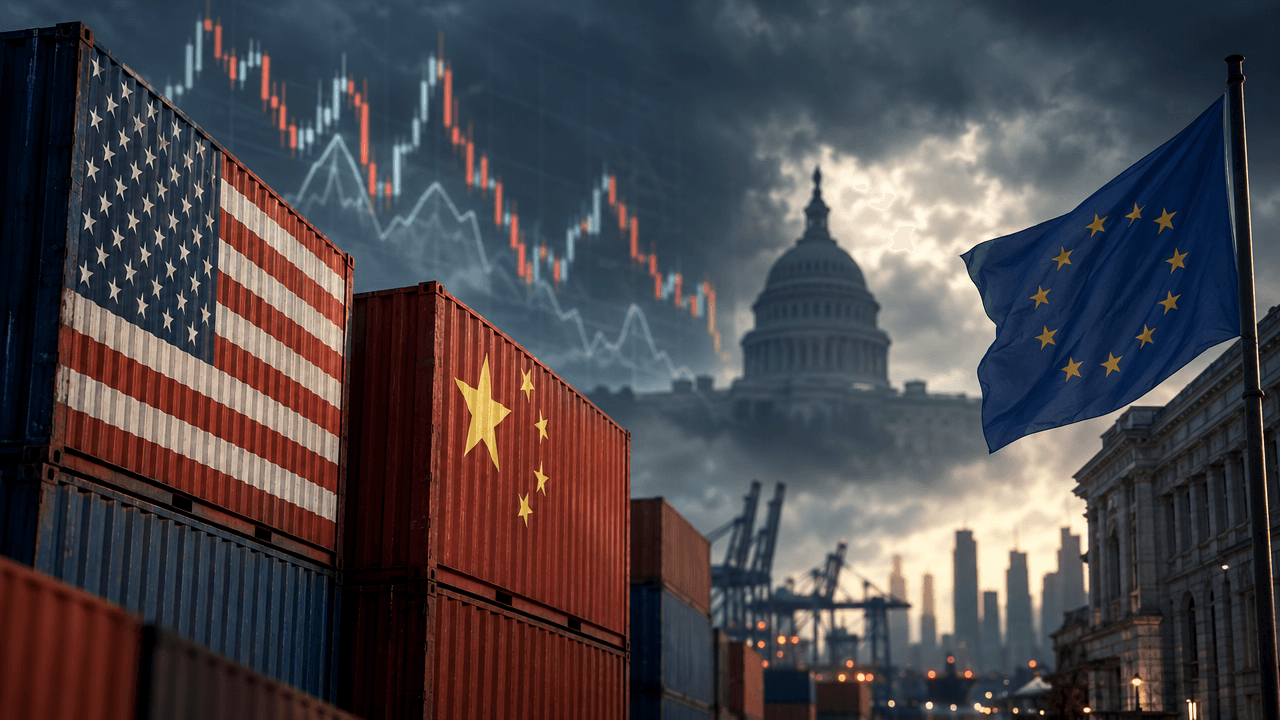
Trade and political risks are becoming a larger force in global markets, complicating an already uncertain inflation and interest-rate outlook. Investors are no longer watching economic data in isolation. Tariff announcements, US-China negotiations, elections, government budgets and geopolitical developments can quickly change expectations for growth, prices and central-bank policy.
The International Monetary Fund projects global growth of 3.1% in 2026 and 3.4% in 2027, but it also expects global headline inflation to rise to 4.7% in 2026 before easing to 4.1% in 2027. World trade growth is expected to slow from 5.0% in 2025 to 4.6% in 2026, reflecting the impact of tariffs and adjustments to production chains. [1]
Why Trade Policy Matters
Tariffs affect markets through several channels. The most immediate is cost. Import duties can raise the price of goods, components and raw materials, putting pressure on company margins and consumer prices. Businesses may respond by passing costs to customers, changing suppliers or delaying investment.
The second channel is growth. If trade barriers reduce cross-border activity, exporters may face weaker demand while manufacturers deal with higher input costs. Companies that depend heavily on international supply chains can become especially sensitive to policy headlines.
The third channel is uncertainty. Even when tariffs are threatened but not implemented, businesses may postpone hiring, capital expenditure and inventory decisions. Markets can react before the economic damage appears in official data because investors price the possibility of weaker earnings and slower growth in advance.
US-China relations remain an important source of this uncertainty. Changes involving technology restrictions, strategic materials, shipping routes or market access can affect semiconductor companies, industrial firms, currencies and commodities. A de-escalation may support risk assets, while renewed restrictions could encourage defensive positioning.
The Inflation And Interest-rate Connection
Trade risks become more market-moving when inflation is already difficult to predict. A tariff can act like a tax on imported products, but its broader effect depends on how businesses and consumers respond. If companies absorb the additional cost, earnings may suffer. If they pass it on, inflation may prove more persistent.
That creates a difficult environment for central banks. A weaker economy could justify lower interest rates, but renewed price pressures may encourage policymakers to remain cautious. This is the classic tension between supporting growth and controlling inflation.
Energy and food prices add another layer. The IMF has warned that higher commodity prices can revive inflationary pressure while weakening growth, creating a stagflationary challenge for energy-importing economies. [8] Traders therefore need to distinguish between a temporary price shock and a persistent inflation trend. Central banks may look through a short-lived increase, but they are less likely to ignore second-round effects on wages, services and expectations.
For markets, the result can be rapid changes in rate expectations. Government bond yields may rise when investors anticipate tighter policy, while equity valuations may weaken as the discount rate increases. Conversely, evidence of slowing growth can push yields lower, even if inflation remains uncomfortable.
European Political Risk
Political developments in Europe can influence markets through fiscal policy, government stability and the future direction of European integration. Election results, coalition disputes and difficult budget negotiations may affect investor confidence even when there is no immediate change in economic data.
Recent market analysis points to greater attention on French fiscal and political uncertainty, with potential effects on government-bond spreads, the euro and European equity performance. [12] The European Stability Mechanism has also noted that political and fiscal uncertainty could trigger further bouts of volatility, particularly where investors are already concerned about debt sustainability. [13]
The practical lesson is that political risk is not limited to election day. Markets may react to opinion polls, budget proposals, parliamentary votes and comments from political leaders. A government that appears unable to pass a credible budget may face higher borrowing costs, while a stable coalition with a clear fiscal plan can reduce the risk premium.
How Traders Can Manage The Uncertainty
The first step is to build scenarios rather than rely on a single forecast. For example, a trader might consider three possibilities: trade tensions ease, tariffs remain unchanged, or restrictions escalate. Each scenario may produce different outcomes for the dollar, euro, equity indexes, bonds and commodities.
The second step is to monitor cross-market confirmation. A political headline may initially move one asset, but a broader reaction is more meaningful. Rising bond yields, a stronger safe-haven currency and falling equity indexes may indicate that investors view the development as a serious growth or inflation risk.
The third step is to control exposure around known event risks. Large positions held through tariff announcements, central-bank meetings or election results can face substantial price gaps. Smaller position sizes, defined risk limits and reduced leverage can help prevent one unexpected headline from overwhelming a trading plan.
Traders should also watch correlations. In a risk-off environment, equities and commodity-linked currencies may weaken together while government bonds and safe-haven currencies attract demand. Those relationships are not permanent, however. If inflation is the dominant concern, bonds may sell off alongside equities.
Final Takeaways
Trade and political risks matter because they can change the economic outlook before traditional indicators confirm the shift. Tariffs may weaken growth and raise prices at the same time. US-China tensions can disrupt supply chains and technology markets. European political developments can influence bond spreads, the euro and regional equity risk premiums.
For SimFi traders, the objective is not to predict every headline. It is to understand the transmission mechanism: how a policy decision could affect growth, inflation, interest rates and investor sentiment. By using scenario analysis, cross-market confirmation and disciplined risk management, traders can respond to uncertainty without allowing it to dictate every decision.
Global macro uncertainty is unlikely to disappear quickly. The most resilient approach is to remain flexible, separate facts from headlines and size trades for the possibility that markets may move faster than the economic data.