
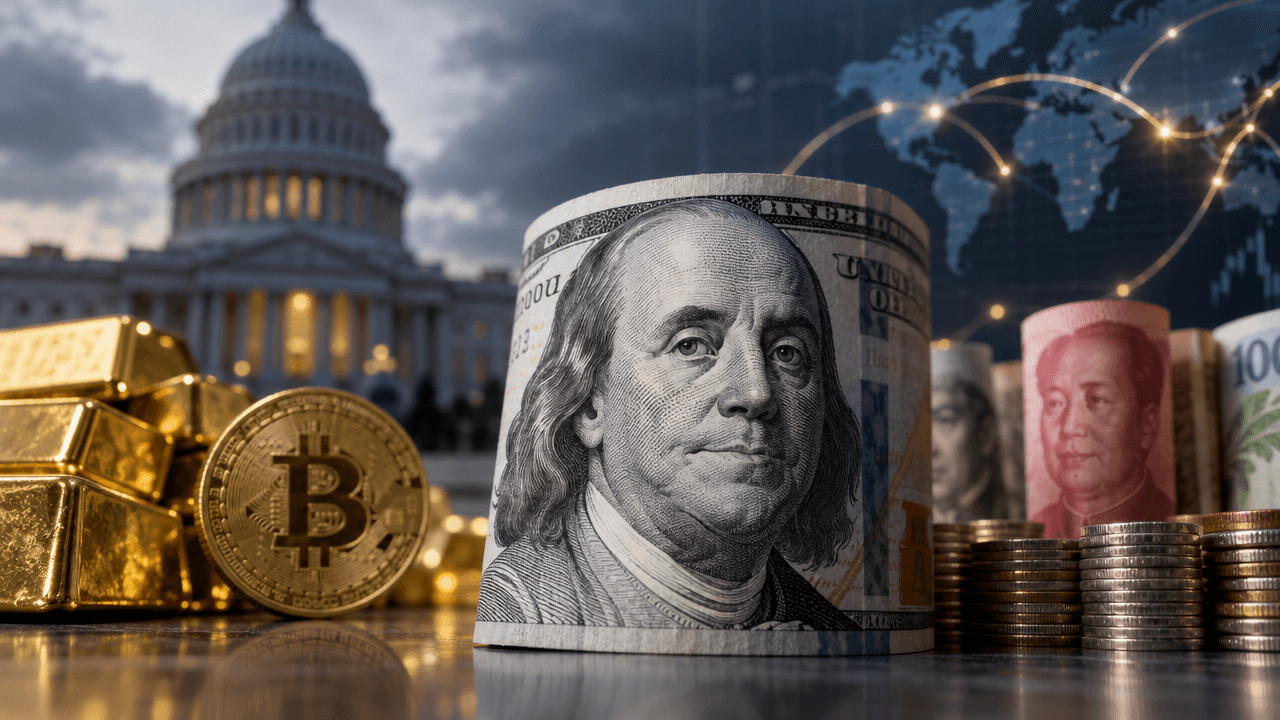
A 10-year US Treasury yield above 5% is more than a round-number milestone. It signals a meaningful shift in the global cost of money, strengthening the dollar while reshaping the risk-reward balance across currencies, commodities, equities, and digital assets. The latest move placed the 10-year yield near 5.145%, while the US Dollar Index gained 0.23% to 103.411. [1]
For traders, the combination matters because Treasury yields influence borrowing costs and asset valuations worldwide. When US government bonds offer higher returns, investors may move capital toward dollar-denominated assets and away from markets perceived as carrying greater risk. That flow can create pressure across emerging-market currencies, gold, and crypto.
WHY THE 5% YIELD LEVEL MATTERS
The 10-year Treasury yield is widely used as a reference rate for global finance. It helps influence mortgage rates, corporate borrowing costs, equity valuations, and the pricing of many financial assets. As the yield rises, the return available from holding a relatively low-risk US government bond becomes more competitive.
The opportunity cost is particularly important. An investor choosing between a technology stock, a speculative token, or a Treasury bond now has to demand a higher potential return from the riskier asset. Otherwise, the safer bond may appear more attractive.
Recent market reporting attributed the rise to stronger expectations for additional Federal Reserve tightening, following inflation data that kept price pressures in focus. The 10-year yield rose above 5%, while the two-year yield remained near 4.86%, suggesting that traders were reassessing the path of interest rates rather than simply reacting to a single move in long-term borrowing costs. [2]
A yield above 5% does not automatically mean markets will continue falling. It does, however, raise the hurdle that risk assets must clear. Companies with strong cash flow and reasonable valuations may cope better, while assets valued primarily on distant future growth can become more sensitive to higher discount rates.
Why Higher Yields Support The Dollar
Higher Treasury yields can support the US dollar through capital flows. Global investors who buy US government bonds typically need dollars to complete those purchases. If US yields rise relative to those available in other major economies, demand for dollar-denominated assets may increase.
The dollar also benefits when traders expect the Federal Reserve to keep interest rates higher for longer. Even if no rate increase occurs immediately, the expectation of tighter policy can attract buyers seeking higher short-term and long-term returns.
The recent dollar index increase to 103.411 reflects this dynamic. A stronger dollar can reinforce the original move because dollar-denominated assets become more attractive, while foreign investors may reduce exposure to assets whose value could be eroded by currency depreciation.
However, traders should distinguish between nominal yields and real yields. Nominal yields measure the stated return on a bond, while real yields account for inflation. If inflation rises rapidly, a 5% Treasury yield may provide less purchasing-power protection than its headline figure suggests. The dollar’s outlook therefore depends not only on the yield level, but also on inflation expectations, Federal Reserve policy, and economic growth.
Pressure On Emerging Markets, Gold, And Crypto
Emerging-market currencies are often vulnerable when the dollar strengthens. Many emerging economies have debt denominated in US dollars, so a stronger dollar increases the local-currency cost of servicing that debt. At the same time, international investors may demand higher returns before holding local bonds or equities.
Historical market commentary shows how this mechanism can affect local-currency debt. In one recent review, a firmer dollar was identified as a major drag on emerging-market debt returns, with only five of 21 benchmark currencies gaining against the dollar. [6]
Gold faces a different but related challenge. The metal does not pay interest, so its relative appeal can decline when Treasury yields rise. A stronger dollar can add pressure because gold is priced in dollars, making it more expensive for buyers using other currencies. Recent reporting linked the combination of higher yields and a firmer dollar with a sharp decline in gold prices. [15]
Crypto markets can experience similar pressure, especially when investors reduce exposure to speculative assets. Bitcoin and other digital assets do not compete directly with Treasury bonds in every portfolio, but both can be affected by changes in liquidity and risk appetite. Higher yields can encourage investors to hold more cash and short-term securities, reducing the capital available for volatile markets.
What Traders Should Watch Next
The next stage of the move will depend on whether yields remain above 5% or quickly retreat. A sustained rise would indicate that investors continue to price stronger inflation, heavier government borrowing, resilient economic growth, or additional Federal Reserve tightening. A reversal could suggest that the market believes yields have moved too far or that economic weakness is becoming the dominant concern.
Traders should monitor inflation releases, employment data, Federal Reserve communications, Treasury auctions, and the spread between US yields and those in Europe, Japan, and other major economies. Currency reactions can also provide useful confirmation. If yields rise while the dollar remains firm, pressure on emerging-market currencies and dollar-priced commodities may persist.
Technical traders can use the 5% level as a reference point, but should avoid treating it as a guaranteed support or resistance level. Markets often overshoot widely watched thresholds. Position sizing, stop-loss planning, and awareness of event risk are more reliable tools than assuming a round number will hold.
Practical Takeaways For Simfi Traders
First, treat Treasury yields as a cross-market signal rather than an isolated bond-market statistic. A sharp yield increase can influence currency pairs, indices, commodities, and crypto simultaneously.
Second, watch the dollar before entering trades in gold or emerging-market currencies. A strong dollar may create a headwind even when the individual asset’s domestic fundamentals appear positive.
Third, be cautious with highly valued growth assets when real yields are rising. Higher discount rates can pressure valuations, particularly when profits are expected far in the future.
Finally, build scenarios instead of relying on a single forecast. If yields hold above 5%, the dollar may remain supported and risk assets may face pressure. If yields fall because growth weakens, the dollar response could become less straightforward: safe-haven demand may support it, while expectations of future rate cuts could weaken it.
The move above 5% is a reminder that the global market is still highly sensitive to interest rates. For SimFi traders, the key lesson is to follow the transmission mechanism: yields influence capital flows, capital flows influence the dollar, and the dollar helps shape the performance of currencies, commodities, equities, and crypto. Understanding that chain can lead to more disciplined decisions than focusing on any single headline.