
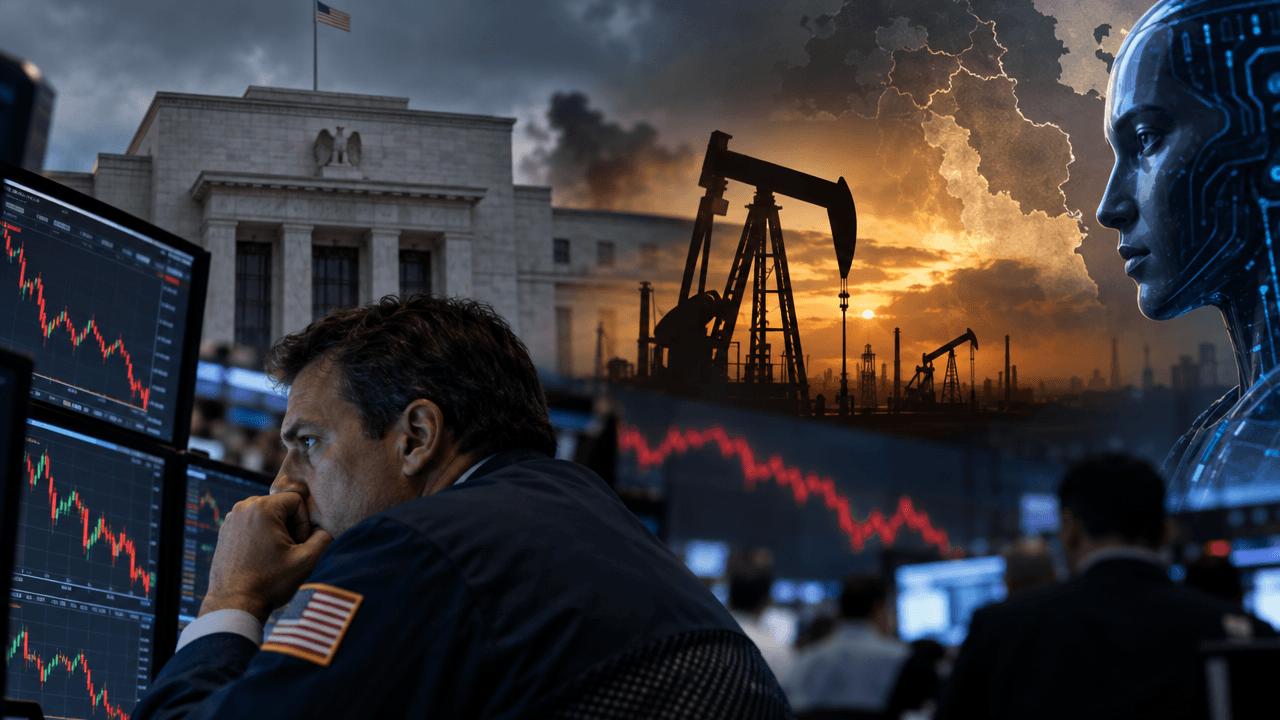
US stocks remain volatile as investors weigh three competing forces: stubborn inflation, shifting Federal Reserve expectations, and geopolitical uncertainty affecting energy markets. In November, the S&P 500 has recorded average daily moves of approximately 1.6%, while the Nasdaq 100 has moved an average of 2.4% per session. Those figures highlight how quickly market sentiment is changing, particularly in technology and semiconductor shares. [2]
For traders, the key lesson is that volatility is not being driven by one isolated headline. Instead, markets are responding to a feedback loop in which inflation affects interest-rate expectations, interest rates influence stock valuations, and geopolitical developments threaten to reignite price pressures.
Inflation Is Keeping The Fed In Focus
The latest inflation data has added to uncertainty about the Federal Reserve’s next move. Consumer prices increased 0.4% in October, exceeding forecasts and keeping inflation well above the Fed’s 2% target. Interest-rate futures subsequently priced in a significantly higher probability of a December rate increase. [11]
Higher inflation matters because it changes the value investors place on future corporate earnings. When traders expect interest rates to remain elevated, future profits become less valuable in today’s dollars. This effect is especially pronounced for high-growth companies whose valuations depend on earnings expected years in the future.
Federal Reserve officials have also emphasized that inflation remains a central policy concern. Governor Michelle Bowman said the central bank supported holding the federal funds target range at 3.75% to 4% at its most recent meeting, while other officials have indicated that further tightening may be necessary if price pressures persist. [1] [12]
This creates a difficult environment for equities. Strong economic growth can support corporate revenues, but it can also encourage the Fed to maintain restrictive policy for longer. Traders must therefore assess not only whether the economy is expanding, but also whether that expansion is compatible with lower inflation.
Oil And Geopolitical Risk Add A Second Inflation Threat
Energy markets are adding another layer of uncertainty. Tensions involving Iran and disruptions to Middle Eastern oil shipments have caused crude prices to move sharply as traders weigh supply risks against the possibility of diplomatic progress. [14]
A sustained increase in oil prices could affect markets in several ways. More expensive fuel raises transportation and production costs, potentially placing upward pressure on consumer prices. It can also reduce household purchasing power, leaving consumers with less money to spend on discretionary goods and services.
For investors, oil is both a market asset and an economic signal. A sudden rally in crude may benefit energy producers, but it can weigh on airlines, transport companies, manufacturers, and consumer-focused businesses. If higher energy prices feed into broader inflation, bond yields may rise and expectations for interest-rate cuts may be delayed.
That is why futures sentiment can reverse quickly. A report suggesting improved diplomatic conditions may push oil lower and support stock futures. A new supply disruption or escalation may have the opposite effect within minutes. Traders should distinguish between short-lived headline reactions and sustained changes in the supply outlook.
Ai Valuations Are Under Pressure
Technology stocks have been another major source of volatility. The artificial intelligence investment boom has supported strong gains across chipmakers, cloud providers, and data-center companies. However, investors are increasingly questioning whether projected growth rates and spending plans can justify current valuations.
Recent declines in semiconductor shares have demonstrated how crowded trades can amplify market moves. When confidence weakens, investors may sell the same high-growth names simultaneously, producing large index swings because technology companies represent a substantial share of major benchmarks.
The concern is not necessarily that artificial intelligence lacks long-term value. Federal Reserve Vice Chair Philip Jefferson said AI could eventually provide substantial productivity benefits, but he also noted that the gains may arrive gradually and create pain for some workers and businesses during the transition. [9]
The practical issue for investors is valuation discipline. A company can have excellent long-term prospects and still be overpriced in the short term. Traders should examine revenue growth, profit margins, capital expenditure, cash flow, and customer demand rather than relying solely on an attractive technology narrative.
How Traders Can Manage The Volatility
The current environment rewards preparation more than prediction. Traders should begin by identifying the events most likely to move prices, including inflation releases, Federal Reserve communications, employment data, oil-market headlines, and major technology earnings.
Position sizing is equally important. Smaller positions can reduce the damage caused by unexpected gaps, while predetermined stop levels help prevent one trade from becoming an emotional long-term hold. Leverage should be treated as a risk-management decision, not merely a way to increase potential returns.
It is also useful to separate market direction from market conditions. A trader may have a correct bullish or bearish view and still lose money if volatility causes an early exit. In fast markets, waiting for confirmation, using wider but carefully sized risk limits, or avoiding trades during major announcements may be more effective than reacting to every price movement.
On a SimFi platform, traders can practice these decisions without exposing real capital. A useful exercise is to build scenarios around three outcomes: inflation remains high and rates rise, oil prices surge because of geopolitical escalation, or inflation cools and AI shares recover. Tracking how stocks, bonds, currencies, and commodities respond can reveal whether a strategy is genuinely robust.
The Road Ahead
US stocks are likely to remain sensitive to incoming data because investors are still debating whether inflation will moderate, whether the Fed will tighten further, and whether AI-related growth expectations are realistic. The combination of policy uncertainty, geopolitical risk, and elevated technology valuations creates conditions for rapid moves in both directions.
The most reliable response is not to predict every headline. It is to understand the relationships connecting inflation, interest rates, energy prices, and valuations. Traders who manage exposure carefully, test multiple scenarios, and focus on evidence rather than market excitement will be better positioned to navigate the next phase of volatility.