
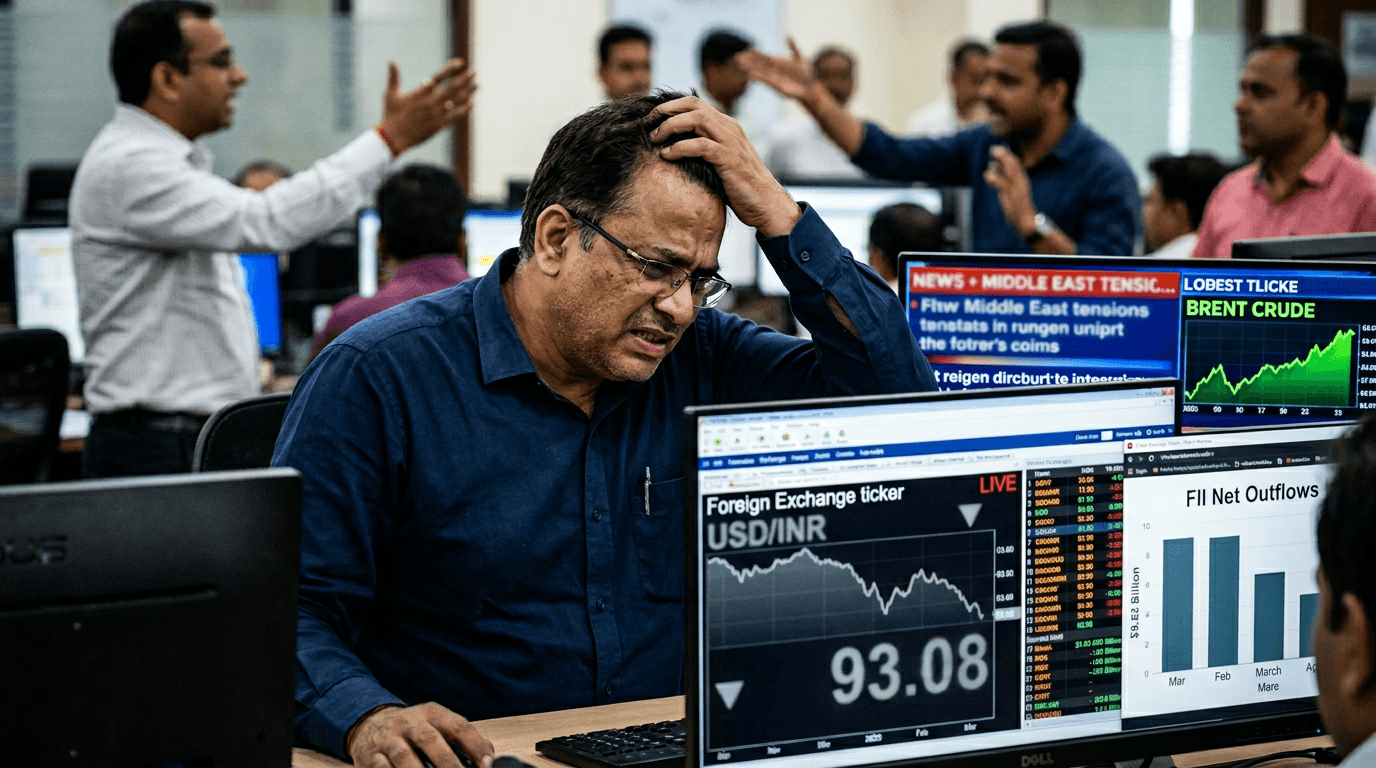
The Indian rupee has plunged to unprecedented lows against the US dollar, as intensifying geopolitical tensions in the Middle East compel foreign investors to reassess their positions in emerging markets. On March 20, 2026, the rupee plummeted to an intraday low of 93.08 per dollar, breaching the 93 level for the first time. By March 23, it had weakened further to approximately 93.15 amid mounting market pressures. This development has profound implications for India's economy and emerging market investors worldwide, demonstrating the rapid ripple effects of geopolitical shocks on financial markets.
The Perfect Storm: Multiple Factors At Play
This dramatic decline in the rupee is not due to a single factor, but a convergence of both global and domestic challenges that have created a perfect storm. The main catalyst is the escalating conflict in West Asia, particularly between the United States and Iran over the Strait of Hormuz. These geopolitical tensions have driven crude oil prices to $106.9 per barrel for Brent crude, with India's oil basket averaging $114.08 per barrel in March—significantly higher than the Reserve Bank of India's (RBI) assumption of $70 per barrel.
India's reliance on energy imports, sourcing over 80% of its energy needs externally, makes it especially susceptible to oil price shocks. Rising import costs put direct pressure on the currency, as importers rush to purchase dollars to cover expensive energy supplies. Concurrently, foreign institutional investors have become increasingly cautious, withdrawing around $9.83 billion from Indian financial markets in March alone—the largest monthly outflow since October 2024. This capital flight has exacerbated selling pressure on the rupee amidst its struggle against a strengthening US dollar, reflected in a dollar index reading of 100.25.
Domestic Market Reactions And Rbi's Response
The rupee's depreciation has coincided with significant volatility in India's equity markets. The Sensex and Nifty fell to 21-month lows before partially rebounding on March 20, with indices recovering to 75,167.91 and 23,313.65, respectively. However, despite support from domestic equity markets, the currency's weakness persists, underscoring external pressures that surpass local sentiment.
The RBI has actively intervened to curb the rupee's fall, primarily by selling dollars from its foreign exchange reserves. Market observers estimate the RBI's net forward dollar sales at approximately $100 billion across onshore and offshore markets through forward contracts and swaps. Despite these efforts, the central bank's foreign exchange reserves fell by $11.68 billion as of March 7, highlighting the extensive intervention needed to defend the currency. As one treasury advisor observed, "The rupee looks vulnerable with the RBI the only one protecting it from further fall by selling dollars," illustrating the precarious situation facing policymakers.
Broader Economic Implications
The rupee's depreciation creates a complex policy landscape for the RBI. While the central bank originally assumed an exchange rate of 88 per dollar for its monetary policy framework, the actual rate has weakened significantly, posing upside risks to inflation forecasts. A weaker rupee makes imports more expensive, directly driving up inflation through higher fuel and commodity prices, precisely when global uncertainty is already affecting economic growth prospects.
However, the situation presents nuanced trade-offs. A depreciated rupee can enhance export competitiveness by making Indian goods more appealing in global markets, potentially supporting India's manufacturing sector and current account. Yet these advantages are overshadowed by immediate concerns over inflation and capital flight, which threaten economic stability and investor confidence.
Key Takeaways For Investors And Traders
The rupee's record low serves as a stark reminder of how emerging market currencies remain susceptible to external shocks, particularly geopolitical crises that disrupt commodity supplies. For traders, the sharp move underscores the importance of monitoring not just economic data but also geopolitical developments that can trigger rapid market repricing.
The RBI's substantial intervention indicates that central bank support remains available, potentially limiting further depreciation in the near term. However, sustained capital outflows and elevated oil prices suggest the rupee may remain under pressure unless geopolitical tensions ease.
As market participants await preliminary purchasing managers' index data for insights into economic activity, the rupee's weakness adds urgency to India's policy response and raises questions about how long the RBI can maintain current intervention levels without depleting reserves. For investors in Indian markets, this environment necessitates heightened vigilance regarding currency risk exposure.