
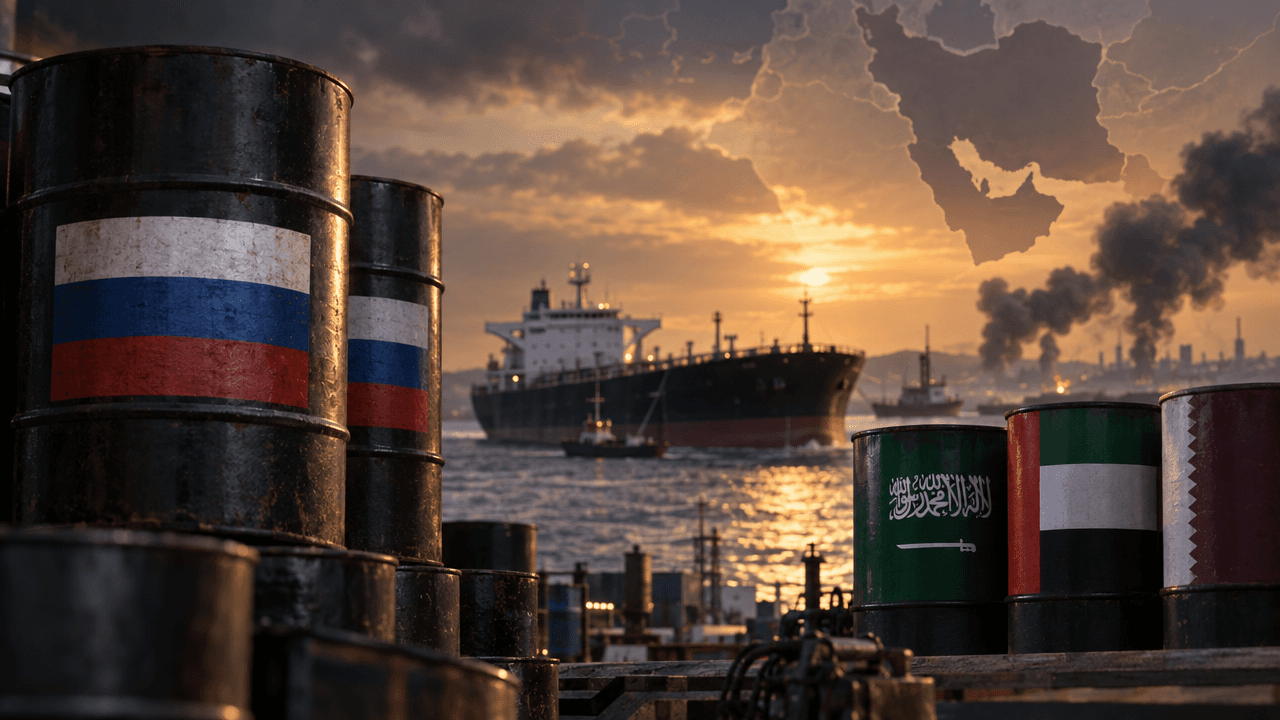
India’s decision to reduce Russian crude imports highlights how quickly geopolitical risk can reshape global energy markets. In September, Indian purchases of Russian oil fell 13%, marking a second consecutive monthly decline and the lowest level since April. The shift came as tensions in the Middle East disrupted major shipping routes, tightened supply conditions and pushed energy prices higher. [1]
For India, the change is more than a temporary adjustment in procurement. It shows how refiners must balance discounted crude against shipping risks, supply reliability, refinery economics and the growing cost of navigating an uncertain global market.
What Changed In September
Russian crude arrivals in India averaged approximately 1.74 million barrels per day in September, compared with about 2.02 million barrels per day in August and 2.65 million barrels per day in July. [11][13] Russia nevertheless remained one of India’s most important suppliers.
The decline was visible across several major refining facilities. Imports at Reliance Industries’ Jamnagar refinery dropped 27%, while Indian Oil Corporation’s Paradip refinery recorded a 21% decrease. Nayara Energy’s Vadinar refinery saw imports fall 8%. [1]
These figures point to a broad change in supply patterns rather than an isolated disruption at a single facility. Indian refiners were still buying crude, but they were increasingly turning to alternative suppliers, especially producers in the Middle East.
Why Middle East Tensions Matter
Oil is a global commodity, but its delivered cost depends heavily on transportation. Crude must travel through strategically important routes including the Strait of Hormuz, the Red Sea and the Bab el-Mandeb passage. When conflict raises the perceived risk of using those corridors, tanker availability, insurance costs and freight rates can all increase.
Recent Middle East tensions disrupted trade through the Red Sea and created additional uncertainty around the Strait of Hormuz. These disruptions contributed to higher energy prices and made the economics of long-distance crude purchases more difficult to predict. [1]
Russian oil may still be priced attractively, but a discount can lose some of its value if freight costs rise, voyages become longer or cargoes face delays. Refiners therefore compare the full delivered cost of each barrel—not just the price listed at the export terminal.
This is an important lesson for traders and investors. Supply disruptions do not need to remove millions of barrels from the market immediately to influence prices. The possibility of delays and rerouted cargoes can be enough to increase volatility.
India Pivots Toward Gulf Suppliers
As Russian imports declined, India increased purchases from Middle Eastern producers including Iraq, Saudi Arabia and Kuwait. Supplies from the region reached roughly 3 million barrels per day in September, broadly returning to pre-conflict levels. [9][13]
This pivot demonstrates India’s strategic advantage as a large and diversified crude buyer. The country imports oil from dozens of nations, allowing refiners to adjust their supply mix when one source becomes less competitive or less dependable. India imported crude from more than 40 countries during the first half of 2026, according to industry data cited by S&P Global. [12]
However, diversification does not eliminate risk. Middle Eastern supplies may be closer to Indian refineries than Russian cargoes, but they remain exposed to regional conflict and chokepoint disruptions. If tensions around Hormuz intensify, Gulf barrels could become more expensive or difficult to transport.
The result is a more complicated energy market in which India must manage both supplier concentration and route concentration.
Competition, Sanctions And Refinery Economics
Geopolitics was not the only factor affecting Russian crude flows. Analysts also pointed to stronger competition from Chinese refiners, tighter Russian crude availability and disruptions to Russian oil infrastructure. [3][14]
Chinese demand can influence the price and availability of Russian barrels for buyers across Asia. If Chinese refiners secure more cargoes, Indian buyers may face higher prices or fewer attractive shipments.
Western sanctions and political pressure also continue to shape the market. India has maintained commercial relationships with Russian suppliers while refining crude into fuels for domestic and international markets. But the compliance, insurance and payment requirements surrounding sanctioned oil can increase operational complexity.
For refiners, the central question is not simply whether Russian crude is available. It is whether the barrel can be purchased, transported, insured, processed and sold at a competitive margin.
What Markets Should Watch Next
Investors and traders should monitor several indicators in the coming months.
First, watch the spread between Russian crude and Middle Eastern grades. A narrower discount could make Russian oil less attractive, particularly if transportation costs remain elevated.
Second, track tanker rates and activity around the Strait of Hormuz and Red Sea. Freight volatility can change refinery margins even when benchmark crude prices move only modestly.
Third, follow India’s total crude imports and refinery utilization. September’s shift did not represent a collapse in Indian oil demand. In fact, stronger refinery operations helped lift overall crude intake while Russian volumes fell. [13]
Finally, watch refined-product exports. Indian refiners have continued supplying overseas markets, making the country an important link between crude producers and fuel consumers. Changes in crude sourcing could eventually affect gasoline, diesel and jet fuel margins in Asia and beyond.
The Bigger Takeaway
India’s 13% reduction in Russian crude imports is best understood as a market adaptation rather than a complete break with Russia. Russian oil remains significant, but its share can fluctuate when prices rise, shipping routes become dangerous or competing buyers increase demand.
The episode reinforces a broader principle: energy markets are shaped by logistics as much as by production. A refinery’s cheapest theoretical source may not be its cheapest practical source once freight, insurance, sanctions and geopolitical risk are included.
For traders, the most valuable signal is the movement between suppliers. India’s shift toward Gulf crude suggests that refiners are prioritizing flexibility and delivery certainty as energy prices rise. If Middle East tensions persist, that flexibility could become one of the most important drivers of crude spreads, tanker rates and refined-fuel margins.