
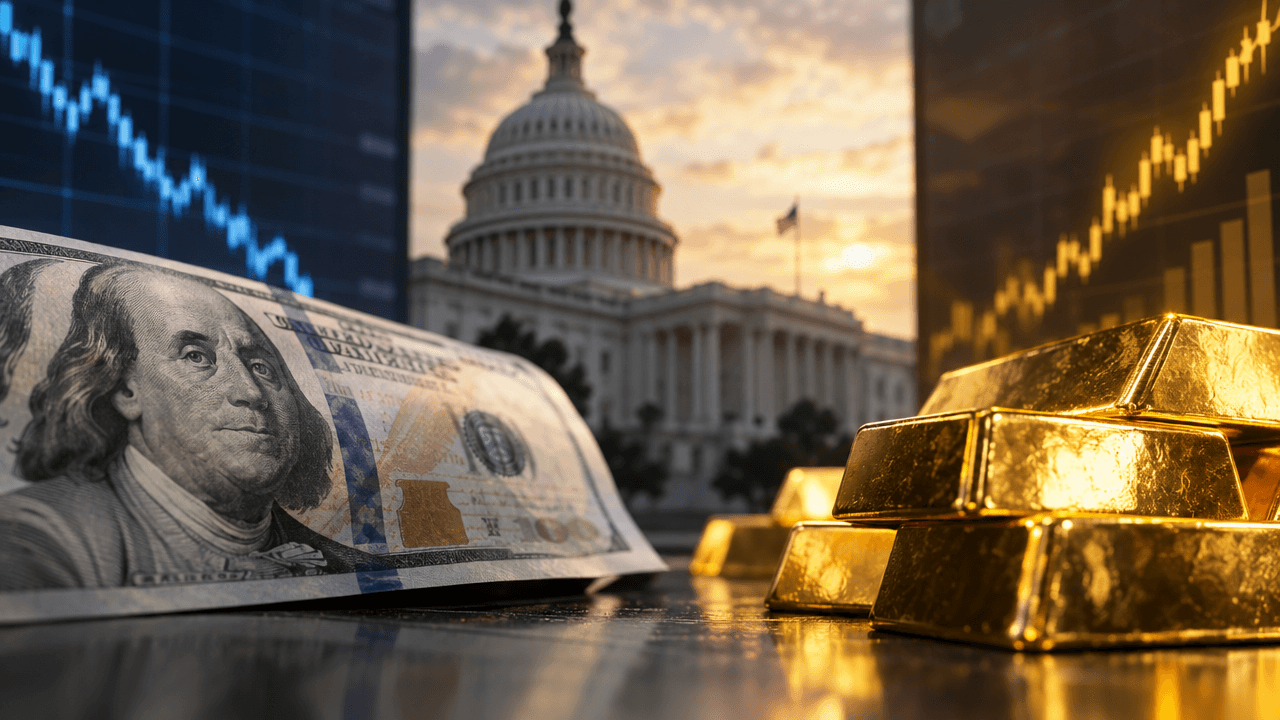
The U.S. dollar has fallen to a one-month low while gold has surged back above $4,000 per ounce, highlighting how quickly political developments can reshape expectations across currency, bond, and precious-metals markets. The immediate catalyst was the Democratic Party’s victory in both chambers of Congress, prompting investors to reassess the outlook for fiscal policy, economic growth, regulation, and Federal Reserve interest rates. [1]
Gold gained more than 2% initially and later advanced as much as 3.4% to approximately $4,059.95 per ounce, recovering sharply from its October 30 low near $3,869.85. At the same time, the dollar weakened to its lowest level in more than a month, while Treasury yields declined across the curve. [3]
For traders, the move is a reminder that markets price expectations rather than simply reacting to headlines. The election result changed the perceived balance between fiscal expansion, political gridlock, economic growth, and future monetary policy—all of which directly influence the dollar and gold.
Why The Dollar Weakened
The dollar often benefits when investors expect stronger economic growth, higher interest rates, or increased demand for U.S. assets. Following the election, however, markets began considering whether divided political priorities could limit the administration’s ability to advance its fiscal agenda.
Democratic control of both the Senate and House may complicate efforts to pass major spending initiatives. Investors also weighed the possibility of tighter regulation affecting the artificial-intelligence industry, an important area of expected economic and corporate growth. These concerns contributed to a more cautious outlook for the U.S. economy and pressured the dollar. [6]
Political uncertainty can weaken a currency when it reduces confidence in the country’s future policy direction. It does not necessarily mean that the dollar will enter a prolonged decline, but it can encourage traders to reduce long-dollar positions, particularly when the currency has already been supported by expectations of U.S. economic exceptionalism.
The dollar’s decline also made dollar-denominated commodities more affordable for international buyers. That effect can provide an additional boost to gold demand when the currency moves sharply lower. [14]
Why Gold Rallied
Gold is particularly sensitive to movements in real interest rates, Treasury yields, the dollar, and investor demand for defensive assets. It does not pay interest, so its opportunity cost tends to rise when bond yields increase. Conversely, falling yields can make gold more attractive relative to fixed-income investments.
After the election results, Treasury yields declined across the curve. The combination of lower yields and a weaker dollar created a favorable environment for bullion, helping gold reclaim the psychologically important $4,000 level. [8]
The rally also reflected a broader shift in risk perception. Investors were not necessarily responding to an immediate crisis; instead, they were positioning for uncertainty around fiscal policy, regulation, economic growth, and the Federal Reserve’s next decisions.
Gold’s rapid rebound illustrates why major psychological levels matter. Prices had recently fallen below $3,900, but a move back above $4,000 can attract momentum traders, systematic strategies, and investors who interpret the level as evidence that the broader bullish trend remains intact.
The Next Test: Labor-market Data
The next major influence on the dollar and gold may come from U.S. labor-market data, particularly the nonfarm payrolls report. Investors are looking for evidence about whether employment remains strong enough to keep inflationary pressure elevated or whether the economy is losing momentum.
A strong jobs report could support the dollar by reducing expectations for near-term Federal Reserve rate cuts. Higher expected interest rates tend to lift Treasury yields and increase demand for dollar assets. That combination could place pressure on gold after its rapid advance.
A weaker-than-expected report could have the opposite effect. Signs of slowing employment may encourage traders to price in a more accommodative Federal Reserve, pushing yields lower and increasing demand for gold as a hedge against economic uncertainty.
The reaction will depend not only on the headline payrolls number but also on wage growth, the unemployment rate, revisions to previous data, and participation trends. Traders should avoid focusing on a single figure without considering the full report.
Practical Takeaways For Traders
First, watch the dollar and Treasury yields together. Gold can rise when both fall, but a divergence may signal that another force is driving the market. For example, gold could remain strong despite a stabilizing dollar if geopolitical or inflation concerns intensify.
Second, respect volatility around political and economic events. The move from below $3,900 to above $4,000 occurred within days, demonstrating how quickly sentiment can change. Traders entering after a sharp rally should consider position size, stop placement, and the risk of chasing momentum.
Third, treat $4,000 as an important reference point rather than a guaranteed support level. If gold holds above it after labor data, bullish momentum may strengthen. A decisive move back below the level could indicate that the election-driven rally is losing force.
Finally, remember that simulated trading still benefits from real-world discipline. Build scenarios before the data arrives, define the conditions that would invalidate your view, and avoid allowing a single headline to dictate an entire trading plan.
Conclusion
The dollar’s fall to a one-month low and gold’s rally above $4,000 reflect a rapid repricing of political, fiscal, and monetary expectations. The Democratic takeover of Congress increased uncertainty around the administration’s policy agenda, while falling Treasury yields and a softer dollar amplified demand for bullion. [1]
The next phase of the move will depend heavily on labor-market data and the Federal Reserve’s interpretation of the economic outlook. For traders, the key lesson is clear: markets respond to the interaction between politics, rates, currencies, and expectations. Monitoring those connections can provide a stronger framework than reacting to any individual headline.