
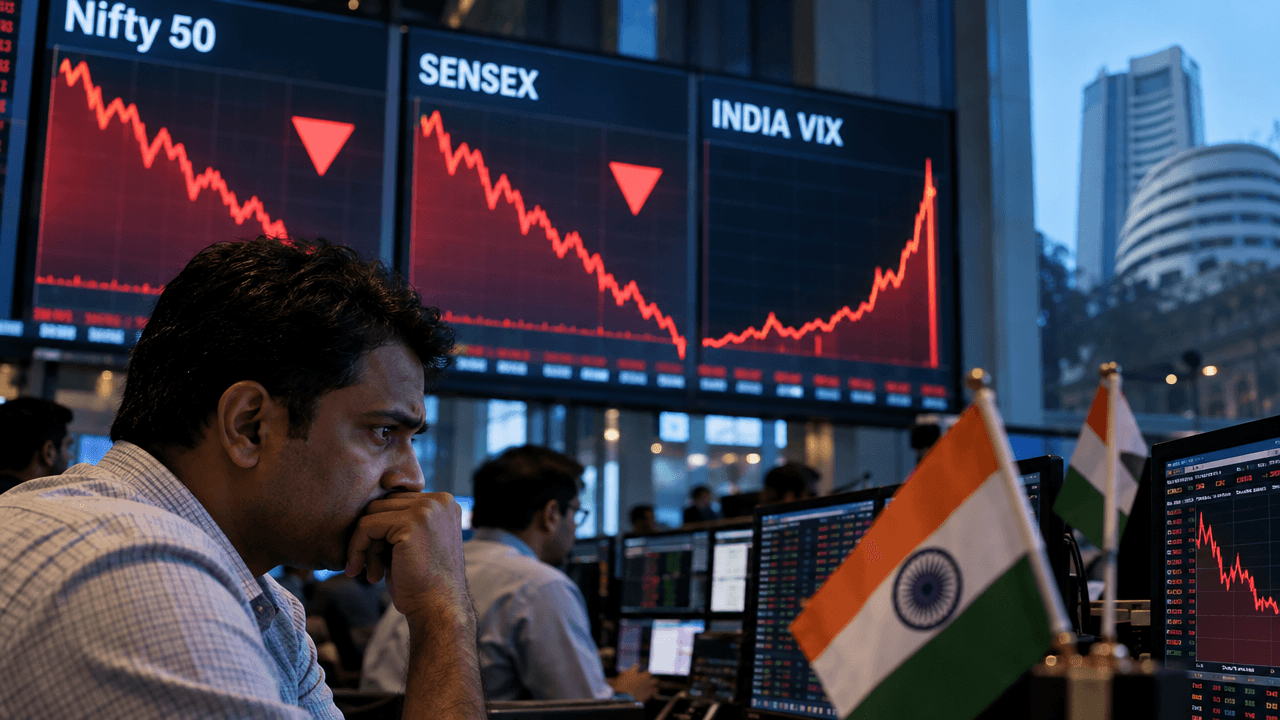
Indian equity markets are reminding traders that bull runs are never one-way streets. After weeks of grinding higher, the Nifty 50’s 1.53% drop, the Sensex’s 1.20% decline, and a near-14% jump in India VIX signal a decisive risk-off turn, with investors rushing to hedge via index futures and options.
Market Snapshot: A Sharp But Orderly Sell-off
The headline numbers point to more than just routine profit-taking. A simultaneous fall in the benchmark indices alongside a steep rise in India’s volatility gauge suggests that investors are not merely booking gains, but actively positioning for larger swings ahead.
The breadth of the sell-off matters. In recent corrections, declines of around 1% in Nifty 50 and Sensex have often coincided with broader weakness in midcaps and smallcaps, amplifying the wealth erosion for retail investors[7][14]. When volatility spikes, these segments typically underperform as traders reduce leverage and cut exposure to high-beta names.
At the same time, this move remains relatively orderly compared with extreme crash scenarios. Liquidity has stayed available, and there have been no signs of systemic stress in key funding markets, which is critical for assessing whether a sell-off is a healthy reset or something more structural.
WHAT’S DRIVING THE DOWNTURN?
Several familiar macro themes are converging. Global rate jitters are back in focus as markets reassess how long central banks might keep policy restrictive to combat sticky inflation. Rising crude oil prices, driven by geopolitical tensions and supply concerns, have repeatedly acted as a headwind for Indian equities by raising imported inflation and pressuring the current account[10][11]. Higher oil prices tend to hurt margins for energy-intensive sectors and squeeze household budgets, dampening growth expectations.
Local factors are adding to the pressure. Episodes of weak corporate earnings, cautious guidance from large IT and consumer companies, and pockets of stretched valuations have often triggered bouts of profit-taking in index heavyweights[2][5]. Foreign institutional investors (FIIs) have responded with net outflows in several recent down moves, amplifying volatility as they unwind positions in large-cap financials, IT, and energy[14][15].
For traders, the key takeaway is that this sell-off is not driven by a single headline, but by a layered set of risks: global rates, commodities, valuations, and flows. That makes the path forward more data-dependent and less about one-off events.
Why India Vix Spiking Matters
The India VIX is often described as the market’s “fear gauge,” but it is better understood as a real-time measure of expected volatility embedded in Nifty options prices. A near-14% jump in the index indicates that options traders are pricing in a wider range of potential outcomes in the short term, from sharper downside to more violent intraday swings.
Higher implied volatility has practical consequences. Option premiums rise, making hedges more expensive but also more powerful for those already long volatility. Traders who were selling options to collect premium in a low-volatility environment face mark-to-market stress when implied volatility spikes, forcing them to adjust positions or increase margins.
Historically, spikes in India VIX during sharp index declines have coincided with broad-based sector corrections and heightened intraday volatility[7][10]. For intraday and swing traders, this environment demands tighter risk controls: smaller position sizes, predefined stop-loss levels, and careful monitoring of overnight gap risks.
Implications For Equity And Fx Traders
For equity traders, the immediate impact is a shift in market regime from trend-following to mean-reversion and range expansion. Short-term price moves can overshoot both on the downside and in relief rallies, making entry and exit timing more critical than usual.
Sector rotation tends to accelerate in such phases. Historically, defensives like FMCG, utilities, and select healthcare names have seen relative outperformance during periods of macro stress and elevated volatility, while high-beta sectors such as smallcap financials, real estate, and cyclicals have underperformed[7][14]. Traders should watch for relative strength rather than absolute price moves to identify where money is hiding.
For FX traders, a sharp sell-off in domestic equities often spills over into emerging-market currency sentiment. Risk-off moves can drive demand for safe-haven currencies while putting pressure on EM FX baskets. India has experienced phases where equity outflows and equity volatility coincide with bouts of rupee weakness, particularly when global risk appetite is fragile[10][14]. Cross-asset correlations tend to rise in such environments, making it essential to monitor equity, FX, and rates together.
How Simulated Finance Traders Can Respond
For SimFi participants, this is an ideal environment to practice managing volatility without the emotional and capital constraints of live markets. A simulated platform allows traders to test how their strategies behave under stress scenarios such as:
1) Index corrections of 2–3% over a few sessions. 2) Sudden jumps in implied volatility and option premiums. 3) Cross-asset moves where equities, FX, and commodities all react to the same macro shock.
One practical approach is to design and backtest hedging strategies using index futures and options. Traders can simulate systematic hedging rules—such as adding a protective put when India VIX breaches a threshold, or gradually reducing leverage when Nifty breaks key support levels—to see how these rules affect drawdowns and equity curves.
Another valuable exercise is stress-testing portfolio concentration. By recreating scenarios similar to past sessions where Nifty and Sensex fell around 1–1.5% on weak global cues and FII outflows[12][14][15], traders can examine how concentrated positions in a handful of sectors behave versus a diversified basket. This helps sharpen judgment on position sizing and correlation risks.
Finally, volatility phases are an opportunity to practice discipline. SimFi traders can set “rules of engagement” for high-VIX periods: maximum daily loss limits, caps on intraday trades, and clear conditions for reducing exposure. The goal is not just to survive volatility, but to develop repeatable playbooks that can be applied when trading real capital.
Outlook And Key Takeaways
The current sell-off and volatility spike are important reminders that markets can transition quickly from complacency to caution. Global rate uncertainty, elevated crude prices, and persistent questions around growth and earnings are combining to push investors toward hedging and de-risking[10][11][14].
For active traders, the message is clear: this is a regime shift, not a random wobble. Expect larger intraday moves, more gap openings, and faster sector rotation. In such an environment, robust risk management, flexible positioning, and scenario-based planning matter more than precise market calls.
SimFi platforms offer a valuable sandbox to rehearse exactly these skills. By treating this episode as a live case study—rather than a one-off scare—traders can refine strategies, build resilience, and be better prepared for the next volatility shock, whether it arrives next week or next year.