
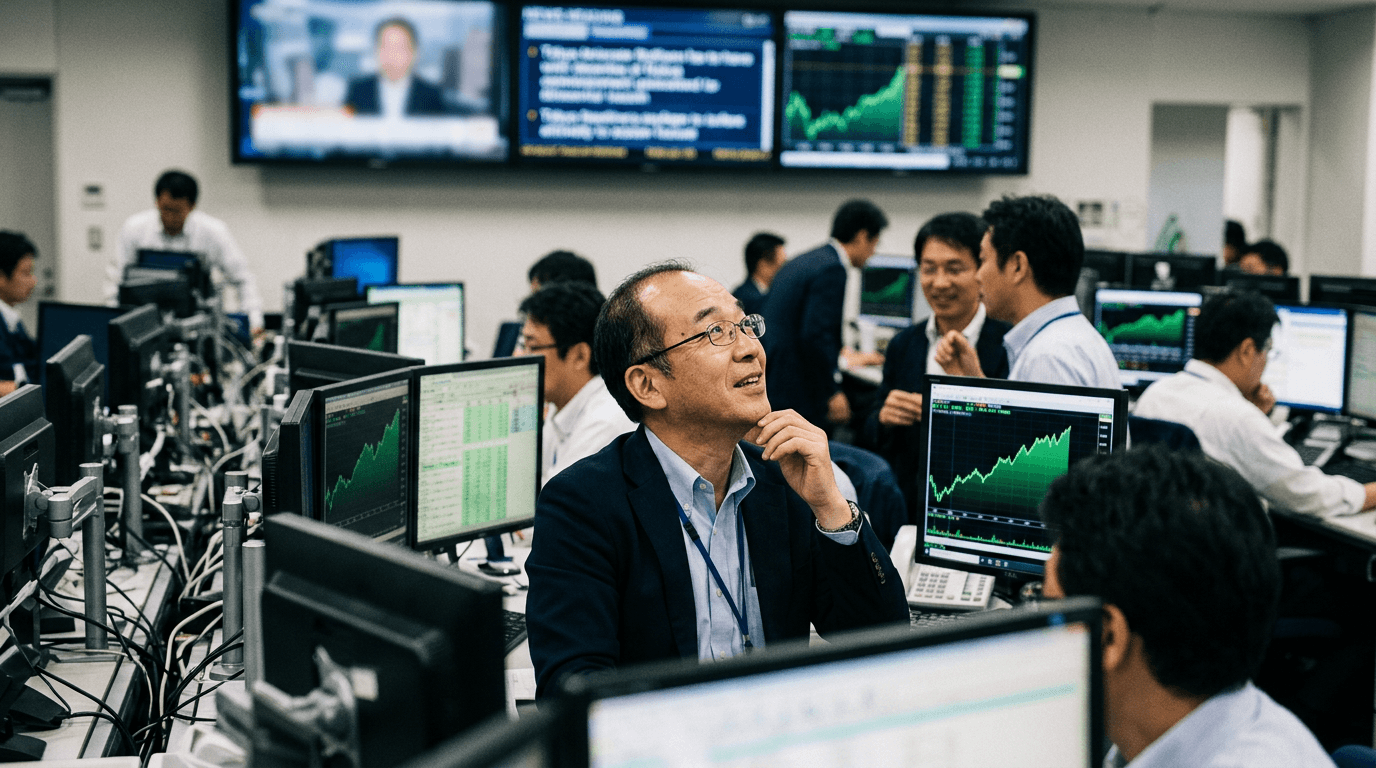
Risk appetite returned to global markets as headlines around a preliminary Iran peace understanding sent stock index futures higher and triggered a sharp rally in Asian equities. Signs of progress toward de‑escalation in the Middle East shifted investors out of defensive positioning and back into equities, with Japan’s Nikkei leading the move.
Risk Appetite Returns On Iran Peace Hopes
Reports of progress toward a peace understanding involving Iran and key global powers helped ease fears of an extended conflict and potential disruption to energy supplies.[5][7] That reduction in geopolitical risk is exactly the kind of catalyst that can flip market sentiment from “risk‑off” to “risk‑on” in a matter of hours.
Global stock index futures moved higher as traders priced in lower geopolitical risk premia and the possibility of more stable growth and earnings expectations.[2][5] U.S. equity futures, including contracts linked to the S&P 500 and Nasdaq 100, traded higher in Asian hours as investors responded to the headlines before cash markets opened.[1][5]
At the same time, demand for traditional safe‑haven assets such as gold and government bonds eased, a classic pattern whenever markets perceive a reduced probability of worst‑case scenarios.[7] In other words, the market began unwinding part of the “insurance” it had bought during the period of heightened tension.
Why Geopolitical Headlines Move Futures First
One reason this type of story shows up in futures markets before cash equity indices is simple: stock index futures trade nearly around the clock. When geopolitical news breaks outside regular exchange hours, index futures become the primary venue for price discovery as traders update their risk views.
In a conflict escalation scenario, futures typically gap lower as investors seek to reduce exposure to cyclical and high‑beta assets, while volatility and safe‑haven demand rise.[3][7] The reverse can happen when there is credible news of de‑escalation or ceasefire: futures rally, volatility tends to compress, and the market rotates back toward risk assets.[7]
For professional traders and serious retail participants alike, this underscores the importance of understanding how futures markets transmit information. Equity index futures are not just a “preview” of the next cash session; they are a real‑time expression of global risk appetite. In a simulated or live environment, watching how futures respond to geopolitical headlines can help traders anticipate sector rotation, regional performance, and intraday volatility.
NIKKEI’S 5% JUMP AND THE ASIA EQUITY RALLY
Asian markets were among the first to react, and Japan’s Nikkei took center stage. Nikkei futures and the cash index surged by around 5%, reflecting a powerful relief rally after a period of elevated geopolitical uncertainty.[4] Such a move in a major developed‑market index in a single session is significant and signals a broad shift in positioning, not just short‑term noise.
Japanese equities had been sensitive to the conflict backdrop because of their exposure to global trade, energy import costs, and investor risk sentiment. When conflict risks fade, investors are more willing to pay up for earnings streams that depend on stable global demand and energy prices.
The strength in Nikkei futures also matters beyond Japan. A sharp move higher in one major regional benchmark often boosts sentiment across other Asia‑Pacific markets, as portfolio managers rebalance risk and momentum traders amplify the move. Reports indicated that broader Asia‑Pacific indices, from India’s Nifty 50 to Hong Kong’s Hang Seng, also traded higher as investors latched onto optimism around diplomatic progress.[4][6]
For traders, a 5% index jump is not just a headline—it is a signal that positioning was heavily skewed toward caution and is now normalizing. This is exactly the type of environment where volatility strategies, index spreads, and sector rotation trades can become attractive in both practice and real‑money contexts.
Safe-havens, Oil, And The Cross-asset Reaction
Geopolitical risk in the Middle East tends to move not only stocks but also oil and safe‑haven assets. When conflict risk rises, markets often price in potential supply disruptions, pushing crude prices higher and fueling inflation concerns.[3] Conversely, peace headlines can have the opposite effect.
As optimism around a possible Iran peace deal gained traction, oil prices came under pressure, with crude sliding on expectations of more stable supply and reduced disruption risk.[5] Lower oil prices, if sustained, tend to be supportive for energy‑importing economies and for sectors sensitive to input costs, such as transportation, manufacturing, and consumer discretionary.
Meanwhile, assets that investors flock to during times of stress—gold, high‑grade government bonds, and defensive currencies—typically face selling pressure as the urgency to hedge tail risks fades.[7] The relief rally witnessed after the truce headlines was described by analysts as a textbook example of markets unwinding part of their war‑premium and volatility hedges.[7]
For cross‑asset traders, this creates opportunities in relative value: equity vs. bond positioning, cyclical vs. defensive equity sectors, energy equities vs. crude, and risk‑on vs. safe‑haven currencies. In a simulated trading environment, tracking the correlation shifts between these assets during geopolitical inflection points can be a powerful learning tool.
Lessons For Active And Simulated Traders
Headline‑driven moves like this offer several practical lessons for traders, whether they are trading real capital or honing strategies in a SimFi environment.
First, geopolitical risk is a classic source of “event volatility.” The direction of the move is often binary—escalation or de‑escalation—but the timing and magnitude are uncertain. This favors robust risk management over prediction. Position sizing, diversification, and contingency planning matter more than having a perfect macro view.
Second, futures markets are the front line of reaction. Monitoring index futures across regions—U.S., Europe, and Asia—helps traders see how sentiment evolves as different time zones come online. A strong rally in Nikkei futures, followed by strength in European and U.S. futures, is a sign that the narrative is being validated globally, not just locally.[4][5]
Third, a relief rally is not the same as a fundamental regime change. Analysts have stressed that ceasefires and preliminary peace understandings offer relief but not full resolution; the underlying geopolitical and economic risks may remain.[7] Traders who chase price without considering whether the news truly alters long‑term earnings or policy trajectories can find themselves on the wrong side once the initial euphoria fades.
Finally, simulated trading can be a valuable way to test how strategies behave during such headline shocks. Traders can replay similar scenarios—war scares, ceasefire announcements, surprise diplomatic breakthroughs—and evaluate how their systems handle gaps, volatility spikes, and cross‑asset divergence. The goal is to build playbooks: predefined responses to scenarios like “conflict escalation,” “ceasefire rumor,” and “formal peace deal.”
In the current case, the jump in global stock index futures and the Nikkei’s 5% surge highlight how fast markets can reprice risk when the narrative shifts from war to diplomacy.[4][5] Whether this relief rally evolves into a durable trend will depend on how concrete the peace progress proves to be, and how it interacts with other drivers like inflation, central bank policy, and corporate earnings.
For now, the message from markets is clear: less perceived conflict risk means more room for risk assets to breathe. For traders, the challenge is not just to recognize that shift, but to navigate it with discipline, context, and a clear framework—whether in live markets or in the safety of a simulated environment.