
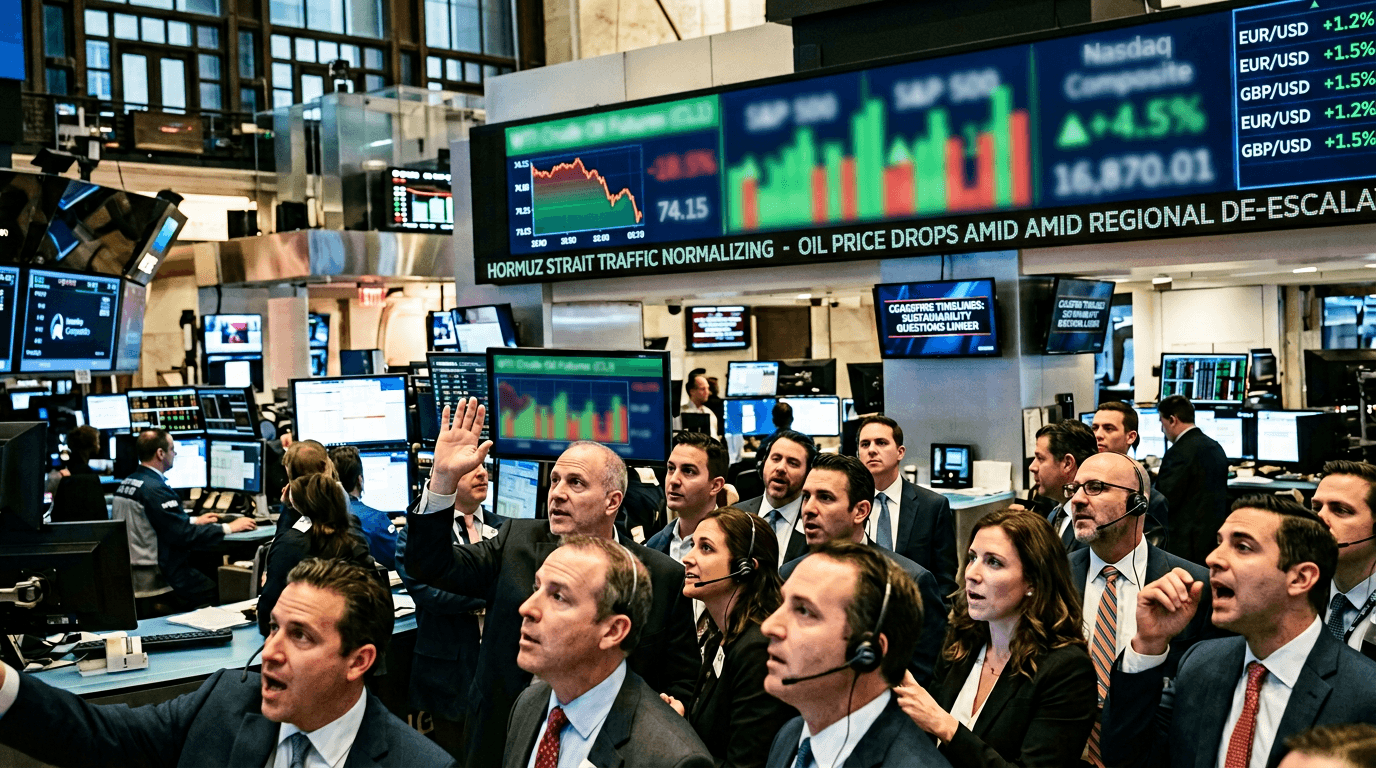
Iran's recent announcement that the Strait of Hormuz is now entirely open has sent ripples through global financial markets, sparking a synchronized surge in equities, bonds, and risk currencies as of April 17, 2026. This geopolitical development is causing a seismic shift in market sentiment, with stock indices hitting new highs and oil prices plummeting by nearly 10% to under $90 a barrel. For investors and traders, understanding the broader implications of this reopening is crucial for identifying opportunities and navigating potential risks.
Immediate Market Reaction
The reopening of the Strait immediately triggered a synchronized response from the markets, underscoring investors' appetite for positive geopolitical news. Equities and bonds rallied in unison, while oil prices and the US dollar took a sharp dive, epitomizing a classic risk-on environment. Brent crude, the global oil benchmark, saw a precipitous drop of 13% to $86 per barrel, the lowest since early March. Both the S&P 500 and NASDAQ 100 reached unprecedented highs, reflecting optimistic market sentiment about the reopening's longevity. Additionally, short-term government bond yields, especially in Europe, fell as investors adjusted their expectations for future rate hikes amid easing inflation concerns linked to energy supply disruptions. This collective rally signifies a major re-evaluation of global economic growth prospects and monetary policy pathways.
Currency Markets And Dollar Decline
A notable consequence of the Strait's reopening has been the rapid depreciation of the US dollar, which saw a steep drop following Iran's announcement. Risk-sensitive currencies, notably the Australian dollar, surged to levels not seen in three years against the dollar as investors shifted away from safe havens towards higher-yielding, growth-oriented economies. This currency movement highlights a larger trend in the market: as energy supplies stabilize and global supply chain issues abate, emerging and cyclically-sensitive economies could experience substantial gains. Additionally, a weaker dollar reduces borrowing costs for dollar-denominated debts held by non-US entities, further enhancing the appeal of emerging markets. For currency traders, this represents a pivotal shift in relative value dynamics that could persist if the reopening endures.
Energy Sector Impacts And Challenges
While falling oil prices might seem like an unqualified boon for consumer-driven sectors and transportation, the energy sector's narrative is more complex. Despite cheaper crude, airlines continue to grapple with jet fuel shortages and costs that have roughly doubled since recent geopolitical tensions began. European carriers have sounded alarms over potential jet fuel scarcities within the next six weeks, leading to flight cancellations and increased baggage fees to counteract high energy costs. This disparity between crude oil prices and refined product availability underscores a key lesson for traders: not all supply chain issues resolve uniformly, and stabilized crude prices may not equate to immediate relief in jet fuel markets. Consequently, energy stocks might underperform despite lower oil costs, and airline stocks could remain under pressure despite signs of energy market recovery.
Duration And Sustainability
The initial market euphoria hinges significantly on the anticipated duration of this reopening. Iran has linked the Strait's status to the length of a Lebanon ceasefire, expected to last around 10 days, potentially leading to broader peace talks. This timeline introduces significant uncertainty for strategic long-term positioning. While current market pricing reflects an optimistic view, with the assumption that the reopening will lead to sustained geopolitical stability, any reversal could swiftly negate today's gains. Investors and traders are advised to exercise caution, acknowledging that current market valuations reflect best-case scenarios. Economic indicators are also crucial, with recent US jobless claims dropping more than anticipated, providing additional support for equities beyond the geopolitical context.
Takeaways For Investors And Traders
The reopening of the Strait of Hormuz is a significant positive driver for risk assets, yet it carries important considerations. First, approach the potential upside with caution, contingent on continued positive geopolitical developments and the reopening's sustainability. Second, understand that different sectors will experience varied benefits from energy normalization; airlines, for example, face distinct supply chain hurdles that lower crude prices alone won't resolve. Third, maintain disciplined position sizing, as much of today's optimism is already reflected in soaring equity valuations. Lastly, this event serves as a reminder of the critical role of geopolitical risk management in modern portfolio strategies. The Strait of Hormuz reopening presents promising opportunities, but successful trading demands a careful balance of optimism with strategic risk management.