
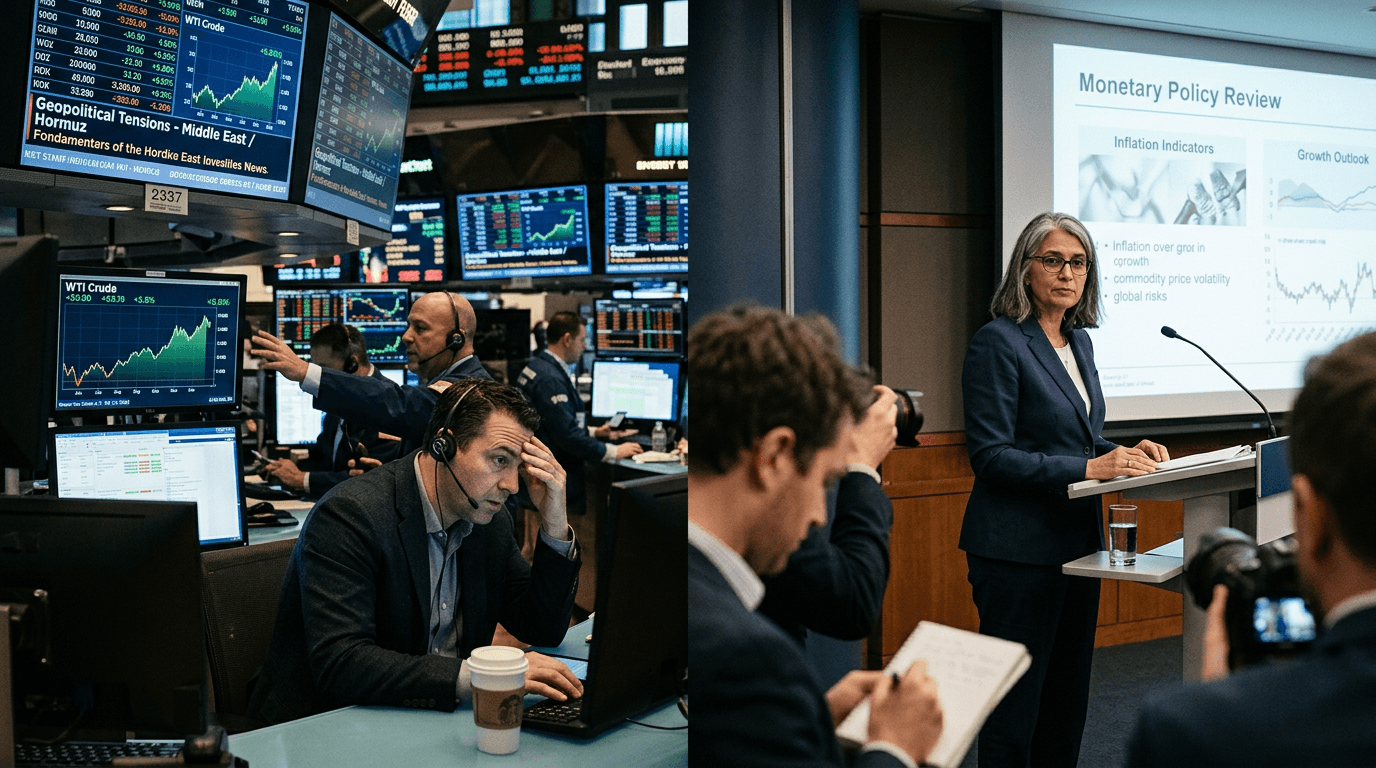
WTI crude oil is back in the spotlight as fears around the Iran war and supply risks in the Strait of Hormuz drive a powerful risk-premium rally. Futures briefly jumped close to double digits intraday and continue to trade near recent highs, even as broader risk markets wobble. For traders and investors, the story is no longer just about oil—it’s about how a geopolitical choke point can ripple through inflation expectations, interest-rate paths, and asset prices globally.
WHAT’S DRIVING THE WTI CRUDE RALLY?
The latest leg higher in WTI is being fueled less by traditional demand growth and more by tightening supply expectations and geopolitical risk repricing.
The ongoing conflict involving Iran has disrupted regional production, damaged infrastructure, and kept markets on edge about potential escalation. Analysts estimate that millions of barrels per day of supply capacity in and around the Persian Gulf have been affected or are at risk, with the International Energy Agency highlighting that this disruption rivals or exceeds some of history’s major oil shocks.
On top of that, traders are increasingly pricing in the risk that the conflict could drag on, rather than be resolved quickly. Headlines that cast doubt on ceasefire efforts or peace talks—particularly involving US and Iranian officials—have repeatedly triggered intraday spikes in crude, with WTI at times jumping 5–9% in a single session as risk premium is recalibrated.
Why The Strait Of Hormuz Matters So Much
The Strait of Hormuz is a narrow waterway, but it is one of the most strategically critical arteries in global energy flows. Roughly a fifth of the world’s crude oil and liquefied natural gas passes through this chokepoint, linking Persian Gulf producers to global markets.
When the strait is partially or fully closed—whether by direct military action, mines, or the perceived risk of attacks—producers struggle to move barrels to market. Storage tanks in the Gulf can fill quickly, forcing output cuts even when theoretical capacity remains high. Recent estimates suggest that well over 10 million barrels per day of global oil supply is either offline, constrained, or logistically impaired due to the Iran conflict and associated attacks on energy infrastructure.
That matters because supply is not just about how much oil can be pumped; it’s about how much can be safely shipped and refined. Disruptions to the shipping lanes, plus drone and missile strikes on refineries and export terminals (including those in Russia and the broader region), have reduced effective supply and raised replacement costs for refiners.
This combination has driven inventories sharply lower, with hundreds of millions of barrels drawn from global stockpiles. If the conflict persists into the coming months, some forecasts see cumulative draws approaching a billion barrels—an enormous buffer loss that keeps upside pressure on prices, even if demand growth moderates.
From Oil Shock To Inflation Shock
For policymakers and markets, higher oil is not just an energy story—it’s an inflation story. Crude feeds into the cost of transportation, manufacturing, agriculture, and logistics. When oil and refined product prices spike, they tend to bleed into consumer prices with a lag, especially in categories like gasoline, airfare, and goods shipping.
The IEA has already trimmed its global oil demand outlook, citing that elevated prices and supply constraints are starting to weigh on consumption. In its latest assessments, demand is now expected to contract modestly year-on-year—something rarely seen outside of major recessions or extreme shocks like COVID-19.
Paradoxically, that doesn’t mean inflation risks vanish. Even with softer demand, a sharp supply-side shock can keep energy prices high enough to feed headline inflation. Central banks, particularly the Federal Reserve and the European Central Bank, are now facing a familiar dilemma: tolerate temporarily higher inflation in the hope that the shock passes, or keep interest rates restrictive for longer to prevent inflation expectations from becoming unanchored.
Market commentators are already warning that if oil remains near or above current levels, it could limit the room for rate cuts or even force central banks to reconsider easing plans. A “bad” scenario for risk assets would see stubborn energy-driven inflation delaying or reversing the monetary policy pivot investors have been banking on.
Policy Responses And Market Cross-currents
Governments and alliances are not standing still. G7 officials have floated the idea of coordinated strategic petroleum reserve (SPR) releases to dampen price spikes and smooth supply disruptions. Such measures can temporarily relieve tightness, but they are finite and cannot fully offset structural or prolonged disruptions in the Strait of Hormuz.
At the same time, OPEC+ policy has become more complex. Even as the group had planned to gradually restore previously cut production, the reality on the ground is that Middle East producers are already being forced to curb output due to logistics bottlenecks and storage constraints. Meanwhile, sanctions and attacks on Russian refineries and export infrastructure have further limited non-OPEC+ flexibility.
For traders, this creates a highly headline-sensitive environment. Bullish catalysts include any sign of escalating conflict, new attacks on energy assets, or evidence of accelerating inventory draws. Bearish catalysts could be credible ceasefire progress, a reopening or stabilization of Hormuz shipping lanes, larger-than-expected SPR releases, or an unexpectedly rapid rebuilding of damaged infrastructure.
Strategy Considerations For Traders
In a regime dominated by geopolitical risk and supply uncertainty, volatility in energy markets tends to remain elevated. For discretionary and systematic traders alike, this has several implications:
1. Risk management first Position sizing, stop placement, and scenario planning become critical. Intraday spikes of 5–10% in WTI are no longer tail events—they are plausible outcomes around major headlines. This argues for smaller base position sizes, wider but well-justified stops, and clear rules for trading around scheduled risk events and news flow.
2. Watch the curves, not just the front month The shape of the WTI and Brent futures curves offers clues about market expectations. Deepening backwardation (near-term contracts priced much higher than longer-dated) usually signals acute short-term tightness and strong risk premium. A flattening or move toward contango can hint that traders expect supply to normalize or demand to weaken more sharply.
3. Cross-asset confirmation Energy-sensitive sectors—airlines, shipping, refiners, and some industrials—often respond quickly to oil moves. Bond yields, breakeven inflation rates, and interest-rate futures can help confirm whether an oil rally is being interpreted as inflationary or recessionary. For example, rising oil prices alongside rising breakevens and firm nominal yields point to inflation fears dominating; rising oil with falling yields may indicate markets are more worried about growth damage.
4. Use simulated environments to test playbooks Given the complexity of geopolitically driven markets, it can be useful to stress-test strategies in risk-free, simulated environments before committing real capital. Traders can model scenarios such as a sudden Hormuz reopening, a larger-than-expected SPR release, or a surprise escalation that pushes WTI toward extreme levels, and study how their systems or discretionary approaches behave.
Conclusion
The Iran war and persistent risks around the Strait of Hormuz have transformed the oil market from a supply-demand balancing act into a geopolitical pressure cooker. WTI’s latest rally is less about booming consumption and more about the price markets are willing to pay for security of supply.
That matters for far more than just crude traders. Higher and more volatile energy prices are feeding into inflation expectations, complicating central bank decision-making, and reshaping cross-asset correlations. Whether the coming months bring a resolution that normalizes flows—or a prolonged disruption that cements an inflation shock—will be a key driver of macro and market outcomes.
For traders and investors, the task now is to respect the volatility, read the risk signals across markets, and build robust strategies that can withstand both the spikes and the reversals that define oil shocks driven by geopolitics.