
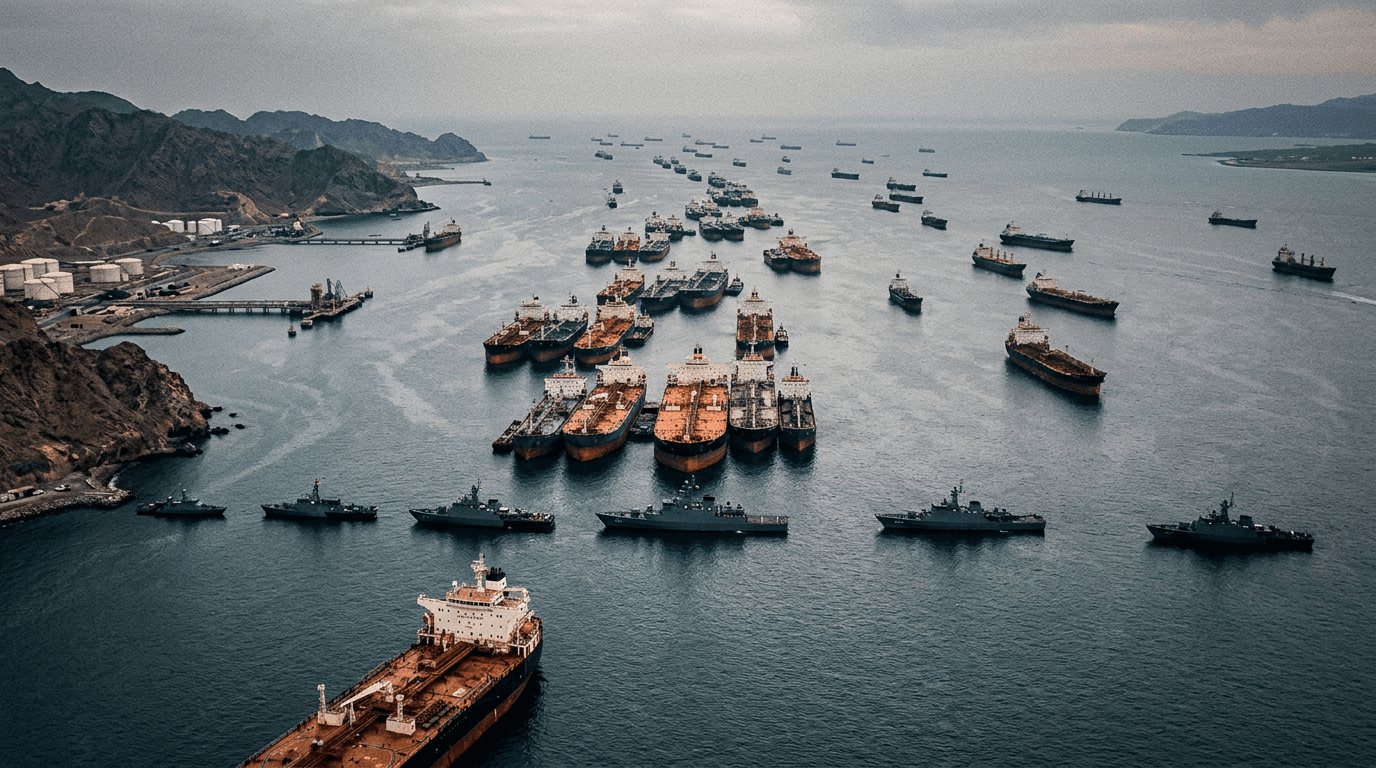
The Strait of Hormuz, a narrow waterway separating Iran and Oman that funnels roughly 20 percent of the world's daily oil supply and a significant portion of global liquefied natural gas, has entered a state of effective closure following Iran's escalating military actions. On March 2, 2026, oil tankers transiting through this critical energy chokepoint abruptly ceased broadcasting their automatic identification signals, and within hours, tanker traffic collapsed. As of early March 2026, approximately 200 oil and LNG tankers are stranded across the Persian Gulf, unable to proceed safely through the waterway. This unprecedented disruption represents one of the most significant energy supply shocks the global economy has faced in decades.
The crisis emerged following Operation Epic Fury, a coordinated military operation launched by the United States and Israel on February 28, 2026, targeting Iran's nuclear facilities and military installations. The operation killed Iran's Supreme Leader Ali Khamenei, setting off a chain reaction of escalation. By March 3, Iran's leadership publicly announced that the Strait of Hormuz was closed to all vessel traffic and warned that any attempt to cross would result in military action. The following day, the Iranian Revolutionary Guard Corps declared complete naval control of the strait, followed by confirmed attacks on at least three tankers, with one set ablaze off the coast of Oman and at least two crew members killed. The situation now represents a direct blockade of one of the world's most strategically vital waterways.
Immediate Market Shocks And Oil Price Volatility
The market response has been swift and significant. Within days of the blockade announcement, crude oil prices surged approximately 13 percent above pre-conflict levels, with West Texas Intermediate trading in the $82 to $84 per barrel range. This represents the beginning of what energy analysts fear could escalate dramatically depending on how long the blockade persists. Qatar has already halted liquefied natural gas production, signaling the breadth of the energy sector disruption. For context, the Strait of Hormuz typically handles roughly 20 percent of global daily crude oil shipments and a major share of LNG exports, making even a short-term closure economically significant.
The energy research firm Wood McKenzie has published analysis considering a scenario that analysts are modeling but hesitant to discuss publicly: a sustained blockade lasting months rather than weeks, combined with strikes on Gulf energy infrastructure. Under this worst-case scenario, oil prices could surge to triple digits, representing economic damage three times more severe than the Arab oil embargo and Iranian Revolution of the 1970s. Such a scenario would risk tipping the global economy into recession, creating cascading effects across virtually every sector dependent on energy or transportation.
Cascading Impacts On Global Supply Chains And Consumer Costs
The economic ripples extend far beyond oil prices. According to research from Rice University's Baker Institute for Energy Studies, there is a well-documented relationship between crude oil price spikes and food price inflation. When oil prices rise significantly, food prices follow with a lag of two to three months. Under the worst-case scenario of a sustained Hormuz disruption, grocery bills for typical American families could rise between 15 and 25 percent. This pattern mirrors the economic devastation experienced during the 1979 Iranian Revolution crisis, which demonstrated how energy chokepoint disruptions cascade through consumer economies within months.
The situation is particularly precarious for nations heavily dependent on Gulf oil imports. China, which purchases over 80 percent of Iranian crude oil, faces acute energy stress from a prolonged closure. China's economy depends on reliable energy access, and while Russian crude provides some buffer, it cannot fully replace the 40 percent of China's oil imports normally sourced from the Gulf. India, already under pressure from US sanctions on Russian oil purchases, faces further supply constraints. The global shipping market has consequently experienced severe disruption, with tanker availability and insurance costs skyrocketing as companies assess geopolitical risks.
THE PATH FORWARD: TEMPORARY DISRUPTION OR SUSTAINED CRISIS?
Despite the severity of the current situation, energy analysts believe Iran may find it impossible to sustain a full, prolonged blockade indefinitely. Iran itself exports oil through the Strait of Hormuz, and its economy, already devastated by international sanctions, internal conflicts, and economic deterioration, cannot absorb the self-inflicted damage of a permanent closure. China's economic pressure as Iran's primary oil buyer would become untenable, making Beijing a potential driver toward negotiated resolution. As of early March 2026, economic pressure on all sides is mounting significantly, and rational actors recognize that a negotiated settlement serves everyone's interests better than prolonged confrontation.
The United States has reportedly offered naval escorts for tanker traffic, and Iranian operatives have engaged in back-channel communications exploring resolution pathways. The critical question facing global markets now is whether this crisis resolves through negotiation within weeks or escalates further. The historical precedent from the 1979 crisis suggests that even severe energy disruptions ultimately prove temporary. However, the Strait of Hormuz has never experienced an effective closure of this magnitude in modern times, making this uncharted territory for energy markets and global economics.