
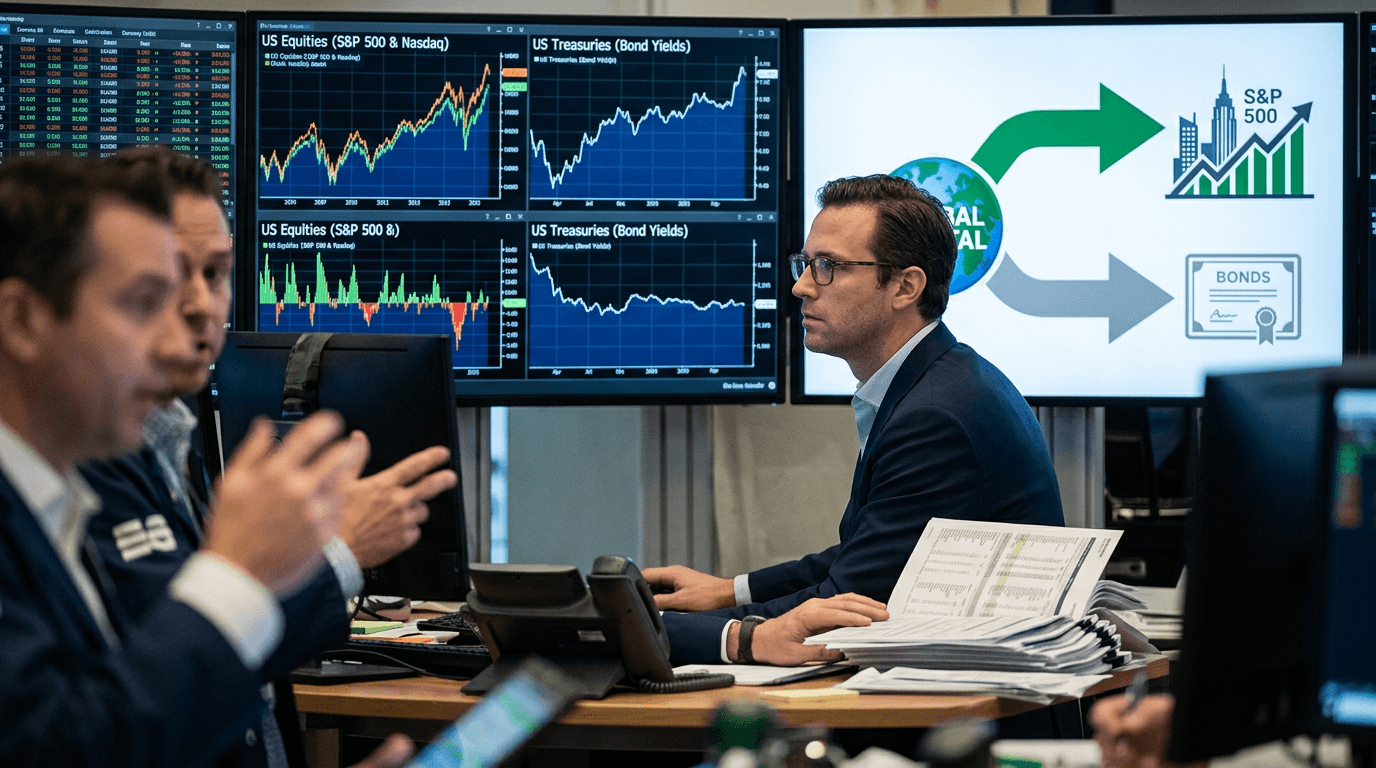
For decades, the U.S. dollar has enjoyed a unique safety premium because the world reliably bought U.S. government debt to park reserves and recycle surpluses. Now Deutsche Bank is warning that this foundation is quietly changing: instead of funding America primarily via Treasuries, foreign investors are increasingly financing the U.S. through stock markets, especially high-growth, AI-linked names.[1][4][6] That might sound like a vote of confidence in U.S. innovation—but it also makes the dollar structurally more exposed to swings in global risk appetite.
WHAT’S CHANGING IN U.S. FUNDING FLOWS
The core of Deutsche Bank’s warning is simple: foreign capital flows into the U.S. are shifting from debt to equity.[1][4][6]
Historically, global central banks, sovereign wealth funds, and long-term investors accumulated U.S. Treasuries and agency debt as “risk-free” assets.[4] That steady demand helped fund America’s large budget and current account deficits while supporting the dollar.
Today, more of the foreign money coming into the U.S. is going into equities—particularly large-cap technology and AI-related stocks that dominate indices and performance.[1][4][6] The AI boom has turned U.S. equity markets into a magnet for global capital, even as geopolitical tensions and trade frictions dampen enthusiasm for holding long-duration U.S. debt.[1][3][5][6]
Deutsche Bank frames this as an “important long-term rotation” in how the U.S. funds itself.[6] In practical terms, the dollar is becoming less anchored by slow-moving official debt buyers and more dependent on market-driven, performance-sensitive equity inflows.[1][4][6]
Why Equity-based Funding Makes The Dollar Riskier
Debt and equity flows behave very differently, and that’s where the risk lies.
First, equity flows are more volatile than reserve buying. Central banks typically adjust their Treasury holdings gradually; asset managers and hedge funds can cut U.S. equity exposure in weeks or days if performance or sentiment turns.[4] When foreign equity flows dominate, the dollar becomes more sensitive to risk-on/risk-off swings.
Second, equity flows are more cyclical and narrative-driven. The current wave of foreign buying is heavily tied to the AI and tech growth story.[1][4][6] If that narrative falters—due to regulation, earnings disappointments, or a crowded positioning unwind—foreign demand for U.S. stocks could reverse, pulling support away from the dollar at the same time.
Third, equity-based funding makes relative returns more central. When foreign investors buy Treasuries, they often care about yields, liquidity, and safety. When they buy U.S. equities, they care about performance relative to other markets. If Europe or Asia starts to outperform, or if domestic risks rise in the U.S., capital can rotate out—again, undermining dollar support.[4][6]
Finally, this shift is happening against a backdrop of ongoing reserve diversification. Many central banks have been gradually diversifying away from the dollar into other currencies and gold.[4] That means there is less “sticky” official demand to cushion the dollar if market-driven equity flows reverse.
Geopolitics, Trade Tensions, And Ai: A New Dollar Regime
Deutsche Bank links this funding shift to two structural forces: geopolitical ruptures and the AI-driven equity boom.[1][3][6]
On the geopolitical side, trade wars, tariff disputes, and sanctions have made some international investors more cautious about holding U.S. government debt.[1][3][5][6] Recent tariff escalations and talk of financial “weaponisation” raise the perceived political risk of being overexposed to Treasuries.[3][5] That nudges foreign capital toward equities, which can feel more flexible and easier to sell.
On the market side, the AI boom has supercharged U.S. stock indices, making them a global performance benchmark and attracting massive inflows into mega-cap tech names.[1][4][6] Deutsche Bank argues this leaves the dollar “more leveraged to AI”: if the AI trade goes well, it reinforces the dollar; if it stumbles, the dollar could suffer alongside U.S. equities.[6]
There is another subtle but important trend: foreign investors are increasingly hedging their dollar exposure when they buy U.S. assets. Deutsche Bank notes that flows into dollar-hedged ETFs have recently surpassed unhedged flows for the first time this decade.[7] In other words, overseas investors want U.S. equity and bond exposure—but are less willing to bear the currency risk. That is a clear signal that confidence in the dollar’s “always strong” status is not as unconditional as it once was.[7]
Implications For Traders, Investors, And Simulated Portfolios
For traders and portfolio builders, this is more than a macro curiosity—it changes how the dollar behaves as an asset.
First, capital flows matter as much as rate differentials. It is no longer sufficient to look only at Fed policy and yield spreads when forming a dollar view. Monitoring foreign positioning in U.S. equities, sector flows (especially tech and AI), and ETF hedging activity becomes critical.[4][7] A world where equity inflows dominate is a world where equity sentiment can move FX.
Second, the dollar can increasingly trade like a “risk asset.” In risk-on phases with strong global growth and tech leadership, foreign equity inflows can push both U.S. stocks and the dollar higher. But in risk-off phases, or during tech corrections, the dollar may no longer reliably act as a pure safe haven—especially if selling is concentrated in foreign-owned U.S. equities.
Third, correlations can flip across regimes. In one environment, the dollar might strengthen alongside rising U.S. equities; in another, aggressive hedging or unwinding of crowded positions could see U.S. stocks and the dollar fall together. Back-testing strategies across different regimes, rather than assuming stable correlations, becomes essential in both live and simulated trading.
For SimFi users, this structural shift is a perfect case study in regime risk. It invites traders to test:
- How dollar pairs react to equity volatility and tech drawdowns
- Scenarios where foreign equity flows slow or reverse
- The impact of increased currency hedging on dollar trends
- Portfolio outcomes when the dollar behaves more like a cyclical, risk-sensitive asset than a pure safe haven
Key Takeaways For Longer-term Positioning
There is no immediate signal here that the dollar must crash. Deutsche Bank’s point is more subtle and more important: the composition of U.S. funding matters, and that composition is changing in a way that makes the dollar structurally more exposed to market sentiment and sector-specific risk.[1][4][6]
For longer-term FX and multi-asset positioning, three practical takeaways stand out:
- Treat U.S. equity and FX views as increasingly linked, especially around tech and AI narratives.
- Incorporate capital flow and hedging data into dollar analysis, not just rate expectations.
- Stress-test portfolios for regimes where the dollar loses some of its traditional safe-haven behavior.
In essence, the dollar is still the world’s reserve currency—but it is gradually behaving more like a risk asset at the margin. For traders willing to adapt their frameworks, that shift creates both new risks and new opportunities in dollar-linked strategies.