
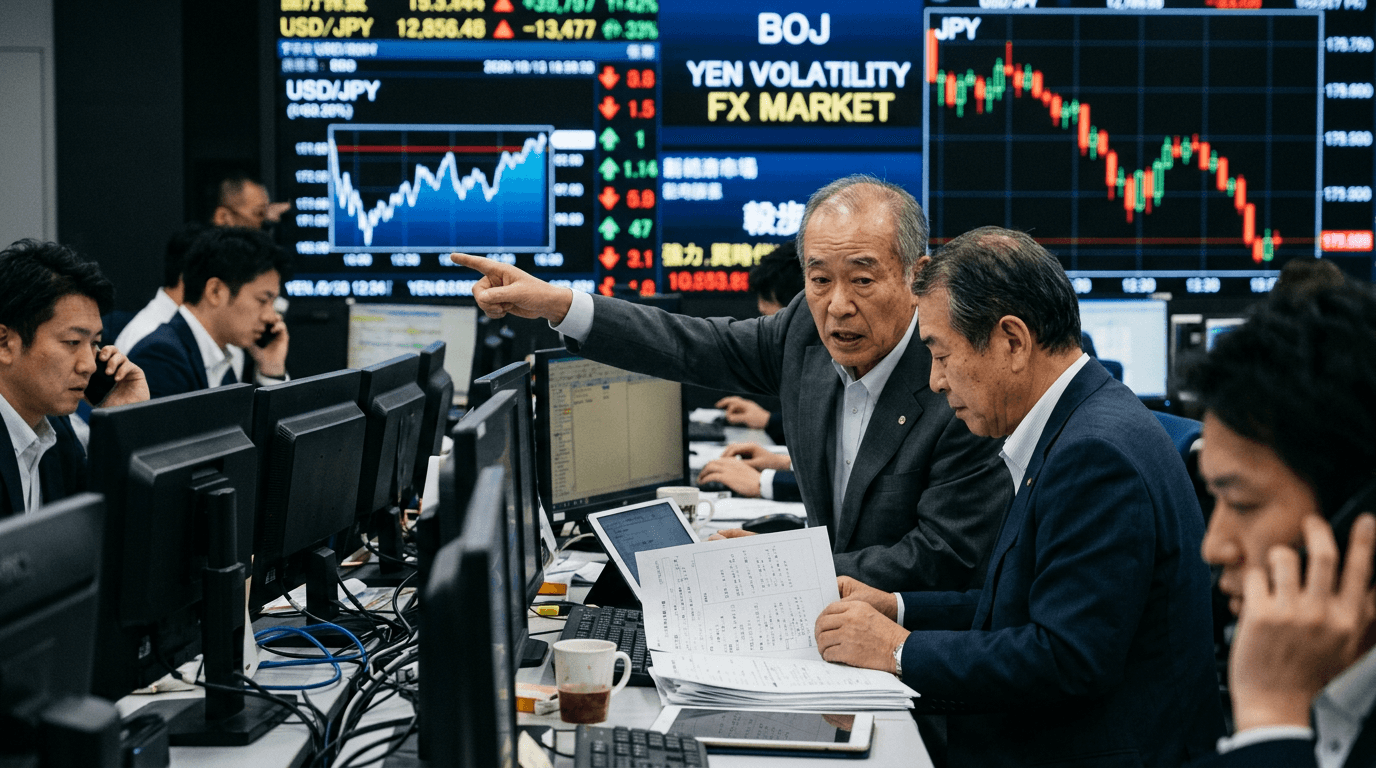
Japanese officials are once again turning up the volume on their warnings to currency markets, signaling a low tolerance for rapid yen weakness as volatility climbs. Finance Minister Satsuki Katayama has repeatedly emphasized that authorities are “prepared to respond comprehensively on all fronts” when speculative FX moves and sharp swings begin to threaten households and the broader economy.[2][8] Chief Cabinet Secretary Minoru Kihara and top currency diplomats have echoed this stance, underscoring that decisive action – including direct intervention – remains firmly on the table.[1][6][11][14]
Yen Under Pressure: Why Authorities Are Talking To Markets
The yen has spent much of the recent period under persistent downward pressure, sliding toward multi‑decade lows against the dollar as interest‑rate differentials, energy shocks, and geopolitical tensions weigh on the currency.[4][5][9] Japan has already demonstrated a willingness to intervene: ministry data show roughly 11.7 trillion yen (about $73.5 billion) spent in yen‑buying, dollar‑selling operations in just one recent month to stem the slide, triggered when the currency breached the 160 per dollar level.[10]
Despite these efforts, officials acknowledge that the yen remains around levels that originally prompted intervention, and volatility has stayed elevated.[10][2] Katayama and other policymakers have singled out speculative activity as a key driver of recent moves, warning that such behavior is exacerbating swings in FX and other markets like crude oil.[2][8] At the same time, they stress that while exchange rates should largely reflect economic fundamentals, “excessive volatility is not desirable” and extreme moves will be met with appropriate action.[7][12]
This mix of structural pressure and political sensitivity creates a classic setup: a weak currency, rising volatility, and a government publicly reminding markets that it can and will step in if needed. For traders, that backdrop makes the risk‑reward calculus around short‑yen positions far more complex.
WHAT “VERBAL INTERVENTION” REALLY DOES
Japan’s latest statements fall into what markets call “verbal intervention” – direct warnings to traders and investors, without immediate large‑scale FX operations. Katayama has framed policy as ready to take “bold action at any time” if required, language that marks an escalation compared with routine commentary and signals that actual intervention is a live option.[9][14] She has also spoken of the time for “decisive measures” drawing near, in what Reuters described as her strongest hint yet of potential market action.[14]
Other officials have reinforced the message. Currency envoy Atsushi Mimura has stressed that Japan will act in line with joint agreements with the United States, which allow interventions to address extreme volatility even while generally favoring market‑determined exchange rates.[6][11][12] He has gone as far as delivering a “final warning” to speculators, explicitly cautioning those betting against the yen that intervention risk is real.[16]
In practice, verbal intervention aims to influence behavior before authorities deploy large sums in FX markets. By reminding traders of past multi‑billion‑dollar interventions and keeping the threat of fresh operations front‑of‑mind, officials try to reduce one‑way speculative positioning and dampen volatility. This can be especially effective when markets are crowded in short‑yen carry trades that are vulnerable to a sudden, policy‑driven snapback.
Impact On Spot, Futures, Options And Carry Trades
Verbal intervention tends to ripple across FX markets well beyond the spot rate. As traders reassess the probability of official action, positioning and pricing adjust across instruments.
In spot FX, the immediate effect is often a pause or partial reversal in yen selling as participants cut risk and cover shorts, particularly when warnings are described as the “strongest yet” or hint that decisive action is imminent.[14][17] Even when the currency does not fully recover, the pace of depreciation may slow as the market tests policymakers’ tolerance.
In FX futures, rising intervention risk can force leveraged players to recalibrate strategies. Short‑yen futures positions built to exploit interest‑rate differentials look less attractive if a sharp, policy‑induced rally could trigger margin calls. That typically encourages position trimming and a shift toward shorter maturities or more hedged structures.
Options markets often react most visibly. As authorities highlight the possibility of abrupt moves that “do not align with fundamentals,” demand for downside protection in dollar/yen – effectively upside protection in yen – increases.[11][13] This can alter options skew, with prices for yen‑strength scenarios rising relative to those for continued weakness, as traders hedge against the risk of a sudden intervention‑driven spike.
Short‑yen carry trades, which borrow cheaply in yen to invest in higher‑yielding currencies or assets, are particularly exposed. The strategy thrives on stable, gradual moves; it suffers when volatility rises and policymakers threaten bold action. Japan’s recent history of stepping in once the yen breaks key levels, combined with explicit warnings that “any options” remain on the table, raises the probability of a disorderly unwind.[7][10] For funds running large carry books, that makes risk management – and close monitoring of official rhetoric – essential.
JAPAN’S POLICY PLAYBOOK: INTERVENTION, COORDINATION, AND LIMITS
Japan’s authorities are signaling that they will use a broad policy toolkit while still respecting international norms. Katayama has emphasized that responses to excessive FX moves will be “comprehensive,” spanning fiscal, monetary, and market operations where necessary.[2] At the same time, officials are careful to reaffirm the independence of the Bank of Japan: Chief Cabinet Secretary Kihara has stressed that monetary policy decisions remain firmly within BOJ’s remit, even as the government raises its FX warnings.[8] BOJ Governor Kazuo Ueda has likewise noted that the central bank does not directly target the exchange rate, but can respond when yen moves threaten the economy and price stability.[7]
Coordination with the United States is a central pillar of this approach. Mimura and Katayama both point to a joint Japan‑US statement that supports market‑driven exchange rates while allowing intervention to address extreme volatility.[6][11][12] Katayama has said that Japanese and US authorities remain in close contact “even when the US is on holiday,” underscoring the importance of trans‑Pacific dialogue in managing yen moves.[3]
There are, however, limits. Past interventions have delivered only partial relief, and the structural forces weakening the yen – including yield differentials and external shocks – are not easily reversed.[4][10] That is why officials increasingly lean on the signaling power of their words: by raising the perceived probability of action, they can influence risk‑taking without constantly deploying tens of billions of dollars.
Practical Takeaways For Traders In A Simulated Environment
For traders using simulated finance platforms, episodes like this are valuable test beds for strategy and risk management. Several practical lessons stand out.
First, verbal intervention is itself a market event. When warnings escalate to phrases like “decisive action” or “bold steps,” intervention probabilities embedded in prices change quickly, affecting spot, futures, and options simultaneously.[9][14] Sim traders can practice mapping those narrative shifts into scenario analysis: What happens to your P&L if dollar/yen spikes three or five big figures on sudden official buying?
Second, crowded positioning amplifies policy risk. Short‑yen carry trades may look attractive during periods of calm, but they can become fragile when authorities repeatedly state they are ready to act “at any time.”[1][2][8][9] Simulated environments allow traders to experiment with hedge structures – such as out‑of‑the‑money options or dynamic stop‑loss rules – without real capital at risk.
Third, cross‑market awareness matters. Japan’s warnings have referenced speculative activity not only in FX but also in crude oil and bond markets.[2] That underlines the interconnected nature of modern trading: volatility in one asset class can feed into another, and policy responses may target multiple channels. Sim traders can use this to build multi‑asset playbooks that consider FX, rates, and commodities together.
Finally, monitoring official communication is not just for macro specialists. Japan’s experience shows that persistent, coordinated messaging from finance ministries, currency envoys, and central bank officials can shape trading conditions as much as data releases. Learning to interpret the tone, frequency, and specificity of those messages is a skill – one that simulated trading can help develop before it is tested in live markets.