
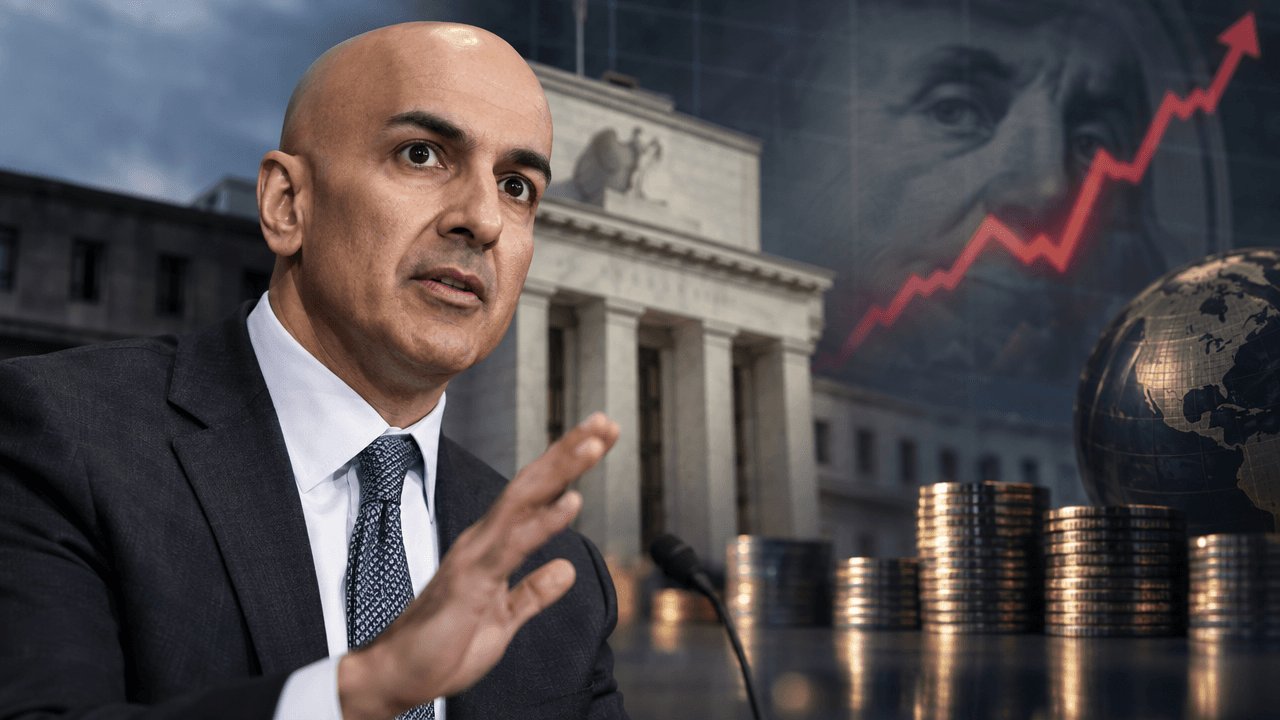
Neel Kashkari’s latest remarks are a clear reminder that the Federal Reserve is not ready to declare victory over inflation, and traders should be prepared for the possibility of at least one more rate hike in 2026 with meaningful consequences for yields, the dollar, and risk assets.[1][2][7][13]
Inflation Still Too High
In recent interviews, the Minneapolis Fed president has repeatedly stressed that U.S. inflation remains “still too high,” even as some data prints have surprised on the softer side.[1][2][14] By Kashkari’s own assessment, many measures of inflation are still running near 3%, notably above the Fed’s long-run 2% target and elevated for more than five years.[1][12][14] He has also highlighted that price pressures are broad-based, affecting services and multiple sectors of the economy rather than being confined to energy or food.[3][10]
This narrative aligns with the Fed’s official projections, which show PCE inflation and core PCE tracking above target through 2026 before gradually converging toward 2%.[4][5][9][11] Kashkari has warned that the longer inflation stays elevated, the greater the risk that expectations drift higher and become unanchored, which would require even more aggressive tightening later on.[12] For traders, the message is straightforward: the Fed still sees inflation risk skewed to the upside, and policy may need to remain restrictive for longer than many had hoped.[4][6][9]
FED’S 2026 RATE PATH AND KASHKARI’S HAWKISH BIAS
Kashkari’s comments do not exist in a vacuum; they fit into a broader FOMC outlook that already assumes one more rate increase before year-end.[5][13] The Fed’s September Summary of Economic Projections showed most policymakers penciling in at least one additional hike, alongside an upward revision to the near-term inflation trajectory.[5][11][13] Kashkari has gone further, reportedly indicating that he has penciled in two rate increases in 2026 and still expects another move, underscoring his hawkish stance.[7][8][12]
Importantly, Kashkari has framed the inflation fight as his top priority, noting that the labor market remains in “decent shape” while prices are “much too high.”[12] This prioritization suggests that marginal deterioration in employment data may not immediately deter him from supporting further tightening if inflation fails to convincingly converge to target.[12][15] That combination—hawkish inflation focus and tolerance for some labor-market softness—supports a higher-for-longer policy rate narrative, which markets must incorporate into pricing for both 2026 and beyond.[4][6][11]
Implications For Bonds, The Dollar, Equities And Crypto
Kashkari’s stance tends to reinforce upward pressure on U.S. yields, particularly at the front and intermediate sections of the Treasury curve, as traders adjust rate expectations toward additional hikes and delayed cuts.[5][7][13] Higher real yields usually support a firmer U.S. dollar, especially when other major central banks are closer to neutral or easing, creating a relative policy divergence that favors dollar strength.[5][13][15] Rate-sensitive assets—growth equities, long-duration tech names, high-beta sectors, and speculative crypto tokens—typically struggle in this environment as discount rates rise and liquidity conditions tighten.[7][13]
Equity markets have already shown sensitivity to hawkish shifts in Fed communication, with repricing episodes following projections that embed further tightening.[5][13] Crypto markets, which often thrive on abundant liquidity and lower real rates, tend to face headwinds when policymakers emphasize stubborn inflation and the need for sustained restrictive policy.[7][13][15] For portfolio managers and active traders, Kashkari’s messaging is a reminder to reassess exposure to duration, leverage, and high-volatility risk assets that are most vulnerable to incremental policy tightening.
What This Means For Traders And Simulated Finance Participants
For traders using platforms like E8 Markets and the broader SimFi space, Kashkari’s comments offer a live macro environment to practice navigating hawkish central bank regimes without real-world capital at risk. His insistence that inflation remains too high and that another 2026 hike is on the table provides a concrete scenario to backtest strategies around policy surprises and rate path revisions.[1][2][7][13]
Simulated trading environments allow participants to build and test playbooks for different outcomes: one more hike followed by a pause, a more extended hiking cycle, or an eventual pivot if inflation finally breaks lower.[4][5][6][9] Traders can experiment with how yield curves, FX pairs, equity indices, and crypto benchmarks might respond to changes in Fed communications and economic data, using historical analogs from past tightening cycles as reference points.[6][9][11] This is particularly valuable for newer traders who need to understand how macro narratives translate into price action before committing real capital.
Practical Takeaways For Your Trading Strategy
Kashkari’s profile as one of the more hawkish Fed officials means his remarks can be used as a stress test for existing assumptions about the path of rates.[1][2][7][12] Traders can take several practical steps:
1. Revisit rate expectations: Compare your assumed policy path to the Fed’s projections and to Kashkari’s more hawkish scenarios, then stress-test positions against an extra hike and delayed cuts.[4][5][7][11]
2. Assess duration risk: Evaluate exposure to long-duration bonds and growth equities, which are most sensitive to higher discount rates and evolving rate expectations.[5][7][13]
3. Rebalance FX views: Consider how a higher-for-longer Fed stance could bolster the dollar against currencies tied to more dovish central banks or weaker growth profiles.[5][13][15]
4. Manage leverage and volatility: In risk assets like crypto and leveraged equity products, ensure position sizing and risk management reflect the potential for policy-driven volatility spikes.[7][13][15]
Within a simulated environment, each of these steps can be implemented, tested, and refined using scenario analysis and forward-testing on historical datasets before being deployed in live markets.
Conclusion: Stay Nimble As Policy Risks Rise
Neel Kashkari’s repeated message that inflation is still too high and his hint at another 2026 rate hike are a clear signal that the Fed’s tightening bias has not vanished, even as some data show incremental cooling.[1][2][7][14] The combination of elevated inflation projections, a willingness to tolerate some labor-market softening, and a consensus for at least one more hike supports higher yields, a resilient dollar, and ongoing pressure on rate-sensitive risk assets.[4][5][11][13]
For traders and SimFi participants, the key is not to predict the exact timing of the next move, but to build robust strategies that can handle hawkish surprises, shifting rate paths, and macro-driven volatility. By using simulated finance platforms to rehearse decision-making under different Fed scenarios, traders can turn policy uncertainty into a training ground for more disciplined, data-driven risk management when real capital is on the line.