
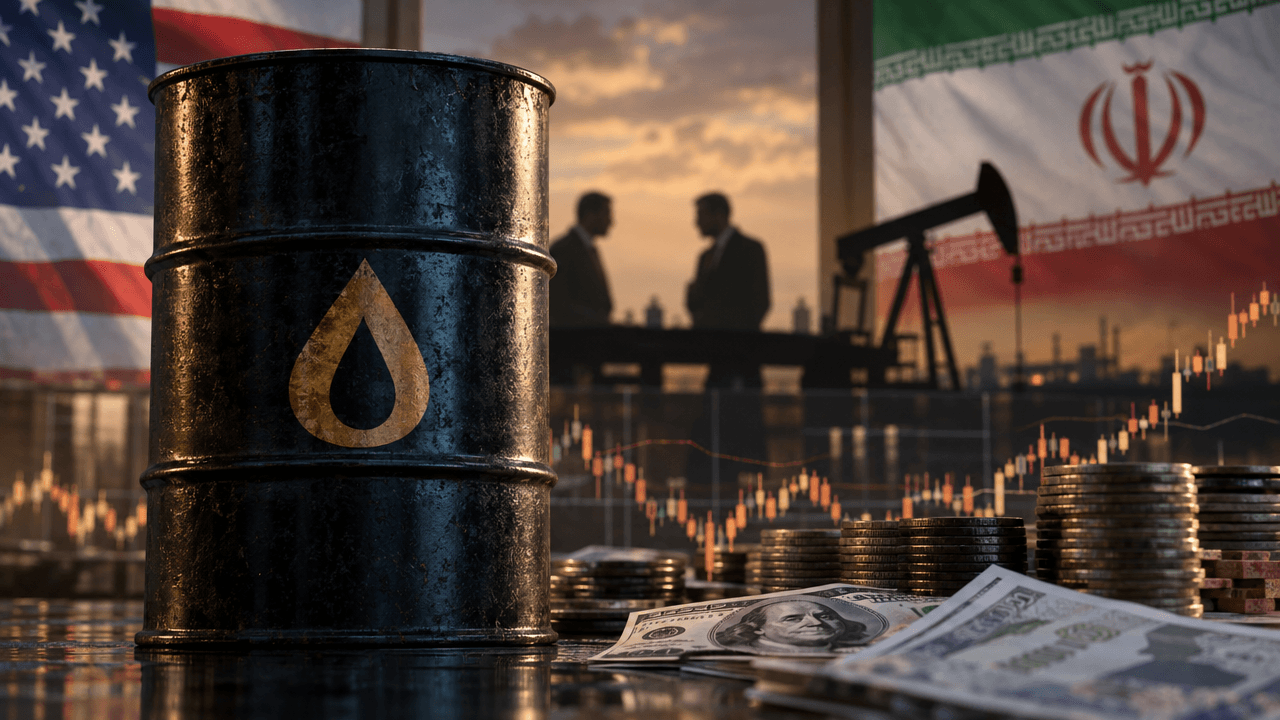
Oil prices are holding at elevated levels as U.S.–Iran talks show no meaningful progress, reinforcing the geopolitical risk premium embedded in energy markets. Front‑month WTI futures are trading close to $90 per barrel, while Brent hovers just below $100, levels that keep fuel costs high for consumers and corporates alike. With diplomacy stalled and traders increasingly skeptical of a near‑term breakthrough, oil remains a central driver of inflation expectations, bond yields, and currency market dynamics.
Geopolitical Stalemate And The Risk Premium
The lack of progress in U.S.–Iran negotiations matters because it prolongs uncertainty over energy flows from the Persian Gulf, especially via the Strait of Hormuz, a key chokepoint for global crude and LNG shipments.[5][9] When talks stall, the market prices in a higher probability of supply disruption, even if physical flows have not yet been materially reduced.
Recent episodes highlight how sensitive prices are to headlines from these talks. Brent crude has traded above $105–108 per barrel on days when negotiations appeared to be at a stalemate, while WTI has pushed into the mid‑90s.[1][6][8] Conversely, when officials signal progress or temporary agreements, crude can retreat several dollars as traders pare back the risk premium.[3][5] The current environment sits firmly in the “stalemate” camp, keeping that premium intact.
For traders, this dynamic underscores that geopolitical risk is not binary. Oil does not only move when conflict escalates or de‑escalates dramatically; it responds to the shifting probability distribution around supply scenarios. Each statement from negotiators, each leaked proposal, and each report on shipping flows can nudge that distribution and, by extension, prices.
Supply Risks And The Strait Of Hormuz
Around a fifth of the world’s oil typically moves through the Strait of Hormuz, so any perceived threat to its openness commands significant attention.[5] In recent months, reports of halted or reduced traffic through the strait have coincided with sharp increases in crude benchmarks, as traders model worst‑case scenarios where exports are constricted for an extended period.[1][5][9]
Even when tanker traffic resumes or improves, as some data have shown during brief windows of diplomatic progress, the broader market has remained in deficit, with prompt demand outstripping available supply.[8][14] This combination—ongoing deficits plus intermittent chokepoint risk—keeps forward curves in steep backwardation, emphasizing a premium for immediate barrels over longer‑dated delivery.[14]
For market participants, this backdrop means spot and near‑dated futures are particularly sensitive to supply headlines. A single report about an incident in the strait, a new sanction, or a naval confrontation can move front‑month contracts far more than longer‑dated ones. Simulated trading environments allow participants to test how portfolios behave when prompt spreads widen or narrow rapidly, preparing them for similar volatility in live markets.
Inflation, Currencies, And Macro Market Ripple Effects
Elevated oil prices feed directly into inflation through higher fuel, transport, and production costs. In the U.S., diesel prices have hovered near record levels during periods of heightened tension, intensifying cost pressures for logistics and industrial sectors.[2] These pressures filter into headline inflation data, influencing central bank expectations and, ultimately, bond yields.
Recent episodes of oil strength linked to U.S.–Iran impasses have coincided with rising yields, as investors demand compensation for higher inflation risk.[2][6] That, in turn, affects equity valuations, credit spreads, and risk sentiment more broadly. Energy, in other words, is not an isolated sector story—it is a macro variable that shapes the cost of capital across the economy.
Currency markets are also in the crosshairs. Import‑dependent economies face deteriorating terms of trade when oil remains expensive, often putting downward pressure on their currencies. Meanwhile, major energy exporters can see their currencies supported or even strengthened, especially if their fiscal positions improve with higher hydrocarbon revenues. Traders who focus only on crude charts risk missing these second‑order effects in FX and rates.
For simulated finance participants, this environment is an ideal laboratory for linking commodities to macro themes. Strategies that incorporate oil as an input into inflation views, bond duration decisions, or currency pairs can help traders understand the interconnected nature of modern markets, rather than treating crude as an isolated asset class.
What Elevated Oil Means For Traders And Simfi Participants
With WTI near $90 and Brent around the high‑90s, energy remains expensive enough to matter for portfolios, but not so extreme as to guarantee immediate policy intervention or coordinated supply responses. That middle‑ground regime can be challenging: trends may be strong but interrupted by sharp reversals whenever diplomatic headlines briefly improve.
Discretionary traders should pay close attention to the timeline and venue of U.S.–Iran talks. Meetings at the UN, regional mediation efforts, and statements from key shipping and tracking agencies can all shift expectations around supply risks.[4][7][9] Building a structured “event calendar” and mapping potential price scenarios to each outcome is one way to avoid being caught off‑guard.
Systematic and quantitative traders can focus on how volatility, term structure, and cross‑asset correlations behave in response to energy headlines. For example, measuring how often spikes in front‑month crude coincide with moves in breakeven inflation, high‑yield spreads, or specific currency pairs can inform factor models and risk controls.[2][6][10] Simulated environments provide a safe space to iterate on such models without capital at risk.
PRACTICAL TAKEAWAYS FOR NAVIGATING OIL‑DRIVEN MARKETS
First, treat geopolitical headlines as a recurring driver, not a one‑off shock. The U.S.–Iran relationship has produced repeated cycles of “talks progressing” versus “talks stalled,” and each phase brings its own price behavior.[3][6][9] Designing playbooks for both regimes can reduce emotional decision‑making when the next headline hits.
Second, integrate physical market indicators—such as export volumes, tanker traffic, and inventory data—into your analysis.[2][5][8] Prices are less likely to fall sustainably while the market remains in deficit and physical flows are constrained. Conversely, signs of normalized shipments and rising stocks can signal that the risk premium is overstretched.
Third, think beyond crude. Equity sectors (energy, airlines, industrials), fixed‑income instruments sensitive to inflation, and key FX pairs all respond to persistent energy price moves. Simulated trading can help you explore sector rotation, relative‑value trades, and hedging strategies that explicitly account for oil’s macro footprint.
Finally, maintain disciplined risk management. Elevated prices and geopolitical tension often coincide with wider bid‑ask spreads, sudden gaps, and crowded positioning. Position sizing, stop‑loss rules, and scenario analysis should be stress‑tested for environments where oil can move several dollars in a single session on new diplomatic or military developments.[1][8][11]
Conclusion
Oil’s resilience near the $90–$100 range, amid stalled U.S.–Iran talks, underscores how geopolitical uncertainty can hard‑wire a risk premium into energy markets. That premium is not just a story about barrels and tankers; it shapes inflation expectations, yields, currencies, and sector performance across global portfolios. For traders and SimFi participants alike, this is a moment to deepen understanding of the links between diplomacy, supply chains, and market structure. Those who can translate complex geopolitical narratives into robust trading frameworks—tested first in simulated environments and refined over time—will be better positioned to navigate whatever the next chapter of the U.S.–Iran saga brings.