
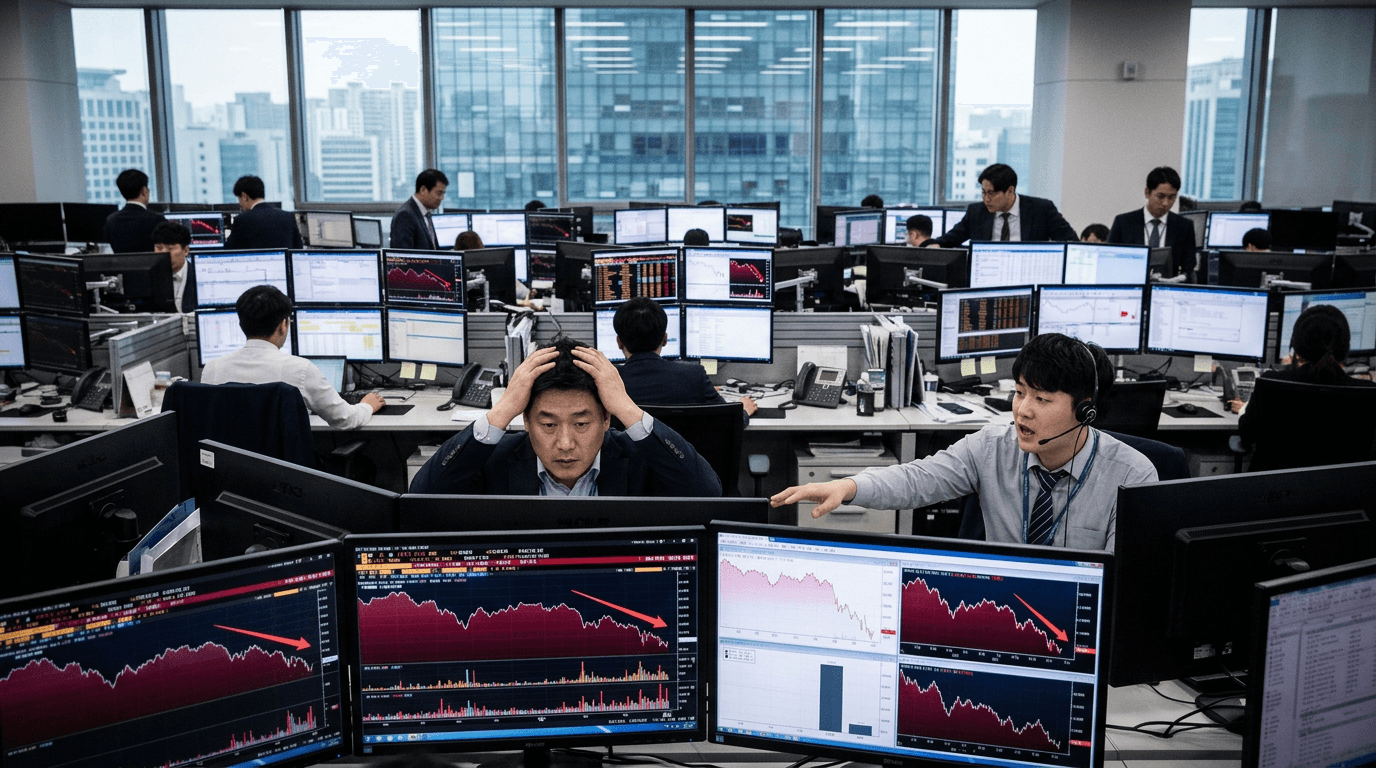
AI-linked stocks across Asia are finally blinking after months of relentless gains, with Korea at the heart of the regional selloff. The same AI narrative that helped propel Asian equities to fresh highs is now being tested as investors question stretched valuations, crowded positioning, and the sustainability of huge AI capex cycles seen in the US and globally.[1][2] For traders, this is not just a story about one bad day for tech, but a live stress test of the entire “AI mania” trade that has underpinned risk sentiment across the region.[1][3][4]
WHAT’S DRIVING THE AI SELL-OFF IN ASIA?
Several forces are converging to pressure AI-linked names after an extraordinary run.
First, valuations in AI and semiconductor leaders have expanded aggressively, often outpacing near-term earnings visibility. As global investors reassess how quickly AI spending will translate into profits, any hint of disappointment or cautious guidance has triggered outsized reactions, especially in chipmakers and hardware suppliers.[1][2] When expectations are priced for perfection, even solid results can look “not good enough.”
Second, global AI capex guidance has become a double-edged sword. Major US tech platforms have flagged massive, ongoing AI infrastructure spending, which initially powered hardware and chip suppliers higher.[2][4] Now, markets are worrying about capital intensity, returns on that spending, and the risk that parts of the AI supply chain become overbuilt. That concern is naturally hitting the upstream enablers of AI—memory, GPUs, servers—many of which are Asian.
Third, macro uncertainty is amplifying the move. Questions around the path of interest rates, slower global growth impulses, and geopolitical risks are encouraging investors to take profit in the most crowded, momentum-heavy trades first. Tech and AI sit at the top of that list, creating a feedback loop where selling begets more selling as risk models, quant strategies, and structured products adjust exposures.
Why Korea Is At The Epicenter
Korea’s equity market is uniquely exposed to the AI theme, which explains why it is leading the regional pullback.
Korean champions are central to the AI hardware stack. Large memory and components manufacturers have been prime beneficiaries of the AI data center buildout, attracting substantial foreign inflows as investors sought pure-play ways to express the AI infrastructure trade.[2][4] That same concentration works in reverse when sentiment turns: a small shift in AI optimism translates into an outsized move in Korean benchmarks.
The market is also heavily influenced by retail investors, who have embraced AI-related names as high-conviction growth stories. When momentum stalls, local retail selling can accelerate foreign outflows, pressuring both equities and the Korean won. In a risk-off environment, investors often hedge or cut exposure in the most liquid, AI-leveraged markets first—Korea fits that profile better than many regional peers.
Finally, Korea is highly sensitive to global cyclical signals. Any cooling in expectations for electronics demand, cloud spending, or handset and device upgrades tends to get priced quickly into Korean tech, turning it into a leading indicator for the broader Asian AI complex.
Ripple Effects On Indices, Futures, And Fx
The AI pullback is not confined to single stocks. It is spilling over into regional indices, futures, and currencies tied to risk appetite.
Equity indices with heavy tech weights—such as Korea’s main benchmarks, Taiwan’s tech-centric indices, and dedicated Asia tech or semiconductor baskets—are underperforming broader regional gauges as AI-linked names correct. Futures on these indices, as well as broader Asia ex-Japan contracts, are seeing increased volatility and wider intraday swings as traders reprice the AI premium.[1][3]
Risk-sensitive currencies in Asia are also feeling the pressure. The Korean won and Taiwan dollar, both associated with tech-heavy export stories, can weaken when AI optimism fades and equity outflows pick up. Other regional FX with high beta to global risk sentiment—including Southeast Asian currencies with equity-linked flows—may also adjust as investors reduce exposure to the AI trade and rotate into perceived havens.
For index and FX traders, the key implication is that AI sentiment has become a macro factor in its own right. Shifts in the AI narrative now move not only single names, but also country risk premia, FX levels, and regional volatility regimes.
IS THIS THE END OF THE “AI MANIA” TRADE?
A sharp pullback in AI-linked equities inevitably raises the question: is the boom over, or is this simply a positioning reset within a longer structural trend?
From a structural standpoint, the AI story remains intact. Corporates and governments continue to ramp up investment in AI infrastructure, data centers, and software, and many Asian firms are deeply integrated into these supply chains.[2][4] Long-term demand for high-end chips, memory, and specialized hardware is unlikely to vanish because of a few weak sessions.
Tactically, however, the market is clearly re-pricing exuberant expectations. AI-related trades had become crowded, with investors extrapolating early upside into multi-year straight-line growth. When positioning is one-sided, any shock—earnings hiccups, guidance downgrades, or macro jitters—can trigger an outsized reaction. What we are seeing now is that the “AI mania” label cuts both ways: it can fuel rapid rallies, but also accelerate corrections.
For disciplined traders, this phase can be healthy. Shaking out weak hands and excess leverage can lay the groundwork for a more sustainable trend, where fundamentals rather than narrative alone drive price action. But it also means higher volatility and the need for more selective exposure.
Practical Takeaways For Traders
First, separate the theme from the trade horizon. The long-term AI opportunity may remain powerful, but short-term positioning can still be stretched. In a simulated or live trading environment, it often pays to distinguish between structural investment views and tactical trading stances.
Second, watch the leaders for signals. Korean AI-linked names, major Asian chipmakers, and regional AI indices can serve as barometers for broader risk sentiment. Failed rebounds or persistent selling in these leaders may warn that the de-risking phase is not over yet.
Third, treat AI as a volatility factor. When positioning is crowded, volatility spikes can be sharp. Adjust position sizing, leverage, and stop-loss levels to account for larger intraday ranges in tech-heavy indices and FX pairs tied to the AI theme.
Fourth, focus on dispersion, not just direction. As the initial “everything AI goes up” phase fades, markets are likely to differentiate between companies with visible earnings leverage to AI and those riding the narrative with weaker fundamentals. Strategies that exploit dispersion—relative value, pair trades, and basket approaches—may perform better than simple long-only beta exposure to AI.
Finally, use corrections to stress-test your playbook. Episodes like this are invaluable for refining risk management, testing scenario planning, and improving execution discipline. For traders operating on a SimFi platform, it is an opportunity to rehearse how you would navigate a similar AI-driven shock in live markets—without the real-world downside.
The retreat in AI-linked equities across Asia, led by Korea, is less a verdict on the end of AI and more a reminder that even the most powerful themes can overshoot. For investors and traders alike, the challenge now is to move beyond AI as a buzzword and engage with it as a complex, volatile, and selective opportunity set—one that rewards preparation, discipline, and a clear separation between story and price.