
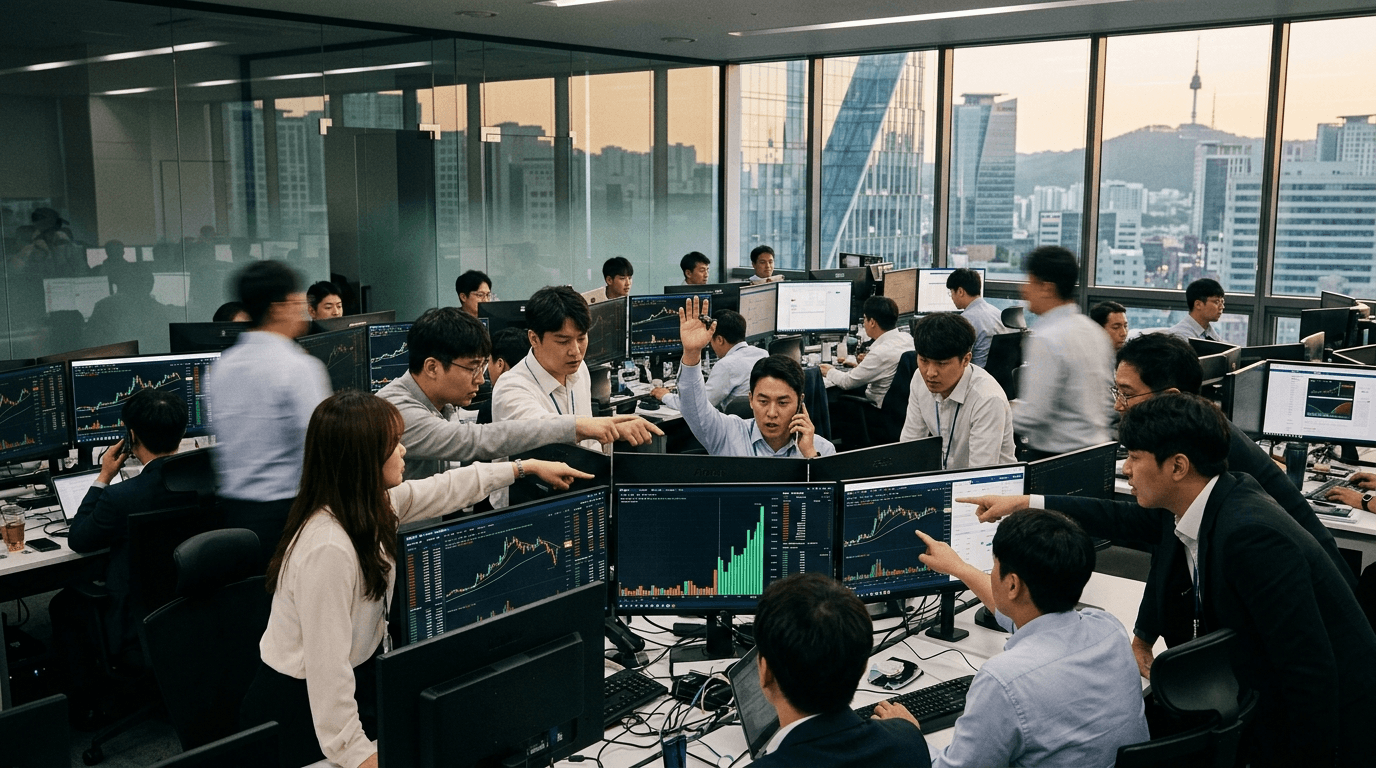
South Korea’s crypto traders are back in force, and the numbers on Upbit tell the story: the exchange’s 24‑hour trading volume has jumped roughly 273% to about $1.84 billion, its highest level since March.[1][4][12] Driven by the latest Bitcoin rally and reinforced by active trading in tokens like XRP and MANTRA, this surge marks a decisive re‑entry by domestic investors into digital assets.[4][12][3]
South Korean Capital Flows Back Into Crypto
Upbit is South Korea’s largest cryptocurrency exchange, processing more volume than any other domestic platform and offering hundreds of listed assets.[1][7] When its turnover spikes nearly threefold in a single day, it is a strong signal that local capital is rotating back into crypto after a quieter period.[1][4] The recent jump to around $1.84 billion in 24‑hour volume is the strongest activity seen since mid‑March, confirming a meaningful behavioral shift.[1][12]
This renewed engagement is closely tied to Bitcoin’s latest leg higher, which has historically acted as the gateway trade for mainstream investors.[4] As BTC moves, Korean traders often follow with increased activity in large‑cap altcoins such as XRP, which has been one of the leading assets on Upbit during the recent spike.[12] The pattern is familiar: first Bitcoin, then majors, then increasingly speculative tokens as confidence and risk appetite build.
For market participants, the key takeaway is that South Korea remains one of the most sensitive regions to crypto momentum, quickly scaling up activity when sentiment turns.[4][10] That responsiveness can create localized bursts of liquidity that ripple through global order books, affecting spreads, volatility, and execution quality beyond Korean markets.[7][10]
WHAT A 273% VOLUME SURGE REALLY SIGNALS
A 273% increase in 24‑hour volume is not just a headline; it reflects several underlying dynamics that traders should understand.[1][4] First, it indicates more orders hitting the book across spot and, in some cases, derivatives markets, which can tighten spreads and improve price discovery—at least temporarily.[3][11] Second, it suggests more intraday turnover, often driven by short‑term traders and algorithms responding to price momentum.[1][4]
Historically, similar jumps in Upbit’s activity have occurred around major listings or news events that attract domestic attention.[3][8][11] During the MANTRA (OM) listing, for example, Upbit’s inclusion of OM in KRW, BTC, and USDT markets triggered a rapid increase in trading volume and a double‑digit price reaction.[3][8][9] Reports noted volume spikes of more than 150%–500% in OM trading following the listing, underscoring how quickly Korean traders can concentrate liquidity in new narratives.[3][11][13][15]
Short‑term, this kind of surge can increase volatility both up and down as traders jockey for position.[3][11] Liquidity is deeper, but order books can still thin out at extremes when momentum chasing and profit‑taking collide. For risk managers and active traders, that means wider realized ranges, faster moves, and the need for tighter execution discipline.
Token Listings Like Mantra Amplify Liquidity
The latest MANTRA developments illustrate how token listings on major regional exchanges can act as catalysts, amplifying local and global liquidity.[3][8][9] When Upbit announced trading pairs for OM in KRW, BTC, and USDT, the token saw an immediate price jump in the mid‑teens percentage range and a sharp expansion in volume.[3][8][9][13][15] Derivatives markets around MANTRA also recorded volume increases of several hundred percent, with open interest rising in tandem.[3][11][15]
Listing on Upbit gives a project direct access to one of Asia’s most active retail trading communities, in a jurisdiction known for relatively high crypto adoption and a growing focus on regulatory clarity.[7][10] That combination makes Korean venues powerful accelerators for new or revived narratives—whether in real‑world asset (RWA) tokens, DeFi protocols, or infrastructure plays like MANTRA Chain.[8][10]
For traders, the implication is straightforward: monitoring upcoming Korean listings and announcement calendars can provide early signals of where speculative liquidity may migrate next.[3][8][14] Tokens that secure strong domestic support often see follow‑through in global markets as arbitrageurs and momentum traders step in to align prices across exchanges.[3][8][10]
Implications For Global Markets And Simulated Finance
Upbit’s volume spike contributes to a broader picture of improving crypto liquidity conditions worldwide.[1][4][7] When large regional hubs such as Korea re‑engage, global turnover tends to rise, reinforcing price moves and reducing slippage in major pairs.[7][10] This can make trend structures more durable, as rallies and corrections are supported by real flows rather than thin‑market distortions.
At the same time, heightened activity amplifies risk. Tokens like MANTRA show how quickly sentiment can swing: following a major drawdown earlier in the year, the Upbit listing and related news flow produced a sharp rebound in price and trading participation.[9][13][15] Traders who are unprepared for these regime changes may find themselves overexposed to gap risk, listing risk, and localized mania in specific names.
Simulated finance environments, such as those offered by platforms like E8 Markets, can be particularly valuable in this phase of the cycle. By mirroring live market conditions—including higher volatility, rapid listing‑driven moves, and cross‑exchange price dynamics—SimFi allows traders to stress‑test strategies without capital at risk. Practicing position sizing, entry and exit rules, and news‑reaction playbooks during simulated versions of events like the Upbit surge can build discipline before deploying real funds.
How Traders Can Position Themselves
With Korean investors returning to crypto, traders should focus on three practical areas. First, keep a close eye on volume metrics and exchange‑specific flows; a jump like 273% in 24‑hour turnover is a clear sign that conditions have changed and that previous volatility assumptions may no longer hold.[1][4][12] Incorporating exchange data into your routine can help identify when local flows are likely to impact global prices.[7]
Second, build a structured approach to trading listing‑related moves. MANTRA’s experience on Upbit—fast price spikes, large volume jumps, and intense early volatility—shows that these events reward preparation.[3][8][9][11][13][15] Having predefined rules for how to engage new listings, or whether to avoid them altogether, can prevent emotional decision‑making when headlines hit.
Third, use simulated environments to rehearse response plans for different scenarios: a sudden regional volume surge, an unexpected token listing, or a sharp reversal after a rally. By treating events like Upbit’s latest spike as case studies, traders can refine their strategy toolkit, test risk limits, and learn how regional hotspots such as Korea feed into global crypto structure.
Conclusion
Upbit’s 273% jump in trading volume, pushing daily turnover to about $1.84 billion and marking the highest level since March, confirms that South Korean investors are re‑entering crypto with conviction.[1][4][12] Combined with listing‑driven momentum in tokens like MANTRA, this resurgence is adding meaningful regional fuel to global liquidity and price formation.[3][8][9][10][11] For traders, the message is clear: regional flows matter, listing calendars are strategic information, and simulated practice is a powerful way to turn fast‑moving news into structured opportunity rather than unmanaged risk.