
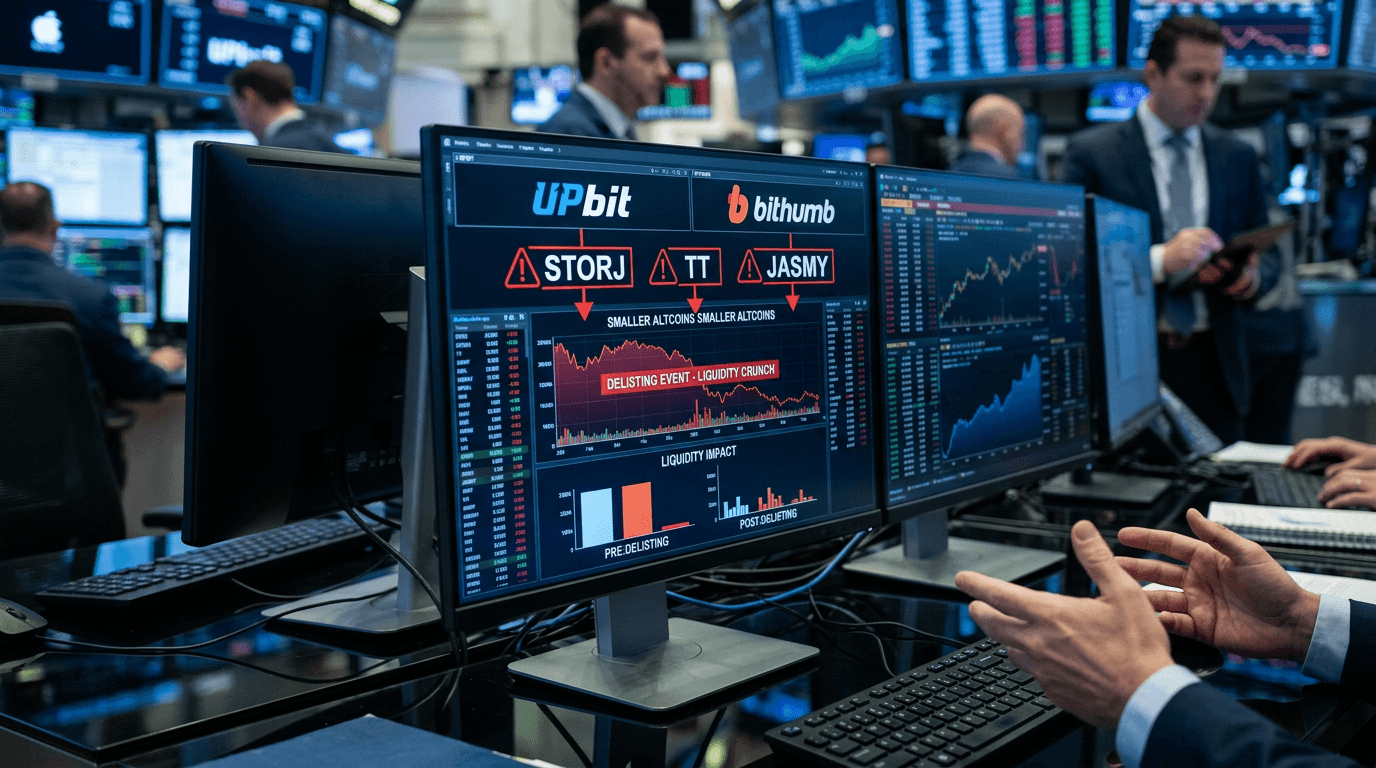
Major Asian exchanges are once again reminding the market that listing is a privilege, not a guarantee. In South Korea, leading platforms Upbit and Bithumb have announced the upcoming delisting of Storj (STORJ), ThunderCore (TT), and JasmyCoin (JASMY), triggering localized selling pressure and reigniting concerns about listing risk for smaller altcoins.[1][2][3] For traders, this news is not just about three tickers—it is a case study in how exchange decisions can reshape liquidity, sentiment, and risk across the broader crypto landscape.
NEW DELISTINGS: WHAT EXACTLY IS HAPPENING?
Upbit and Bithumb have confirmed that trading support for STORJ, TT, and JASMY will end on September 14, with multiple trading pairs affected, including STORJ/KRW, STORJ/BTC, JASMY/BTC, JASMY/USDT, TT/KRW, and TT/BTC.[1][4][9] After the cutoff, users will no longer be able to buy or sell these assets on the two largest Korean exchanges, though they will still be able to withdraw tokens for a limited time.[1][4][9]
Importantly, this decision follows a period in which these tokens had already been flagged with “trading warning” designations due to unresolved concerns around project transparency, activity, and compliance.[1][2][3][5] The exchanges have indicated that those issues were not adequately addressed, prompting the transition from warning status to full delisting.[1][2][3]
Trading will cease on the specified date, and all open buy and sell orders for the affected pairs will be canceled, limiting the chance for last‑minute repositioning via limit orders.[4][9] Withdrawals are expected to remain available until around October 14, giving holders roughly a month after trading ends to transfer their STORJ, TT, and JASMY to other venues or self‑custody wallets.[1][4][9] For investors, that timeline is a critical operational detail—there is a clear window to act, but not an indefinite one.
WHY UPBIT AND BITHUMB’S MOVE MATTERS BEYOND KOREA
At first glance, delistings on Korean won‑based exchanges might look like localized events. However, Upbit and Bithumb together represent a major share of South Korea’s crypto trading volume, particularly in altcoins, and their listing decisions often influence regional sentiment and liquidity.[1][5] When both exchanges coordinate to remove the same tokens, it sends a strong signal to the market that these assets are considered higher‑risk or lower‑priority from a compliance and investor‑protection standpoint.[1][2][3][5]
There is also a structural backdrop: Korean regulators have been tightening oversight of virtual asset service providers, prompting exchanges to review and rationalize their token lists more aggressively.[10][13][14] Data from Korea’s Financial Supervisory Service shows that KRW‑denominated exchanges have delisted hundreds of tokens in recent years—394 between 2022 and May 2026—with delistings growing significantly faster than new listings.[10][13] Some analyses estimate delistings have jumped over 250% year‑on‑year, while new listings have dropped sharply, reflecting a clear shift towards stricter standards.[13][14]
This week’s move on STORJ, TT, and JASMY fits that pattern. It is part of a broader trend in which exchanges reduce exposure to projects with weaker liquidity, limited disclosures, or perceived regulatory vulnerabilities.[10][13][14] Even if the immediate price impact is highest where KRW trading dominates, the narrative around “listing risk” can travel globally through sentiment channels, especially for altcoins that rely heavily on a small number of centralized exchanges.
Localized Selling Pressure And Altcoin Fragility
For the three affected tokens, the announcement has already led to selling pressure as Korean traders unwind positions before liquidity disappears on local venues.[9] When a major exchange announces a future delisting, market participants often front‑run the event, selling into remaining liquidity rather than risk being stuck with assets that are harder to trade.[5][9]
The impact can be amplified in altcoins that have relatively concentrated volume on a handful of exchanges. If a large percentage of daily turnover happens on Upbit and Bithumb, losing those venues can reduce order‑book depth and widen spreads elsewhere, making price discovery more volatile.[1][5][9] This dynamic is not unique to STORJ, TT, or JASMY—other tokens previously delisted from Korean exchanges, such as various fan tokens and smaller projects, saw similar patterns of localized stress and global spillover in liquidity.[11][15]
From a portfolio‑management perspective, this underscores the fragility of smaller altcoins. Their fundamentals are not only about technology or community; they also hinge on exchange relationships, compliance posture, and ongoing monitoring by listing committees.[10][13][14] A token can be liquid and tradable one month, then suddenly face a major liquidity shock the next if it fails exchange reviews.
What Listing Risk Really Means For Traders
Listing risk is the possibility that one or more exchanges will restrict, suspend, or remove trading support for a token. For altcoin traders, it is an operational and market risk that sits alongside price volatility, smart contract risk, and regulatory uncertainty.
Several practical dimensions matter
1) Venue concentration If most of a token’s volume is on one or two centralized exchanges, losing a single venue can materially affect liquidity and price stability.
2) Warning signals Trading warnings, “investment alerts,” or watchlist designations are often precursors to delistings. They indicate that the exchange sees unresolved issues with the project’s disclosures, activity, or risk profile.[1][2][3][5]
3) Regulatory environment In jurisdictions where regulators are increasing scrutiny, such as South Korea, exchanges may proactively trim token lists to reduce compliance risk.[10][13][14] Tokens perceived as marginal or opaque are more vulnerable.
4) Operational timelines Announcements typically specify cutoff dates for trading and withdrawals. Missing those windows can leave holders with assets that are technically theirs but far harder to trade or move at scale.[1][4][9]
For traders and investors, managing listing risk means monitoring exchange notices, diversifying venue exposure, and avoiding over‑reliance on illiquid altcoins that lack robust, multi‑exchange presence.
How Simulated Finance Helps You Learn Without The Damage
Delisting events like this are ideal case studies for SimFi platforms, where traders can observe and model the effects of exchange decisions without putting real capital at risk. A simulated environment allows you to:
1) Test how portfolio liquidity changes when a major venue removes key altcoins, and how quickly you would need to react operationally.
2) Experiment with position‑sizing rules that explicitly factor in listing risk—for example, capping exposure to tokens with high venue concentration or recent warning flags.
3) Run scenario analyses on cross‑exchange spreads and volatility as liquidity migrates from one region to another when a delisting is announced.
4) Practice building watchlists that include not just price and volume, but also exchange‑specific status (normal, warning, delisting scheduled) and regulatory backdrop.
By treating events like the Upbit and Bithumb delistings as learning exercises, traders can develop more resilient strategies—ones that recognize exchange behavior as a core driver of risk for altcoins, not just a background detail.[1][2][3][10][13]
Conclusion
The joint decision by Upbit and Bithumb to delist Storj, ThunderCore, and JasmyCoin is more than a localized headline—it is a reminder that access and liquidity are conditional for smaller altcoins.[1][2][3][5] In an environment where regulators are pushing exchanges to prioritize investor protection, listing standards are tightening and delistings are becoming more frequent, particularly in markets like South Korea.[10][13][14]
For traders, the key takeaway is clear: listing risk is real, tangible, and often underappreciated. Monitoring exchange notices, evaluating venue concentration, and treating warning labels seriously can help reduce the chance of being caught in a liquidity squeeze. Simulated trading environments offer a safe way to stress‑test strategies against exactly these kinds of shocks, turning market headlines into practical skill‑building opportunities.
Ultimately, delistings like these reinforce a core principle of modern crypto trading: risk is not just in the chart, it is embedded in the infrastructure that makes trading possible. Understanding that—and planning for it—can make the difference between reacting in a panic and executing with discipline when the next delisting announcement hits the tape.