
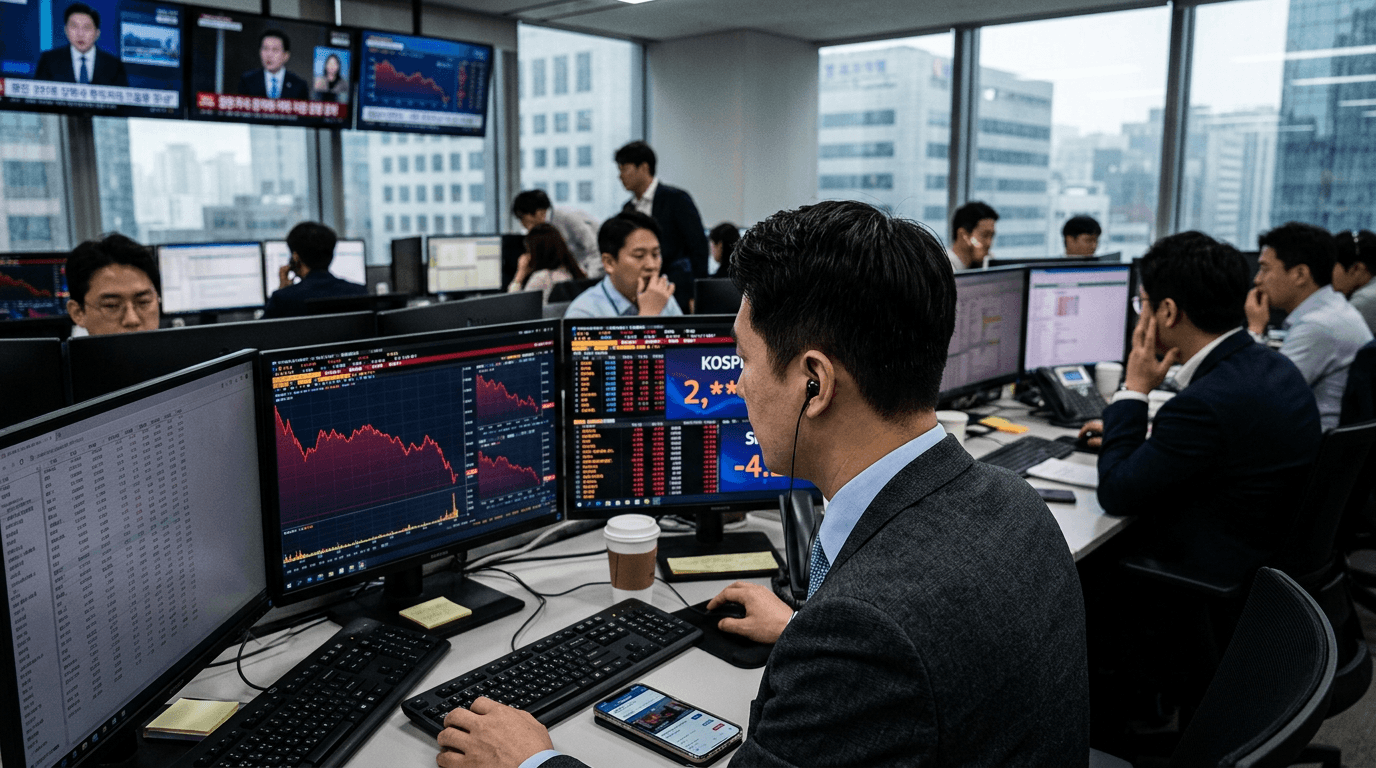
South Korea’s stock market has flipped from market-darling to bear territory in a matter of weeks, and the trigger is the one theme that has dominated global equities all year: artificial intelligence chips. The Kospi index has now fallen more than 20% from its June record high, meeting the standard definition of a bear market as investors reassess how much they are willing to pay for future earnings from AI chip leaders like Samsung Electronics and SK Hynix.[2][3][5] That reversal is rippling through Asia’s futures markets, dragging regional risk sentiment lower and reminding traders how quickly a loved narrative can turn into a source of volatility.[9][11]
WHAT’S BEHIND KOREA’S SUDDEN BEAR MARKET
Until recently, South Korea was one of the world’s best‑performing stock markets, powered largely by the explosive gains in a handful of AI‑linked semiconductor names.[1][3][5] The Kospi had more than doubled from mid‑2025 levels, with returns over 70% for the year at its peak, before the tide turned.[1][3][6]
The drawdown accelerated as the index dropped over 5% in a single session, taking cumulative losses past 20% from the June highs and pushing the market into technical bear‑market territory.[2][5][6] Heavyweight Samsung Electronics and SK Hynix led the decline, posting single‑day falls of around 5–7% even after reporting very strong profit rebounds, highlighting how stretched expectations had become.[2][3]
Two structural features amplified the move
First, concentration risk. A large share of Kospi’s gains and market capitalization has been tied to a small cluster of semiconductor and AI‑beneficiary stocks.[3][5] When sentiment around that theme wobbled, the index had little diversification to cushion the blow.
Second, leverage. Leveraged and thematic products, including exchange‑traded funds designed to magnify chip‑sector moves, have increased both upside and downside volatility.[1][3] As prices fell, forced de‑risking and unwinds in these products accelerated the selloff.
The Ai Chip Story: From Euphoria To Doubt
The core of this correction is not that AI is disappearing, but that investors are re‑pricing how fast and how profitable the AI infrastructure boom will be.
For much of the rally, markets priced in near‑flawless execution: continued surges in data‑center spending, rapid adoption of AI services and a long, uninterrupted upcycle for memory chips and advanced semiconductors.[1][3][5] Korean chipmakers became key global proxies for that story.
Now, several questions are emerging:
- Earnings versus expectations: Even with blockbuster profit rebounds at Samsung and SK Hynix, traders are asking whether current and future earnings can justify the steep valuations already embedded in prices.[3][5] When stocks sell off on good news, it often signals that expectations had become excessively optimistic.
- Pace of AI spending: Global investors are increasingly focused on the risk that major U.S. and Chinese tech platforms could normalize or slow the torrid pace of AI infrastructure spending after an initial surge.[1][2][5] Any hint of flatter capex curves recasts the demand outlook for memory and logic chips.
- Cyclicality of memory: AI demand sits on top of a traditionally boom‑bust memory cycle. Even if the long‑term AI trend is intact, shorter‑term corrections in pricing and inventories can still be sharp, and markets are pricing in that cyclicality more aggressively.
Importantly, several analysts emphasize that the market is questioning the pace of earnings growth more than the existence of AI demand.[5] That nuance matters: it suggests a reset in valuations and positioning, not necessarily a structural end to the AI theme.
Why This Matters For Asia Futures And Global Risk
Because Korea has become such a central AI proxy, a bear market in the Kospi is reverberating across Asia‑Pacific futures and regional indices.[9][11]
First, index futures linked to Korean equities and broader Asia benchmarks have come under pressure as global investors hedge their AI exposure and reduce risk in correlated markets such as Taiwan, Japan, and Hong Kong.[9][11] During the latest leg of the selloff, Asian equity futures broadly traded lower even before underlying cash markets opened, reflecting overnight de‑risking from global funds.
Second, volatility is being repriced. Implied volatility on Korean indices and related sector futures has climbed as traders anticipate wider trading ranges and potential headline shocks around AI‑chip earnings, regulatory news, or capex guidance from U.S. mega‑caps.[2][3][5] This repricing tends to spill over into other regional contracts, raising option premiums and margin requirements.
Third, sector leadership in Asia is being questioned. For much of the year, AI hardware and chip supply‑chain names have led regional markets higher. A sharp reversal in Korea encourages investors to rotate, at least tactically, into less crowded areas such as financials, domestic consumption, or more defensive sectors across Asia.
For macro and index‑level traders, this episode underscores how a single theme—AI chips—can act as a regional risk barometer. When the leading beneficiary market slips into a bear phase, it sends a powerful signal about risk appetite across the broader Asia complex.
LESSONS FOR TRADERS: NAVIGATING AI‑DRIVEN VOLATILITY
For both discretionary and systematic traders, the Korean bear market offers several practical lessons:
- Beware of narrative concentration: When a market is driven overwhelmingly by one story—in this case, AI chips—diversification benefits can vanish quickly. Position sizing and sector limits matter more than ever in narrative‑dominant environments.
- Watch positioning and leverage, not just fundamentals: Strong earnings from Samsung and SK Hynix did not prevent a selloff because positioning and expectations had run ahead of fundamentals.[3][5] Tracking flows in leveraged products, margin data, and ETF activity can provide early warning of fragility.
- Respect technical thresholds: The 20% drawdown mark is arbitrary in theory, but meaningful in practice. Crossing into “bear market” territory often triggers algorithmic responses, risk‑model adjustments, and headline‑driven selling or hedging. That can create both momentum and mean‑reversion opportunities.
- Trade the volatility, not just direction: When macro narratives are in flux, options, volatility strategies, and relative‑value trades (such as Korea versus other AI‑exposed markets) can sometimes offer better risk‑reward than outright directional bets on the index.
HOW SIMULATED TRADING CAN HELP YOU STRESS‑TEST STRATEGIES
Episodes like Korea’s AI‑driven bear market are where preparation pays off. For many traders, the challenge is not identifying that a market is stretched, but managing execution, risk, and emotions when the unwind begins.
Simulated trading environments allow you to
- Recreate concentrated bull‑to‑bear transitions, testing how your strategies behave when a single theme reverses quickly.
- Practice managing gap moves and high‑volatility sessions, including placement of stops, profit‑taking rules, and intraday risk limits.
- Explore hedging tactics using index futures and options when a core thematic position (like AI chips) starts to wobble, without the pressure of real capital on the line.
- Experiment with correlation and contagion trades, such as how a shock in Korea might propagate to Taiwan’s chip sector, Japan’s tech exporters, or broader Asia indices.
By pressure‑testing your approach in a risk‑free setting, you can develop playbooks for different market regimes: euphoric rallies, sharp corrections, and grinding bear phases. That preparation is particularly valuable in AI‑linked markets, where sentiment can shift rapidly and liquidity can thin out just when you most need to adjust positions.
As South Korean stocks slide into a bear market and AI chip optimism cools, traders are being reminded that even the hottest themes are not one‑way trades. The key is not to predict every twist in the AI story, but to build robust strategies and risk frameworks that can survive—and even capitalize on—the volatility that comes with it.