
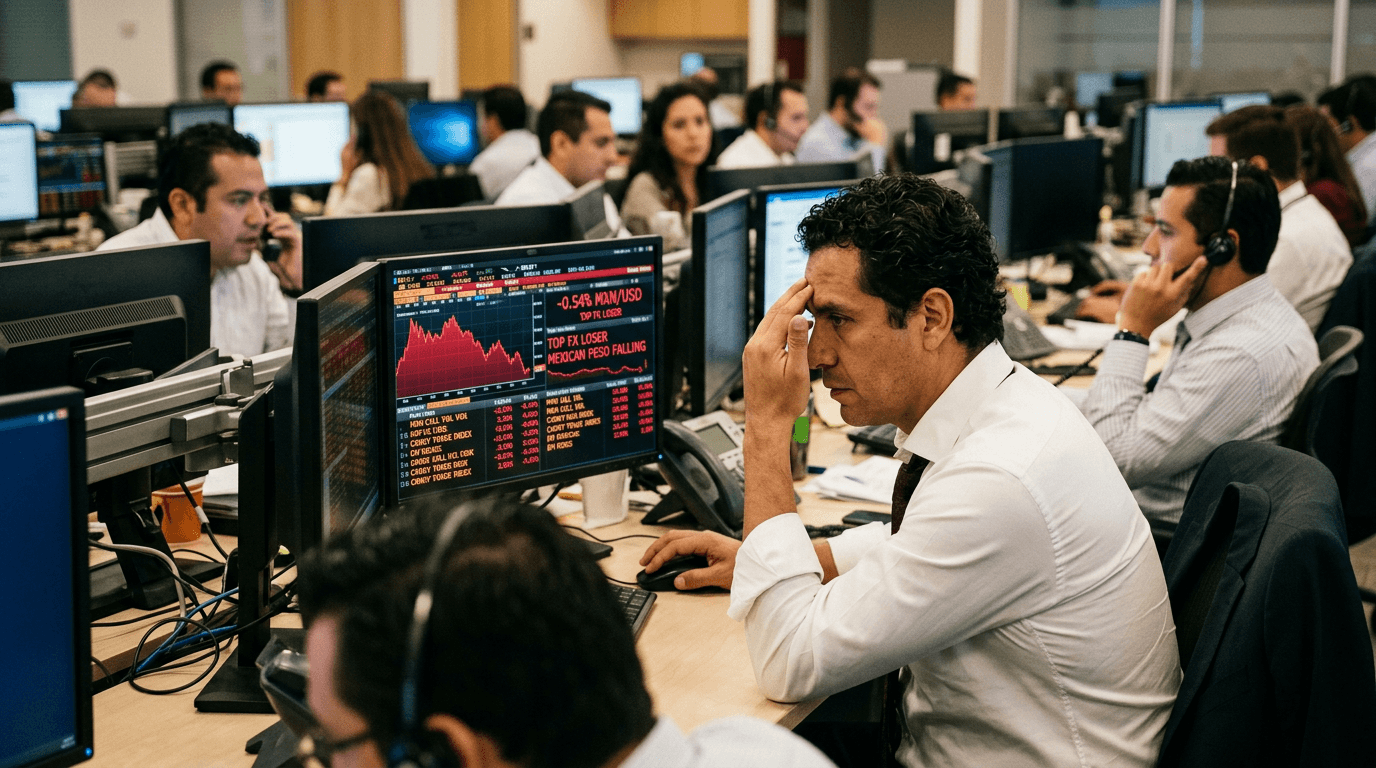
In the latest FX session, the Mexican peso slipped about 0.54% against the U.S. dollar, making it the top currency loser on the day. On the surface, that may sound like a routine move. In reality, it offers a useful snapshot of how quickly sentiment can shift around emerging‑market currencies and why traders need to understand the mechanics behind these daily percentage changes.
WHAT A 0.54% MOVE REALLY SIGNALS
Foreign exchange markets are highly liquid, and moves of 0.5–1.0% in a single session are not unusual, especially for emerging‑market currencies like the Mexican peso. For context, the dollar–peso rate has recently been trading around the mid‑17s per dollar, after falling from levels above 18 pesos a year earlier[17]. A 0.54% depreciation in one session is not a crisis signal, but it is enough to change the risk–reward profile for short‑term trades.
Daily FX moves are driven by a mix of global and local factors: interest‑rate expectations, economic data surprises, commodity prices, and shifts in risk appetite. In Mexico’s case, the peso tends to react strongly to U.S. yield moves, changes in Federal Reserve expectations, and any hint of domestic political or policy uncertainty. Recent episodes have shown that when investors worry about reforms or fiscal discipline, the peso can weaken quickly as offshore funds reduce exposure[16][19].
So, while 0.54% does not compare to the multi‑percentage‑point swings seen in periods of stress, it is significant enough to trigger automated signals, risk limit checks, and strategy tweaks among professional traders, especially those running leveraged or systematic positions.
Why The Mexican Peso Matters For Carry Traders
The peso’s move is particularly important because the currency has long been a cornerstone of global carry‑trade strategies. Carry trades involve borrowing in low‑yield currencies and investing in higher‑yield ones, earning the interest-rate differential as long as exchange rates remain relatively stable. Mexico has typically offered relatively high interest rates compared with developed economies, making MXN a popular “carry” destination[19].
When the peso weakens 0.54% in a day, it can partially offset the carry earned over weeks or even months. For highly leveraged traders, this translates into meaningful mark‑to‑market losses. Streaming data systems that track performance in real time will flag MXN as a risk point, prompting traders to reassess whether the current carry still justifies the volatility.
This reassessment is not just about today’s move. Investors are constantly weighing:
- Whether the Bank of Mexico will continue to cut rates or pause.
- How resilient Mexican growth and fiscal metrics look.
- Whether global risk appetite supports holding emerging‑market FX.
If the balance tilts toward higher volatility and lower expected carry, some traders may choose to lighten MXN positions, rotate into other high‑yield currencies, or hedge more aggressively using options and forwards.
IMPACT ON MXN‑LINKED DERIVATIVES AND RISK PRICING
A session where MXN is the top loser also ripples into the derivatives market. MXN‑linked instruments—such as FX forwards, options, and swaps—are priced off expectations of future volatility, interest‑rate differentials, and directional flows. When spot MXN moves sharply relative to peers, implied volatility in options can rise, bid–ask spreads may widen slightly, and hedging costs can increase.
For example, traders long MXN via options might see higher option prices as demand for downside protection grows. Market makers, in turn, adjust their risk models to reflect a potentially wider trading range for USD/MXN, especially if the move coincides with new macro information, such as policy comments or economic releases.
From a risk‑management perspective, the key change is in perception. A currency that has been relatively stable can suddenly look more fragile if it consistently appears at the top of the loss leaderboard. In recent years, the peso has swung between being one of the strongest emerging‑market currencies—benefiting from carry and nearshoring narratives—and one of the weakest when political or policy concerns came to the fore[18][19]. A 0.54% drop does not define a trend, but repeated sessions like this can mark the early stages of a broader re‑rating of risk.
LESSONS FOR SIMULATED AND REAL‑MONEY TRADERS
For traders using simulated finance platforms like E8 Markets, sessions where MXN leads losses are ideal case studies in FX risk and strategy design. Several practical lessons stand out:
First, always look past the headline percentage. Check where the currency sits in its broader range. For the peso, a 0.54% move within a multi‑month trading band around 17–18 per dollar is very different from a similar move that breaks key support or resistance levels[17]. Context determines whether you are seeing noise or a potential trend shift.
Second, stress‑test carry trades. In a simulation environment, you can model how a series of daily moves—say three consecutive 0.5–1.0% declines—would impact a leveraged long‑MXN position. This exercise highlights how quickly unrealized carry can be wiped out by FX volatility, and why risk‑adjusted returns matter more than headline yield.
Third, integrate derivatives into your thought process, even if you are trading spot. Ask how a move like this might change the cost of hedging with options or the pricing of forwards. Simulating different hedging strategies helps you understand how professional desks manage downside risk when currencies like MXN come under pressure.
Finally, pay attention to cross‑market signals. The peso does not trade in isolation: moves in EM equity indices, local bond yields, and other high‑yield currencies often reinforce or contradict what you see in FX. When MXN is the top loser but other EM currencies are stable, it suggests a Mexico‑specific issue. When MXN weakens alongside broader EM FX, it is more likely a global risk‑off episode.
Putting The Move In Perspective
The latest session’s 0.54% drop in the Mexican peso is not a shock event, but it is a meaningful data point for anyone following emerging‑market FX, carry trades, or MXN‑linked derivatives. It reminds traders that return streams built on yield differentials are always at the mercy of daily price action, and that risk perception can change quickly even without major news headlines.
For simulated traders, treating this kind of move as a learning opportunity is more valuable than trying to “call” the next tick. Use it to refine your understanding of how FX markets price risk, how emerging‑market currencies like MXN can switch from market darlings to laggards, and how robust position sizing and hedging can turn volatility from a threat into a manageable component of your overall strategy.