
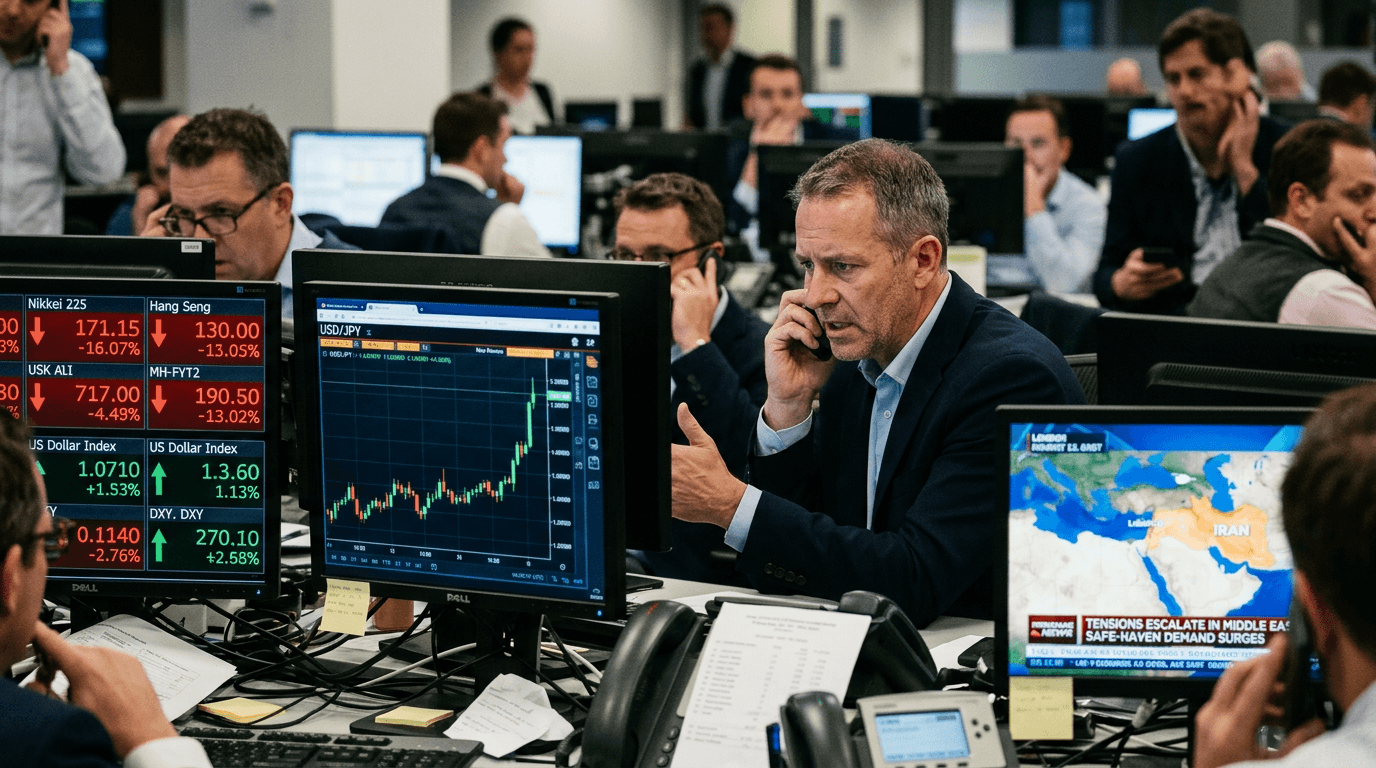
The global equities playbook has undergone a dramatic reversal. For months, the dominant trading narrative centered on artificial intelligence's transformative potential, with investors rotating capital out of traditional safe havens and into growth-heavy Asian markets. That thesis has been upended by escalating Middle East tensions and military strikes on Iran, triggering a sharp reversal in currency flows, equity allocations, and risk sentiment worldwide. The "sell America, buy Asia" trade that characterized recent market behavior is now unwinding as investors rush back to traditional safe-haven assets, particularly the U.S. dollar and Treasury securities.
The Collapse Of The Ai-driven Playbook
For the past several months, market dynamics were dominated by a singular narrative: artificial intelligence would drive unprecedented returns, particularly in Asian technology hubs and growth markets. This conviction had pushed capital flows decisively away from the traditional safe-haven assets that typically attract investors during periods of uncertainty. The U.S. dollar weakened as traders positioned for continued economic strength and assumed geopolitical risks remained contained. Asian equities surged on AI enthusiasm, with investors believing the region's tech-heavy composition positioned them perfectly for the AI revolution.
The U.S.-Israeli military strikes on Iran and Iran's swift retaliatory attacks have shattered this consensus almost overnight. The conflict has reintroduced an old market dynamic: geopolitical risk premiums and energy supply concerns dominate investor psychology, fundamentally altering asset allocation decisions. What worked for the past several months—betting on Asian growth and betting against the dollar—is now bleeding capital as the world confronts a new reality of elevated geopolitical tension and energy market instability.
Energy Prices Reshape The Risk Landscape
The immediate market impact centers on energy, the sector most directly affected by Middle East instability. Oil prices soared, with U.S. benchmark crude reaching $72.70 per barrel, levels not seen since the summer driving season, while Brent crude climbed 9% to nearly $79.19 per barrel. Natural gas prices experienced even more dramatic moves, with European LNG prices leaping 25% on March 4 alone, following a 39% surge the previous day. U.S. natural gas futures rallied nearly 6%, signaling broad-based energy inflation expectations.
These energy price spikes create a cascading effect throughout global markets. The Strait of Hormuz, through which approximately one-fifth of global oil supplies pass, faces potential disruption if the conflict intensifies. For resource-poor nations like Japan, which relies heavily on oil and natural gas imports through this critical chokepoint, the implications are severe. Japan's Nikkei 225 fell 3.1%, while South Korea's benchmark sank 7.2% as markets reopened after a holiday. The energy shock threatens to reignite inflation concerns just as central banks attempt to normalize monetary policy, adding urgency to the geopolitical calculus.
The Dollar's Resurgence As Safe Haven
The most significant shift in equity market dynamics appears in the sudden resurgence of the U.S. dollar as a safe-haven currency. As geopolitical tensions escalated, capital that had been flowing out of dollar-denominated assets and into emerging market carry trades reversed sharply. European markets fell 2.7% on the STOXX 600 index, the biggest daily decline since April, while U.S. S&P 500 e-mini futures dropped 1.6%. Treasury yields fell as investors sought safer investments, a classic risk-off move that pulls capital back into U.S. assets.
This reversal has profound implications for emerging market currencies involved in carry trades, particularly the Hungarian forint and Turkish lira, both vulnerable to rapid outflows if the conflict extends. The virtual circle of flows out of the dollar and into emerging markets that characterized much of 2025 could reverse into a vicious deleveraging cycle, with tremendous implications for forex volatility and emerging market stability.
Sector Rotation And Equity Market Stress
The conflict has triggered immediate and dramatic sector rotation within equity markets. Airlines have become the clearest victims, with American Airlines, United, and Delta suffering significant losses on Monday. Higher oil prices directly threaten airline profitability by increasing fuel costs, while the conflict itself has disrupted operations, closed airports, and left travelers stranded. Across Asia, the pain was acute: All Nippon Airways fell 3.3%, Japan Airlines dropped 6.4%, Korean Air plunged 10.3%, and Qantas Airways lost 1.8%.
This sector-specific damage expands more broadly as investors reassess the earnings impact of elevated energy prices across the economy. Manufacturing faces margin pressure from higher production costs, while consumer-focused businesses confront both energy inflation and potential demand destruction if the conflict triggers a broader economic slowdown.
Key Takeaway For Investors
The Middle East conflict has fundamentally disrupted the dominant equity market narrative of the past several months. The "sell America, buy Asia" thesis that drove capital flows has reversed sharply, replaced by traditional safe-haven dynamics that favor the U.S. dollar and domestic equities. Energy prices will remain the critical variable determining how long this reversal lasts and how deeply it impacts global growth. Investors positioned for continued Asian outperformance and dollar weakness must acknowledge that the risk environment has shifted materially, requiring a reassessment of portfolio positioning, particularly regarding energy exposure, emerging market currencies, and sectors vulnerable to inflation acceleration.